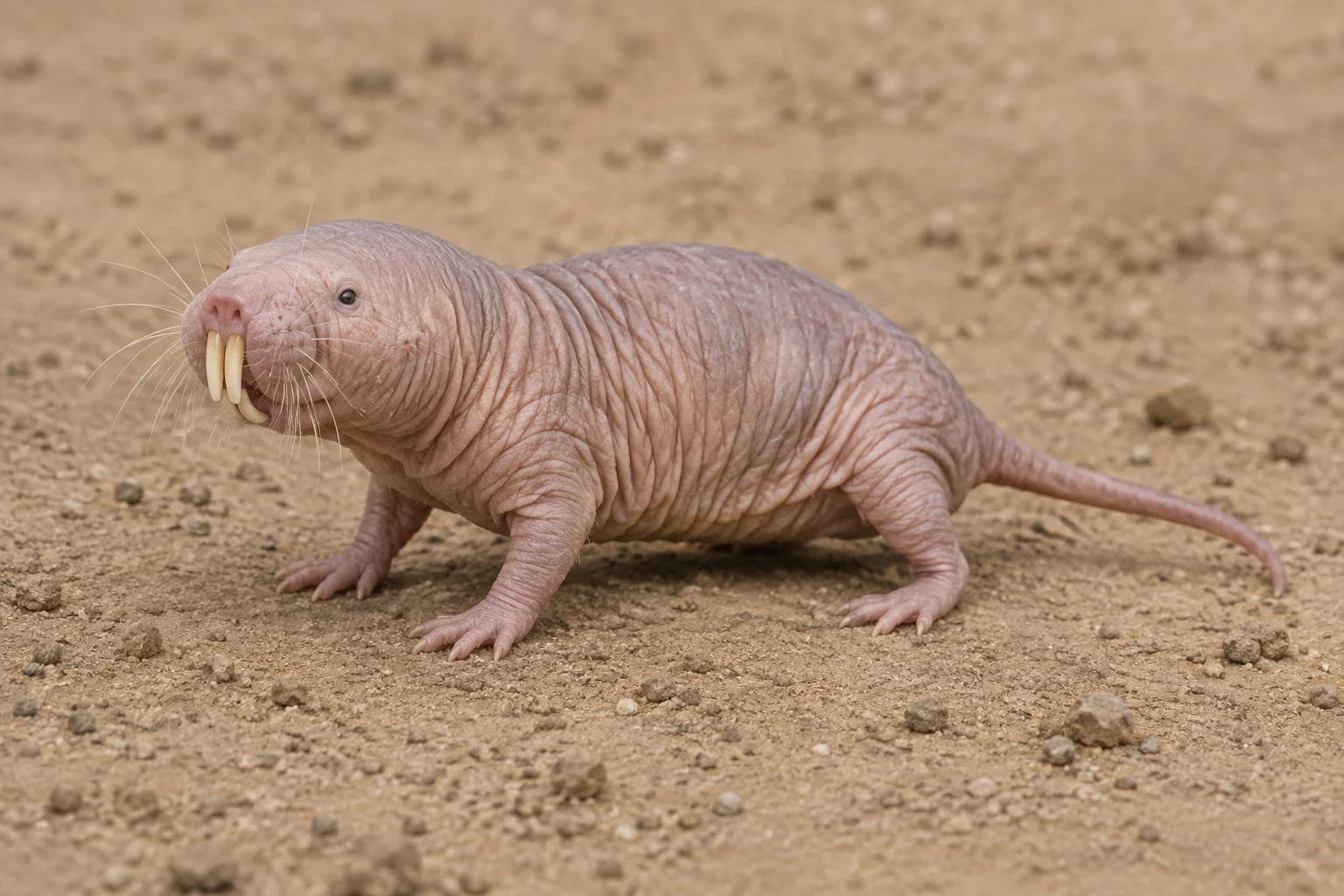
Naked mole-rat - AI-generated scientific interpretation.
Modern AI-generated scientific illustration. Diagnostic features follow the selected zoological sources; pose, individual pattern and fine details are interpretive. Not specimen photography or independent evidence.
Overview
Naked mole-rats have wrinkled pinkish skin, tiny eyes and no external ear pinnae. They are nearly hairless rather than literally devoid of hair: sensory whiskers and fine hairs assist life underground. Powerful incisors excavate soil, and the lips can close behind the teeth to limit dirt entering the mouth.
Colonies share networks of tunnels and chambers in semi-arid eastern Africa. Underground plant parts supply food, while a single breeding female and a few males account for much of reproduction. Other individuals contribute to maintenance, food acquisition and care. These cooperative arrangements are unusual among mammals, but queen and worker remain biological shorthand rather than human political roles.
Barker and colleagues’ 2021 work identified colony-specific soft chirps. Acoustic comparisons and cross-fostering supported learned group dialects, linking communication to social membership. A culturally transmitted call feature does not imply human language, unlimited vocabulary or conscious rules about colony citizenship.
A separate 2021 cooperative-task investigation challenged the idea of rigid nonbreeder castes. Behavioural flexibility makes it unsafe to assign a permanent soldier or digger identity solely from an individual’s appearance. Laboratory colony findings and wild behaviour should also remain distinguished; the selected sources support a varied social rodent rather than one universal colony blueprint.
Origins & earliest records
The living species is identified as Heterocephalus glaber. Research on longevity, physiology and social behaviour developed from observations and controlled colonies; no exact evolutionary origin is assigned from those experiments.
Evidence & interpretation
Species observations establish the burrowing body form. Acoustic studies, fostering and behavioural measurements examine communication and cooperation. Results from particular colonies do not establish identical organization in every wild colony.
Selected bibliography
Documented works and useful reading. This is not a list of every appearance.
- 01
Naked mole-rat
Selected bibliography; bounded source account, not exhaustive coverage.
- 02
Cultural transmission of vocal dialect in the naked mole-rat
Selected bibliography; bounded source account, not exhaustive coverage.
- 03
Naked mole-rats do not specialise in cooperative tasks
Selected bibliography; bounded source account, not exhaustive coverage.
Family, evolution & connections
Taxonomic classification
A hierarchy of classified groups, not a chain of direct ancestors.
Source note: Family rank is omitted because classifications differ in whether Heterocephalus is included in Bathyergidae or placed in Heterocephalidae. Eusociality is not a rank.
- kingdomAnimalia
- phylumChordata
- classMammalia
- orderRodentia
- genusHeterocephalus
- speciesHeterocephalus glaber
References
Sources supporting this profile. Linked pages have their own scope and editorial standards.
- InstitutionalNaked mole-ratResearch access: 2026-10-10
- ResearchCultural transmission of vocal dialect in the naked mole-ratResearch access: 2026-10-10
- ResearchNaked mole-rats do not specialise in cooperative tasksResearch access: 2026-10-10
Image credits
AI-generated scientific interpretationNaked mole-rat - AI-generated scientific interpretation.
Modern AI-generated scientific illustration. Diagnostic features follow the selected zoological sources; pose, individual pattern and fine details are interpretive. Not specimen photography or independent evidence.