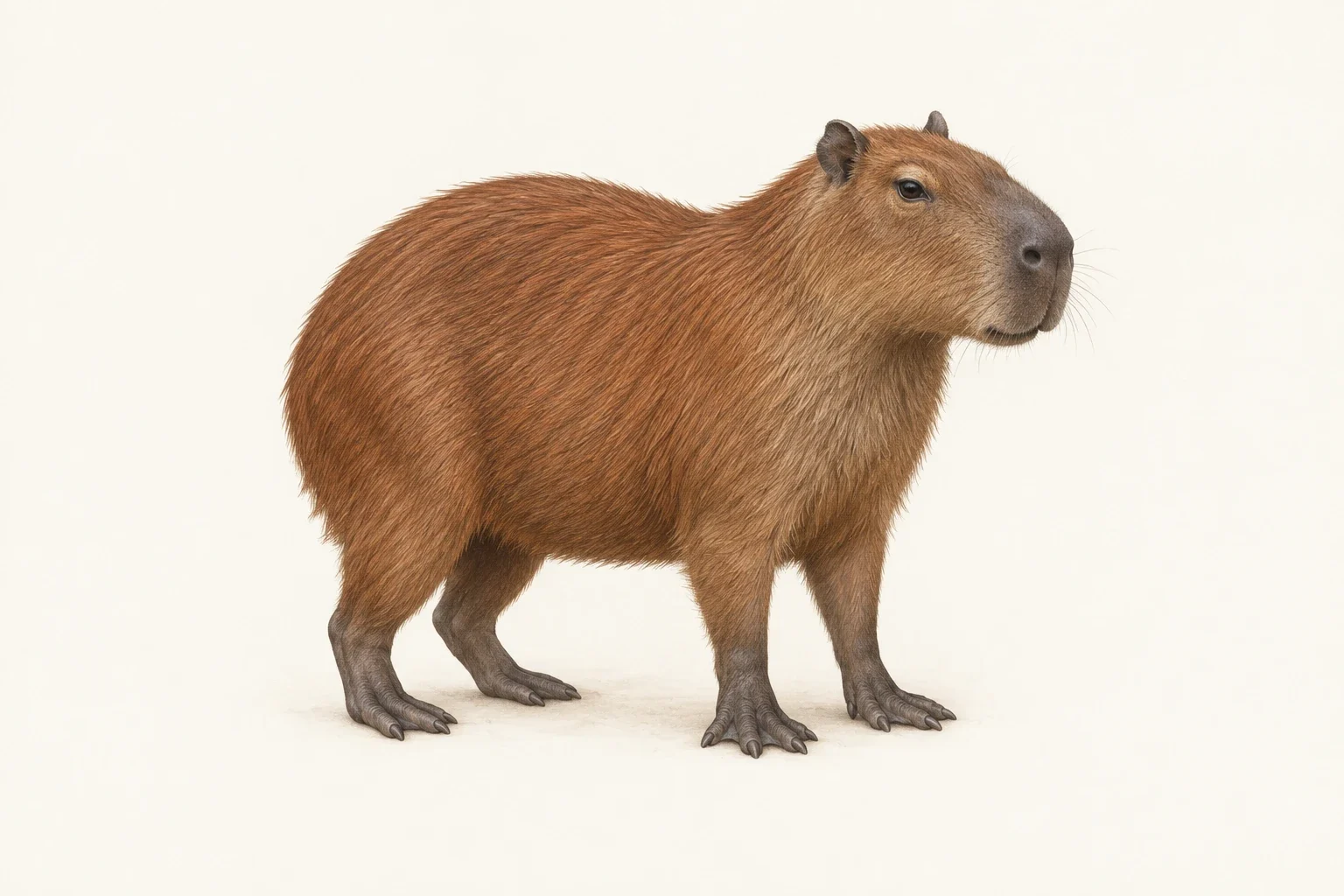
Capybara - AI-generated scientific interpretation.
Modern AI-generated scientific illustration. Diagnostic features follow the selected zoological sources; pose, individual pattern and fine details are interpretive. Not specimen photography or independent evidence.
Overview
The greater capybara has coarse brown hair, a heavy barrel-shaped body and no conspicuous external tail. Its eyes, ears and nostrils sit high on the head, allowing an animal resting low in water to keep these features above the surface. Short legs end in partly webbed feet, with four digits on the front feet and three on the rear.
Water helps capybaras escape danger and manage heat, while feeding occurs largely on land. Grasses are important foods, and intestinal processing, including reingestion of faecal material, helps use fibrous vegetation. Semi-aquatic therefore describes a connection between water and terrestrial feeding, not a life spent entirely submerged.
Groups combine adults and young, with social organization influenced by resources and season. An individual seen alone need not represent a separate solitary species or an invariant social rule. The selected university account discusses population-specific observations; exact group size and reproductive schedules should not be universalized from one locality.
Common-name accounts sometimes combine the greater and lesser capybara. The Mammal Diversity Database distinguishes Hydrochoerus hydrochaeris from H. isthmius, and this entry concerns the former. An older zoo page’s family label also differs from modern placement within Caviidae. Resolving those scope differences prevents a familiar animal from accumulating contradictory taxonomy and geographic claims.
Origins & earliest records
Hydrochoerus hydrochaeris is attributed to Linnaeus, 1766. This profile uses the currently distinguished greater capybara rather than combining both living Hydrochoerus species.
Evidence & interpretation
Institutional accounts document anatomy and ecology. The university account and current mammal database delimit the species; the zoo’s general capybara page is used for shared external features while its combined species scope is retained as a limitation.
Selected bibliography
Documented works and useful reading. This is not a list of every appearance.
- 01
Hydrochoerus hydrochaeris
Selected bibliography; bounded source account, not exhaustive coverage.
- 02
Capybara
Selected bibliography; bounded source account, not exhaustive coverage.
- 03
Hydrochoerus hydrochaeris
Selected bibliography; bounded source account, not exhaustive coverage.
Family, evolution & connections
Taxonomic classification
A hierarchy of classified groups, not a chain of direct ancestors.
Source note: Caviidae follows the modern mammal treatment; older Hydrochaeridae labels are not copied. The lesser capybara is excluded from this species profile.
- kingdomAnimalia
- phylumChordata
- classMammalia
- orderRodentia
- familyCaviidae
- genusHydrochoerus
- speciesHydrochoerus hydrochaeris
References
Sources supporting this profile. Linked pages have their own scope and editorial standards.
- InstitutionalHydrochoerus hydrochaerisResearch access: 2026-10-10
- InstitutionalCapybaraResearch access: 2026-10-10
- InstitutionalHydrochoerus hydrochaerisResearch access: 2026-10-10
Image credits
AI-generated scientific interpretationCapybara - AI-generated scientific interpretation.
Modern AI-generated scientific illustration. Diagnostic features follow the selected zoological sources; pose, individual pattern and fine details are interpretive. Not specimen photography or independent evidence.