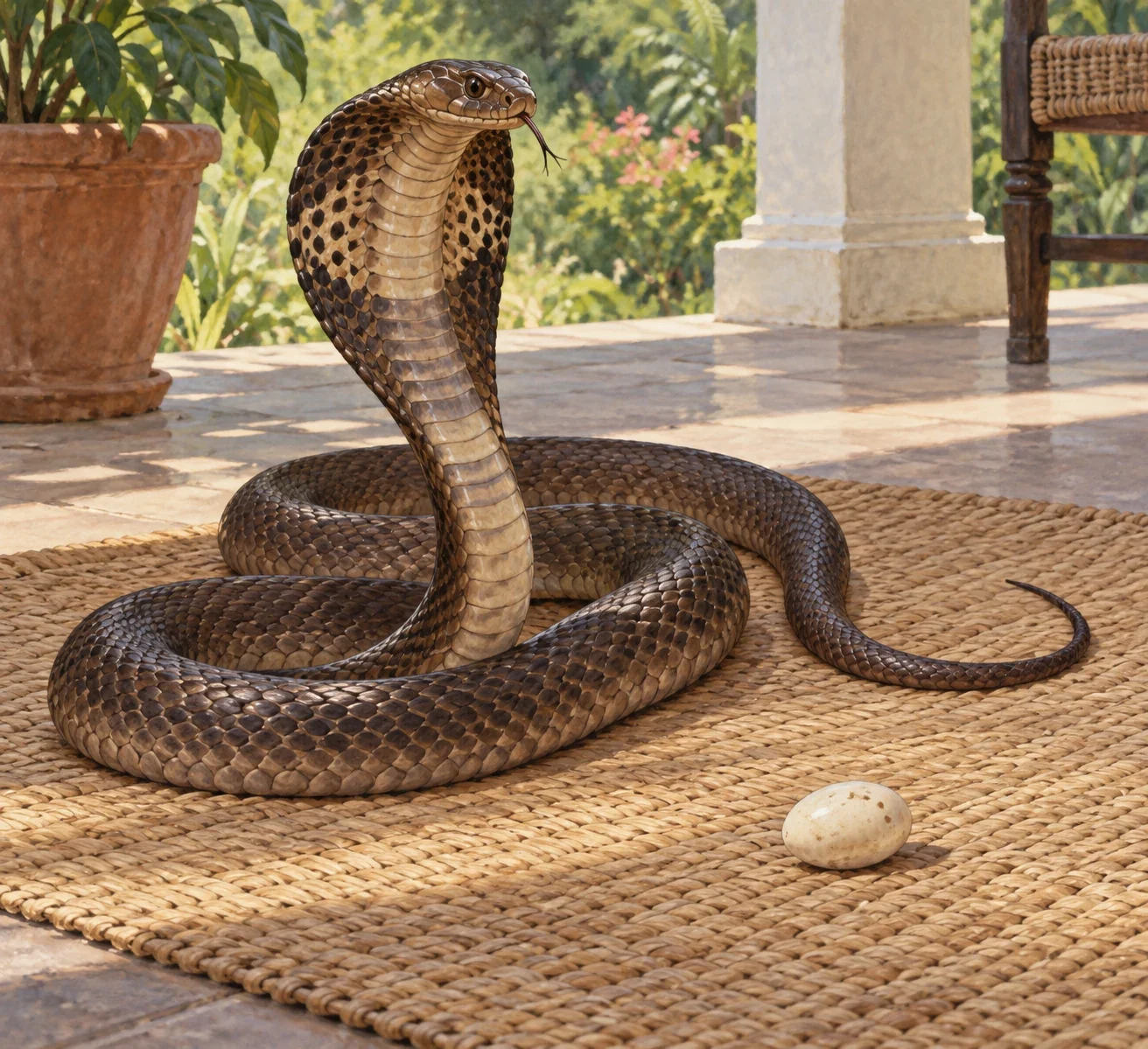
Unofficial AI interpretation of Nagaina beside the last egg on a veranda, evoking the original story’s confrontation. Cobra form and object relationship follow the text; exact colour, hood pattern, pose and setting details are imagined, not a real species identification.
Unofficial AI interpretation of Nagaina beside the last egg on a veranda, evoking the original story’s confrontation. Cobra form and object relationship follow the text; exact colour, hood pattern, pose and setting details are imagined, not a real species identification. Full-frame display derivative; no upscaling.
Overview
Nagaina first approaches Rikki from behind while he is speaking with Nag beneath the tailorbirds’ nest. Darzee’s warning makes the young mongoose leap clear of her strike. He lands near her back and bites, but his hesitation allows her to escape the encounter wounded and angry. She is identified as Nag’s wife and as a cobra, with a hood and a striking, coiling body. The text does not give her the complete colour or body measurements supplied for Nag. A portrait can therefore follow the cobra form without treating her partner’s black colour, length or hood marking as independently documented features of her own.
The pair’s intentions become clearer when Rikki overhears them near the bathroom. Nagaina argues that killing the bungalow’s human occupants will cause the mongoose to leave, returning the garden to the cobras. Their eggs in the melon bed make the desired territory a future home for their young. Nag follows her plan by entering the bathroom and waiting near a water jar, where Rikki attacks him. The struggle ends with Teddy’s father firing at Nag. Nagaina’s subsequent search for him and the news of his death turn a territorial campaign into a confrontation with the opponent who has destroyed her partner.
Rikki asks for a distraction while he reaches the eggs. Darzee’s wife, rather than Darzee, performs the feigned broken-wing display that draws Nagaina away. The cobra follows the apparently injured bird, whose pretended vulnerability exploits her readiness to seize prey. She then heads toward the house and threatens Teddy on the veranda. Rikki arrives with the last surviving egg after destroying the others. He uses it to draw her attention away from the child and announces what has happened in the melon bed. The egg is a concrete object in the confrontation, not a magical token or a source of supernatural power.
Once the household moves out of immediate danger, Nagaina and Rikki circle and feint on the veranda. The mongoose repeatedly jumps beyond her strikes. She eventually takes the remaining egg and flees toward the cobras’ hole. Darzee’s wife delays her briefly, and Rikki catches her tail before following into the underground passage. The fight below is not directly narrated: the reader sees the grass stop moving, hears Darzee’s premature lament, and then sees Rikki emerge with his statement that Nagaina will not return. The ending presents his victory through that return and declaration rather than a witnessed account of each action inside the hole. The literary cobra is formidable, calculating and protective of her offspring, but the story does not make her invulnerable or grant her human transformations.
First appearances & development
Nagaina belongs to Kipling’s original Rikki-Tikki-Tavi story in The Jungle Book. Animal speech and calculated territorial plans give the cobra an individual dramatic role beyond a generic snake antagonist. The profile follows that literary character; no film appearance, independent cobra myth or real animal biography is substituted for her story.
Canon & continuity
Retained story distinguishes dialogue, actions and narrator judgments. Fine anatomy and later adaptation traits remain unspecified.
Selected bibliography
Documented works and useful reading. This is not a list of every appearance.
- 01
Rikki-Tikki-Tavi, in The Jungle Book
Complete story: ambush, bathroom plan, eggs and pursuit.
Family & connections
A source-supported family tree or inspiration record has not yet been compiled for this profile. Related reading below indicates a connection in subject matter, not a proven lineage or creative influence.
References
Sources supporting this profile. Linked pages have their own scope and editorial standards.
- Primary fictionThe Jungle Book — primary textResearch access: 2026-10-11
- Bibliographic and rights recordProject Gutenberg catalogue: The Jungle BookResearch access: 2026-10-11
Image credits
Unofficial modern AI interpretationUnofficial AI interpretation of Nagaina beside the last egg on a veranda, evoking the original story’s confrontation. Cobra form and object relationship follow the text; exact colour, hood pattern, pose and setting details are imagined, not a real species identification.
Unofficial AI interpretation of Nagaina beside the last egg on a veranda, evoking the original story’s confrontation. Cobra form and object relationship follow the text; exact colour, hood pattern, pose and setting details are imagined, not a real species identification. Full-frame display derivative; no upscaling.