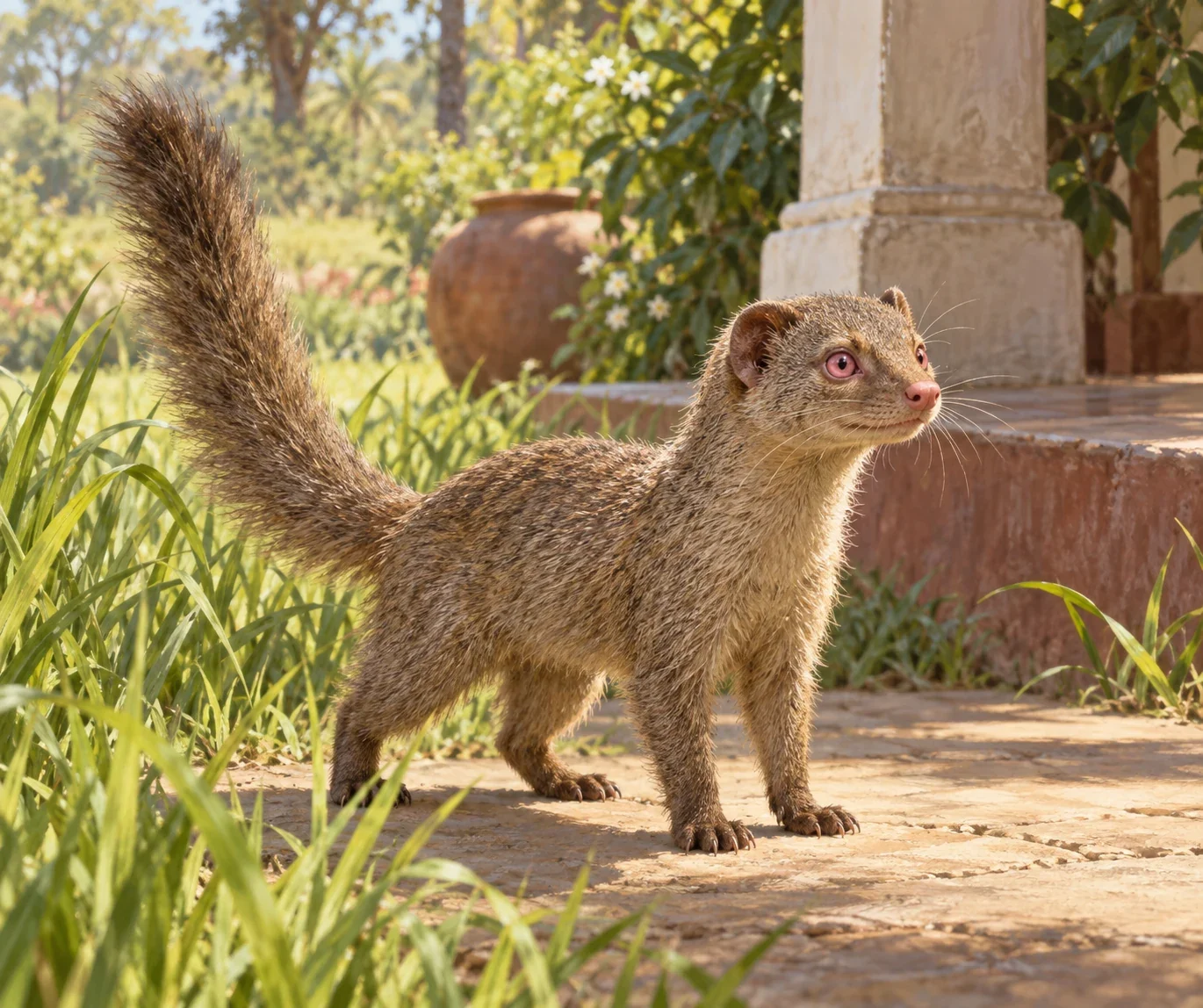
Unofficial AI interpretation of Kipling’s Rikki-tikki-tavi exploring the bungalow garden, following his pink eyes and nose, mongoose form and fluffed tail. Fur palette, pose and veranda details are imagined; no film design or precise real species is claimed.
Unofficial AI interpretation of Kipling’s Rikki-tikki-tavi exploring the bungalow garden, following his pink eyes and nose, mongoose form and fluffed tail. Fur palette, pose and veranda details are imagined; no film design or precise real species is claimed. Full-frame display derivative; no upscaling.
Overview
A summer flood washes the young mongoose from his family’s burrow, and Teddy’s household finds him apparently lifeless. Warmth and care revive him. The narrator describes fur and tail resembling a small cat’s, a weasellike head and habits, and pink eyes and nose. His tail can fluff into a bottle-brush shape; his rattling battle cry gives the story its name. Rikki explores the table, lamps and rooms with restless curiosity rather than behaving like a passive household ornament. He sleeps near Teddy but investigates disturbances at night. The character is a speaking animal of the story, whose narrated appearance is not a scientific diagnosis of a mongoose species.
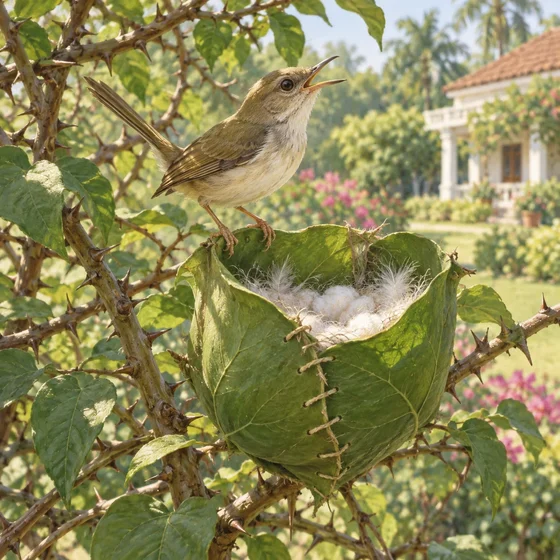
In the garden he meets Darzee and the tailorbird’s wife, grieving because the cobra Nag has eaten a fallen fledgling. Darzee’s warning alerts Rikki to Nagaina approaching from behind, and he jumps clear of her strike. His first bite is hesitant: the text stresses that he is young and inexperienced. He later kills Karait, the small snake threatening Teddy, through a carefully placed bite after evasive movement. The narrator rejects the old claim that a mongoose survives snakebite by eating a magical curing herb, emphasising timing and agility instead. This explanation is part of the literary narrative, not evidence that Rikki has a universal immunity or an invulnerable body.
Rikki’s night investigation reveals a different kind of danger. Chuchundra’s anxious advice helps direct his attention to the bathroom, where he overhears Nag and Nagaina planning to kill the household’s adults so that the mongoose will leave. He waits while Nag settles by a water jar, then bites and holds the cobra’s head as the larger animal thrashes him around the room. Teddy’s father fires a shotgun into Nag, leaving Rikki stunned and singed. The opening celebrates the mongoose’s great fight, but the narrated event includes the human’s intervention; it should not be rewritten as a wholly unassisted victory or as proof that every opponent is easy for him to defeat.
Nagaina’s remaining eggs make the conflict continue after Nag’s death. Darzee’s wife carries out the broken-wing diversion while Darzee stays with the nestlings and sings. Rikki destroys the eggs in the melon bed but preserves the last as leverage when Nagaina threatens Teddy on the veranda. Their confrontation ends in a pursuit to the cobras’ hole. He follows while gripping her tail, despite the danger of entering a confined place where she might turn. Darzee prematurely mourns him, but Rikki emerges dusty and declares that she will not return. The story closes with his continuing guard over the garden. His courage therefore combines observation, risky decisions and assistance, rather than a supernatural guarantee of success.
First appearances & development
Kipling’s Rikki-Tikki-Tavi places a young mongoose in a bungalow garden, giving animals conversation and social roles while retaining pursuit, nesting and predation as narrative concerns. This profile follows the original story in The Jungle Book; no animated adaptation, real animal biography or independent folklore origin is substituted for that literary character.
Canon & continuity
The complete retained story distinguishes narrator description, dialogue and observed actions. Character abilities and assistance are limited to that literary account; later adaptation traits are excluded.
Selected bibliography
Documented works and useful reading. This is not a list of every appearance.
- 01
Rikki-Tikki-Tavi, in The Jungle Book
Complete original story: rescue, garden warnings, bathroom fight, eggs and final pursuit.
Family & connections
A source-supported family tree or inspiration record has not yet been compiled for this profile. Related reading below indicates a connection in subject matter, not a proven lineage or creative influence.
References
Sources supporting this profile. Linked pages have their own scope and editorial standards.
- Public-domain primary fictionThe Jungle Book — complete primary literary textResearch access: 2026-10-11
- Bibliographic and rights recordProject Gutenberg catalogue: The Jungle BookResearch access: 2026-10-11
Image credits
Unofficial modern AI interpretationUnofficial AI interpretation of Kipling’s Rikki-tikki-tavi exploring the bungalow garden, following his pink eyes and nose, mongoose form and fluffed tail. Fur palette, pose and veranda details are imagined; no film design or precise real species is claimed.
Unofficial AI interpretation of Kipling’s Rikki-tikki-tavi exploring the bungalow garden, following his pink eyes and nose, mongoose form and fluffed tail. Fur palette, pose and veranda details are imagined; no film design or precise real species is claimed. Full-frame display derivative; no upscaling.