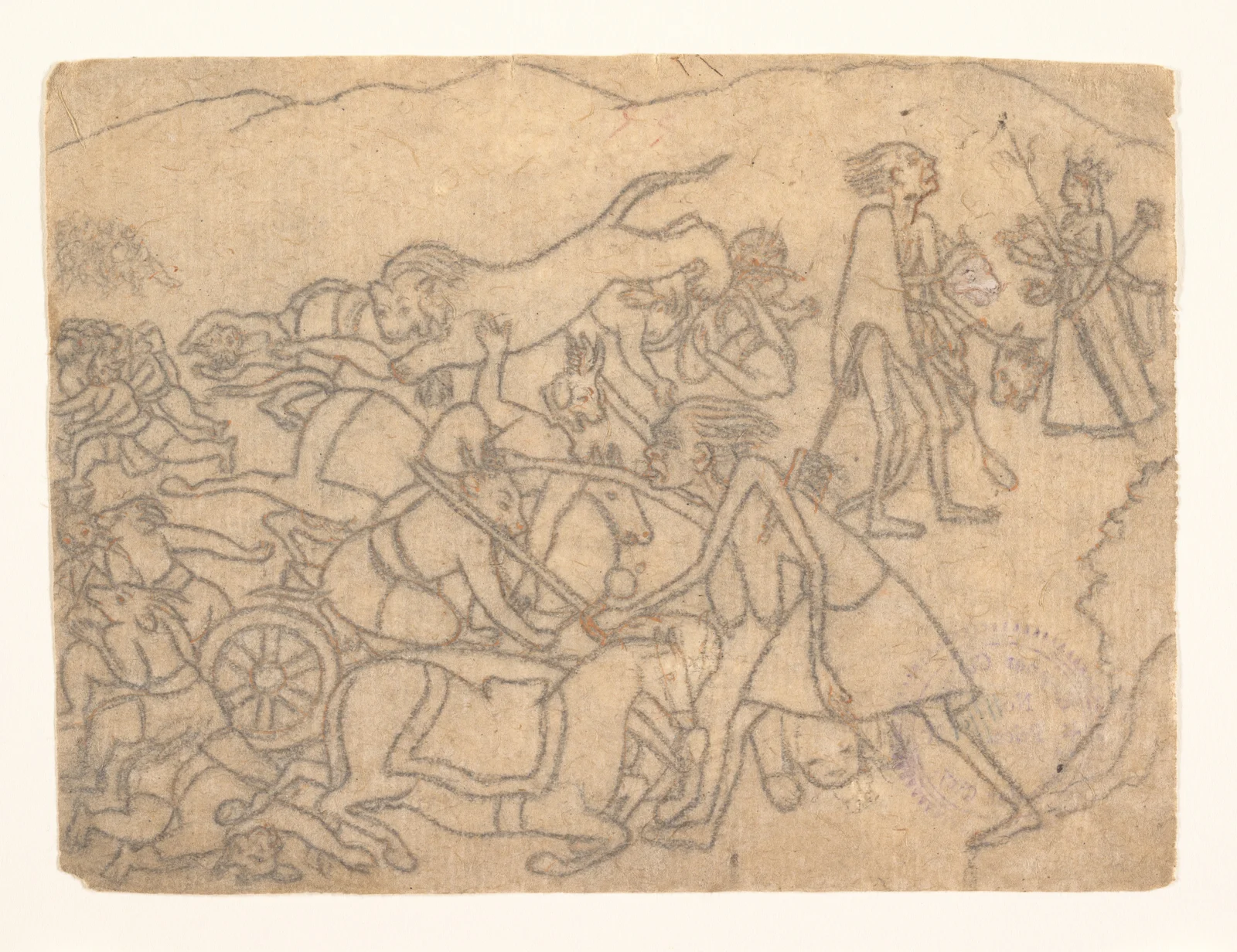
Pale graphite-and-ink battle drawing: Kali fights among fallen warriors and a lion, then at upper right presents the severed heads of Chanda and Munda to many-armed Durga.
Guler, ca. 1780. This drawing depicts the defeat of Chanda and Munda and the presentation of their heads to Durga. The museum names the pair collectively; it does not identify which individual head belongs to each demon.
Overview
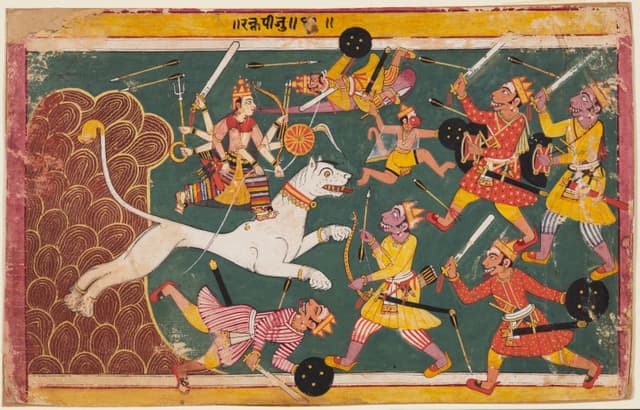
Munda shares Canda’s report about the goddess and the later command to capture her. In the battle he covers Kali with showers of arrows and thousands of discuses. After she beheads Canda, Munda rushes at her and is struck down with her sword.
Kali brings the defeated pair before Candika, who gives her the name Camunda from Canda and Munda. Their linked narrative roles do not make them alternate names for one being.
Origins & earliest records
South Asian Hindu sacred narrative
Records & interpretation
Full relevant hosted Pargiter passages directly read; Medhas’s narration within the Markandeya Purana.
Selected bibliography
Documented works and useful reading. This is not a list of every appearance.
- 01
The Mārkaṇḍeya Purāṇa
Canto 85, 86, 87; historical English edition date, not Sanskrit composition date.
Family & connections
A source-supported family tree or inspiration record has not yet been compiled for this profile. Related reading below indicates a connection in subject matter, not a proven lineage or creative influence.
Primary records and illustrations
The Mārkaṇḍeya Purāṇa, Pargiter translation
Devī-Māhātmya; hosted 1904 translation. Canto 85, 86, 87
Full relevant chapter narrative directly read on Wisdomlib; source-specific translation and narrator retained; no illustration claimed.
References
Sources supporting this profile. Linked pages have their own scope and editorial standards.
- Historical primary religious-text translationPargiter, Markandeya Purana — canto 85Research access: 2026-10-05
- Historical primary religious-text translationPargiter, Markandeya Purana — canto 86Research access: 2026-10-05
- Historical primary religious-text translationPargiter, Markandeya Purana — canto 87Research access: 2026-10-05
Image credits
Historical narrative drawingPale graphite-and-ink battle drawing: Kali fights among fallen warriors and a lion, then at upper right presents the severed heads of Chanda and Munda to many-armed Durga.
Guler, ca. 1780. This drawing depicts the defeat of Chanda and Munda and the presentation of their heads to Durga. The museum names the pair collectively; it does not identify which individual head belongs to each demon.