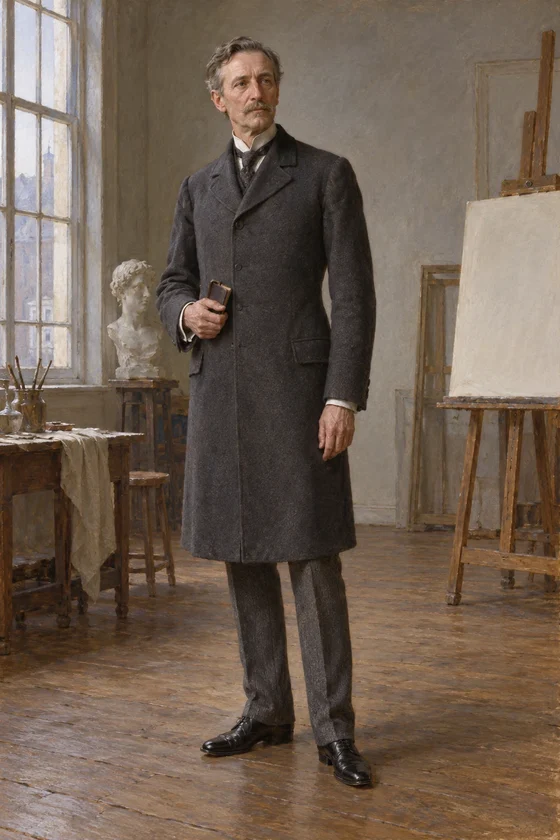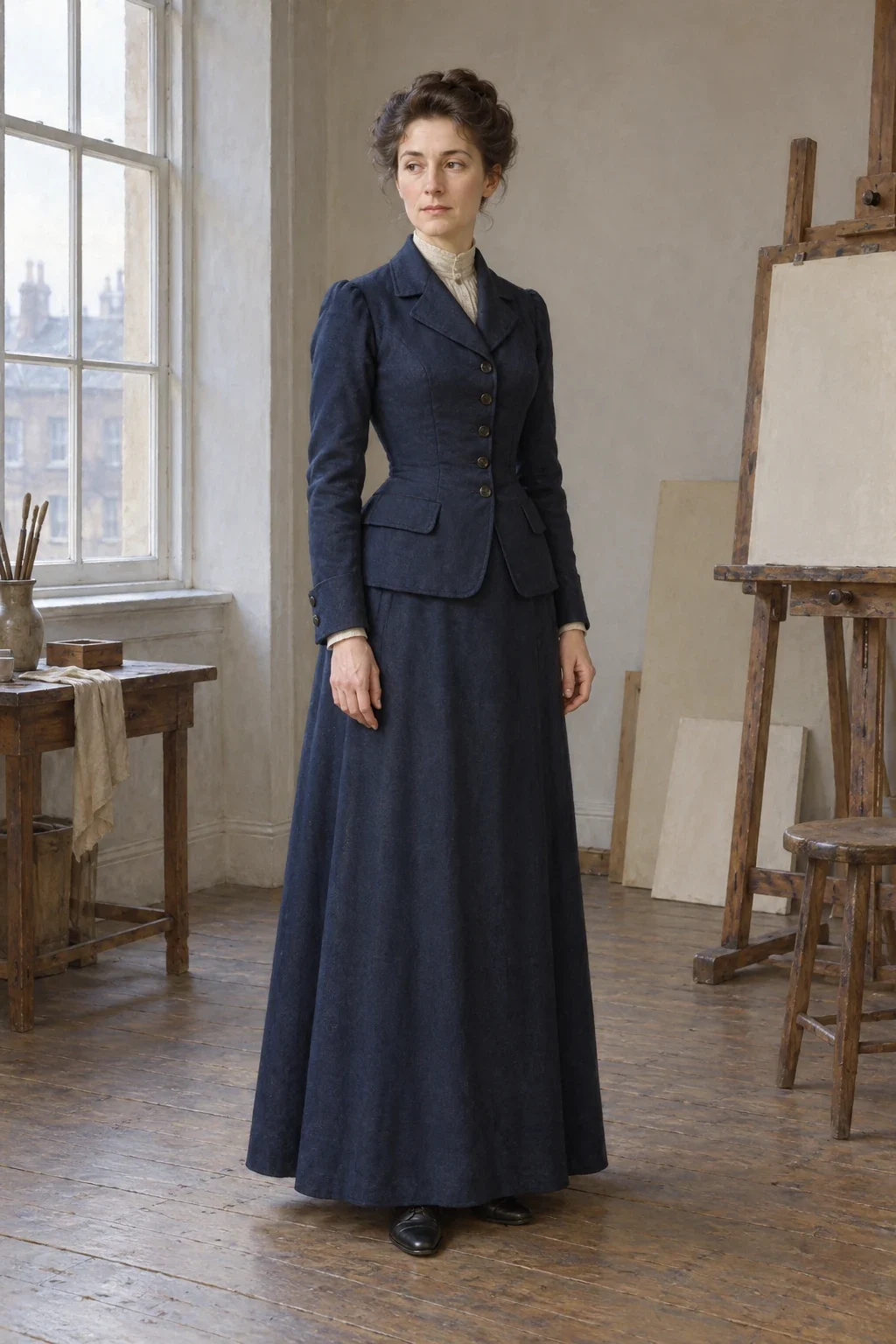
Original AI literary interpretation.
Overview
Mrs. Monarch is the retired Major's wife and partner in seeking paid modelling work after the loss of their money. At their first interview she is ten years younger than his fifty, tall, straight, slim and stiff, dressed with conspicuous precision in dark-blue cloth with lappets, pockets and buttons. Her husband remembers that she was called the Beautiful Statue when they married; this is a nickname for her poise, not a supernatural condition. She is shy about the request, anxious to maintain professional dignity, and initially confident that an actual lady should be ideal for illustrated stories about fashionable people.
Her ability to remain still, shaped by years of being photographed, does not produce the variety the narrator wants. He finds that she remains recognisably the same woman in every pose and makes his fictional figures look too tall. Her neatly arranged back hair and formal carriage suit certain views, but he increasingly prefers the adaptable Miss Churm. Mrs. Monarch regards that model's untidiness with disapproval and is troubled when Oronte becomes another competitor. The narrator repeatedly interprets her feelings through class distinctions of his own; her pride and his professional frustration are part of their difficult relationship, not proof that a society woman's identity makes her artistically or personally worthless.
Under financial pressure she and the Major wait patiently for work and accept tasks beneath their former social position. She serves tea to Oronte, then on a later visit offers to rearrange Miss Churm's hair, making the competing model's head more effective for the artist's composition. She picks up a dropped rag and helps her husband wash and polish the studio's domestic things. The narrator recognises the generosity and desperation in this change, yet ultimately pays the couple to go away. Their later lives are not supplied. Her arc therefore includes both class-bound rigidity and the capacity to assist someone who has replaced her.
First appearances & development
Individual in Henry James’s authored English tale The Real Thing, told retrospectively by an unnamed illustrator with professional ambitions and class assumptions of his own.
Canon & continuity
Complete four-section tale: 135 numbered units, including four section labels. Retained title, author, Macmillan imprint, 1893 date, 1892 copyright, author’s note and complete contents read. No whole-collection or native physical-copy claim.
Selected bibliography
Documented works and useful reading. This is not a list of every appearance.
- 01
The Real Thing and Other Tales - The Real Thing
Year is the retained Macmillan collection title; retained copyright says 1892. No first-appearance or independently verified physical-copy claim.
Family & connections
A source-supported family tree or inspiration record has not yet been compiled for this profile. Related reading below indicates a connection in subject matter, not a proven lineage or creative influence.
References
Sources supporting this profile. Linked pages have their own scope and editorial standards.
- Primary authored first-person literary narrativeThe Real Thing - complete original English tale and retained collection framingResearch access: 2026-10-21
Image credits
AI-generated illustrationOriginal AI literary interpretation.