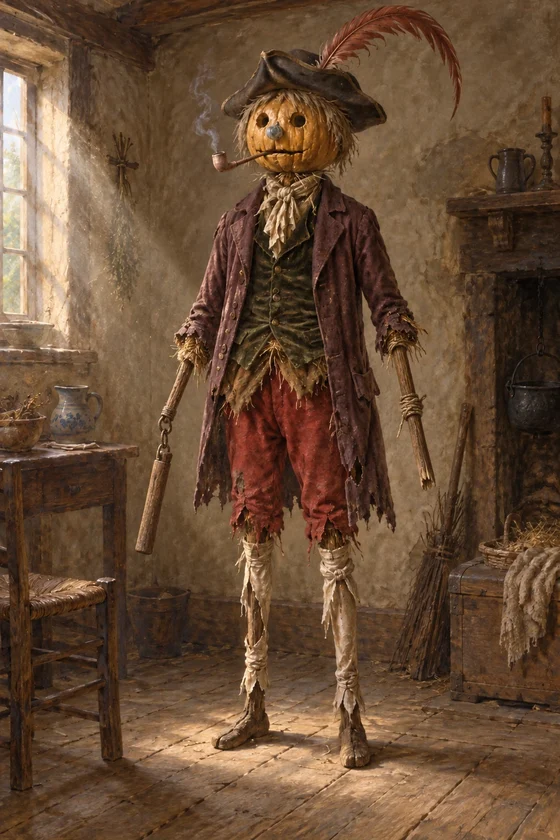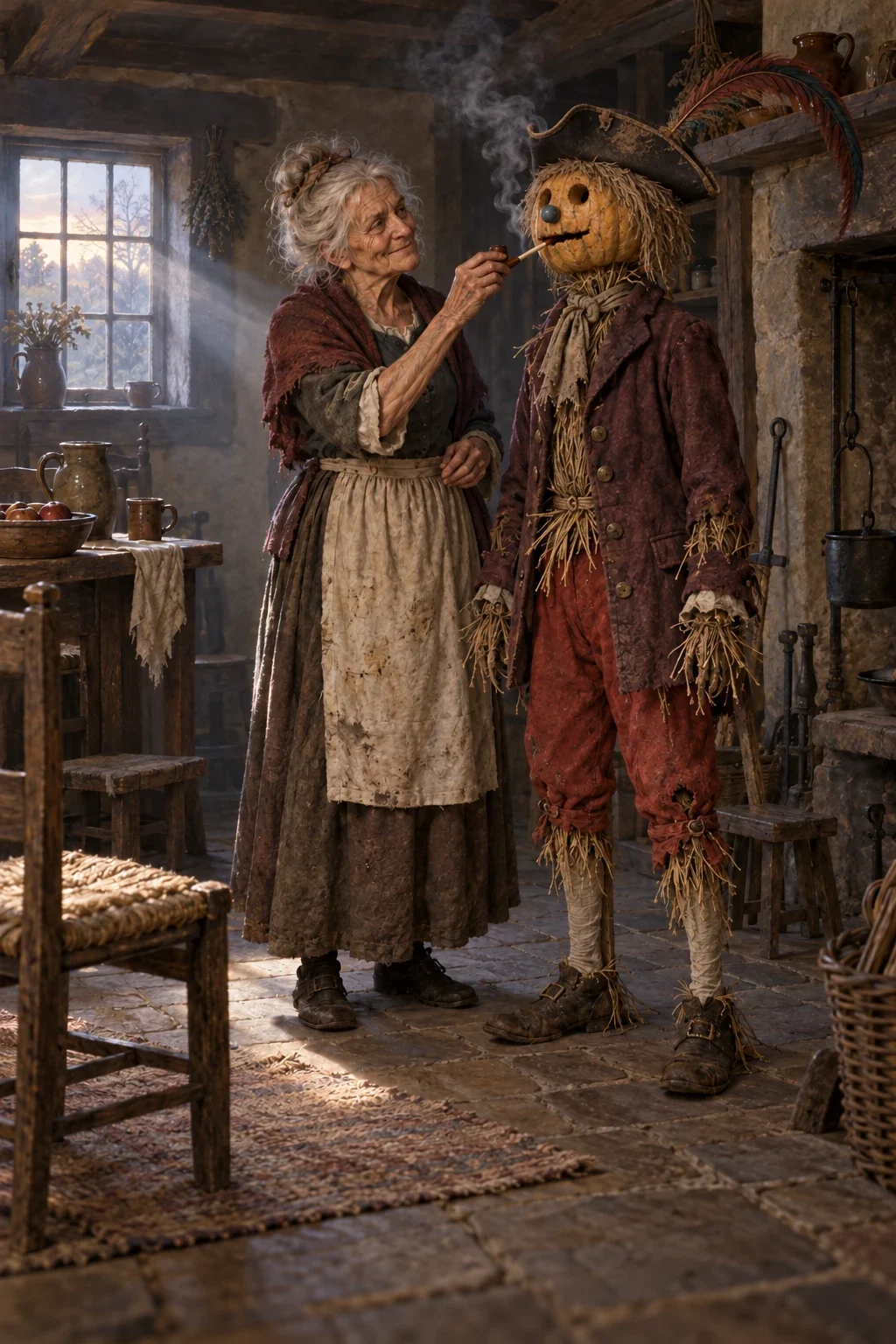
AI interpretation of Mother Rigby beginning the animation of her scarecrow with the bewitched pipe.
Casting, dress and cottage layout imagined; authored fiction, not a historical witch portrait. Full-frame derivative; no upscaling.
Overview
Mother Rigby is the witch who constructs and animates Feathertop in Nathaniel Hawthorne's authored New England tale. The narrator calls her exceptionally cunning and powerful, but introduces her through an ordinary household concern: birds are threatening the corn in her patch. She rises before sunrise in late May to make a scarecrow. Her mood and enjoyment of tobacco lead her to build a fine gentleman instead of something horrifying. This domestic beginning establishes the mixture of practical labour, supernatural command and social mockery that shapes her actions.
Her materials are worn tools, a meal bag, straw, a pumpkin and discarded clothes. The broomstick used as a backbone is one she has ridden at midnight. The narrator also recalls her making puppets from clay, wax, mist and smoke. She calls to an invisible helper named Dickon for a burning coal; neither his appearance nor the coal's place of origin is established. A profile or illustration can therefore show the commanded effect without giving that unseen helper an invented canonical body. Her own described features include a wrinkled face, skinny hands and a brown arm, without a complete costume specification.
She puts the pipe into the scarecrow's mouth and directs him to smoke, walk and speak. Encouragement changes into intimidation when he falters, and she threatens to dismantle him. The narrative presents her will as forceful while retaining uncertainty about whether the result is real transformation or an illusion. Her affection is equally conspicuous: she praises the puppet and treats him as a darling creation. She supplies imaginary riches, a guiding staff and a secret introduction to Justice Gookin, then sends him to court the magistrate's daughter Polly.
When Feathertop returns distressed, Mother Rigby first proposes retaliatory torment and disfigurement against the people she assumes have rejected him. He instead explains that he has seen his own emptiness. After his collapse, she pities his unusually tender feelings and compares him with respectable human charlatans who never confront themselves. Although she says she could revive him, she chooses a harmless, useful scarecrow vocation. Her closing command for another coal returns the story to its beginning. These powers and judgments belong to Hawthorne's fictional witch, not evidence about historical New England practitioners.
First appearances & development
Nathaniel Hawthorne's authored story supplies the subject; its narrator's claimed fireside legend is part of the literary framing, not independent collected folklore.
Canon & continuity
Original story passages support these fictional character claims. Project Gutenberg records ebook512 as public domain in the USA; catalogue-generated plot summaries are excluded.
Selected bibliography
Documented works and useful reading. This is not a list of every appearance.
- 01
Feathertop: A Moralized Legend, in Mosses from an Old Manse
Character claims follow the original tale, distinct from electronic custody and rights metadata.
Family & connections
A source-supported family tree or inspiration record has not yet been compiled for this profile. Related reading below indicates a connection in subject matter, not a proven lineage or creative influence.
References
Sources supporting this profile. Linked pages have their own scope and editorial standards.
- PrimaryMosses from an Old Manse: original Feathertop storyResearch access: 2026-10-11
- CustodialProject Gutenberg ebook512: custody and USA rightsResearch access: 2026-10-11
Image credits
AI literary interpretationAI interpretation of Mother Rigby beginning the animation of her scarecrow with the bewitched pipe.
Casting, dress and cottage layout imagined; authored fiction, not a historical witch portrait. Full-frame derivative; no upscaling.