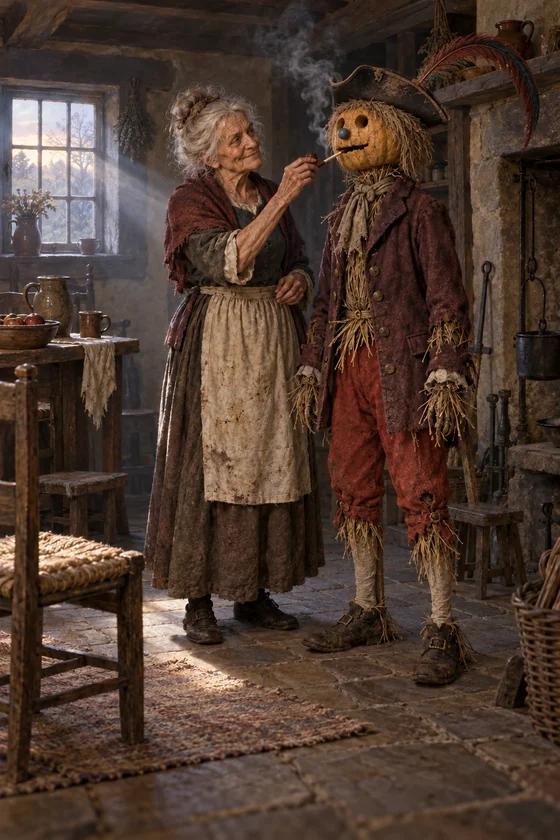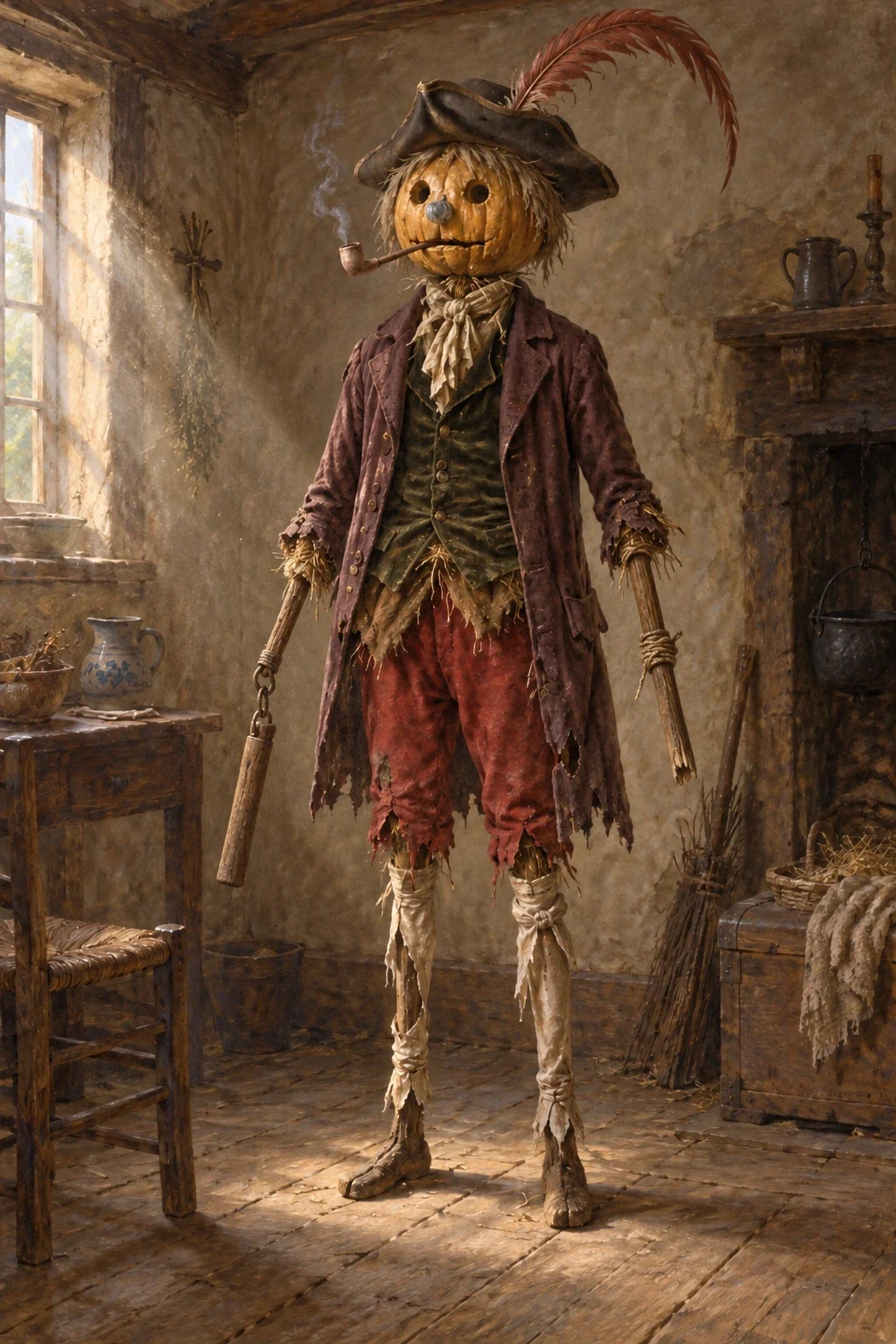
AI interpretation of Feathertop as the original clothed pumpkin-headed scarecrow, with a smoking pipe.
Initial constructed form; room, fine fabric details and pose imagined from the authored tale. Full-frame derivative; no upscaling.
Overview
Feathertop is the artificial gentleman created by Mother Rigby in Nathaniel Hawthorne's Feathertop: A Moralized Legend. His initial purpose is practical: to frighten birds from her newly sprouting corn. His body is assembled from discarded household and agricultural materials. A broomstick forms his backbone, mismatched implements become arms and legs, and a straw-filled meal bag supplies the trunk. His head is a shrivelled pumpkin with cut eyeholes and a mouth slit. These materials remain important after he appears to become a man.
Mother Rigby dresses the figure in an old plum-coloured coat, a velvet waistcoat, scarlet breeches and damaged silk stockings. Her dead husband's wig and a three-cornered hat with a rooster's tail feather complete the costume. She changes her plan when she admires her handiwork. A bewitched pipe lends the scarecrow movement, speech and an increasingly convincing human appearance. The narrator questions whether its underlying substance ever changes: illusion may account for the transformation. Continued smoking sustains the effect; when the pipe is emptied, the gentleman begins to fade.
Sent into town with a staff that appears to be a gold-headed cane, Feathertop impresses spectators with his dress and polished manners. Their guesses about noble rank and nationality reveal how confidently they mistake surfaces for substance. A child and a dog react differently. Mother Rigby gives him a secret word that gains entry to Justice Gookin's household, where Polly becomes attracted to him. The text leaves Gookin's earlier connection to evil suggestive rather than fully explained; the profile does not convert that suggestion into a documented pact.
A truthful mirror breaks the social performance. Polly sees the patchwork beneath the splendid appearance, and Feathertop sees it too. He returns to his maker in despair, rejects continued existence, and throws away the pipe. The figure collapses into straw, sticks, clothes and pumpkin. Mother Rigby judges his sensitivity ill suited to a world populated by unreflective impostors, and decides to return him to scarecrow work. His self-recognition gives this artificial being a vulnerability absent from the confident people who admired him.
First appearances & development
Nathaniel Hawthorne's authored story supplies the subject; its narrator's claimed fireside legend is part of the literary framing, not independent collected folklore.
Canon & continuity
Original story passages support these fictional character claims. Project Gutenberg records ebook512 as public domain in the USA; catalogue-generated plot summaries are excluded.
Selected bibliography
Documented works and useful reading. This is not a list of every appearance.
- 01
Feathertop: A Moralized Legend, in Mosses from an Old Manse
Character claims follow the original tale, distinct from electronic custody and rights metadata.
Family & connections
A source-supported family tree or inspiration record has not yet been compiled for this profile. Related reading below indicates a connection in subject matter, not a proven lineage or creative influence.
References
Sources supporting this profile. Linked pages have their own scope and editorial standards.
- PrimaryMosses from an Old Manse: original Feathertop storyResearch access: 2026-10-11
- CustodialProject Gutenberg ebook512: custody and USA rightsResearch access: 2026-10-11
Image credits
AI literary interpretationAI interpretation of Feathertop as the original clothed pumpkin-headed scarecrow, with a smoking pipe.
Initial constructed form; room, fine fabric details and pose imagined from the authored tale. Full-frame derivative; no upscaling.