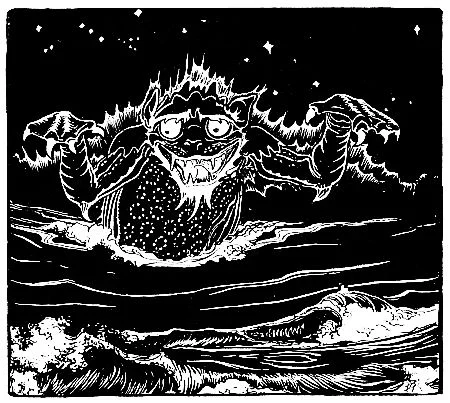
Batten: the first Huge Monster from the sea
Exact Fin and Kingdom of the Big Men scene shows the first monster approaching from the water. Pointed ears, webbed hands and decorative spots are Batten’s interpretation; father and mother not separately shown. Selected title-page edition1895; John Dickson Batten1860–1932 credited illustrator; Joseph Jacobs compiler/editor.
Overview
The first enormous attacker demands the king’s daughter and half his kingdom, forcing the ruler into nightly combat. His arrival is preceded by the sea moving in fiery kilns and like a darting serpent; that imagery describes the water’s motion and does not itself identify him as a serpent. Fin postpones two encounters by falsely reporting the queen’s death and then the king’s. On the third night he fights, with Bran’s venomous strike bringing the attacker down.
The following challenger asks vengeance for his son and claims the kingdom, establishing the second monster as the first one’s father. After another victory the mother comes ashore, declaring that Fin killed her husband and son. Her projecting tooth is compared with a distaff and is harder for Fin to guard against than her hands. Bran again intervenes and she dies. The king then says the brood’s mother is dead and his kingdom can rest. All three remain unnamed in the selected text, so the profile records the family together while distinguishing their motives and physical descriptions.
Origins & earliest records
Jacobs’s source note attributes the containing story to J. G. Campbell’s The Fians, pp. 175–192. The selected 1895 adaptation is the directly inspected witness. Kinship and attack sequence are supplied by its dialogue rather than derived from a modern monster catalogue.
Records & interpretation
The three challenges, stated husband-and-son relationship and mother’s tooth are literary attestations of a giant family. The moving fiery sea is narrated arrival imagery, not proof of fire-breathing anatomy. No actual animal family or historical royal siege is established.
In the literature
“my husband and my son”
How Fin went to the Kingdom of the Big Men; p200; mother’s challenge
The first monster demands the king’s daughter and half his realm. His father next seeks revenge and sovereignty; the mother then names the dead two as her husband and son. Bran disables each with the venomous shoe and Fin carries off each head. No wider ancestral genealogy is given.
Selected bibliography
Documented works and useful reading. This is not a list of every appearance.
- 01
More Celtic Fairy Tales: How Fin went to the Kingdom of the Big Men, pp. 196–201; note XLIII
Selected episode and relevant source note inspected. Earlier works named by Jacobs are attributed references, not falsely claimed as independently collated texts.
- 02
More Celtic Fairy Tales
Jacobs, More Celtic Fairy Tales, selected1895 Nutt/Putnam edition, PG34453. Complete How Fin went to the Kingdom of the Big Men, pp194–204, and relevant noteXLIII independently read.
Family, evolution & connections
The invading monster household in the Big Men tale
The slain son, his avenging father and the mother’s explicit husband-and-son declaration.
Scroll sideways to see all branches. With a keyboard, focus the tree and use the arrow keys.
- Unnamed monster father and mother (joint parents)
- Their unnamed son
Explicit family statements in the named Jacobs retelling. Unnamed tale characters remain unnamed. The unrelated king of the Big Men is not their father or clan ancestor.
Unnamed son slain by Fin
The next attacker identifies the previously slain monster as his son; the final hag also identifies the son as hers.
Unnamed avenging father
The father follows his son’s death. He is distinct from the king whose household Fin protects.
Unnamed mother and wife of the avenging father
The final hag says Fin killed her husband and her son. The king subsequently identifies her as the brood’s mother.
Located primary passages
Specific passages supporting details in this entry, grouped by their published witness.
More Celtic Fairy Tales
Jacobs, More Celtic Fairy Tales, selected1895 Nutt/Putnam edition, PG34453. Complete How Fin went to the Kingdom of the Big Men, pp194–204, and relevant noteXLIII independently read.
- The first monster demands the king’s daughter and half his realm. His father next seeks revenge and sovereignty; the mother then names the dead two as her husband and son. Bran disables each with the venomous shoe and Fin carries off each head. No wider ancestral genealogy is given.
- The opponents arrive from the sea; the narrative likens its fiery motion to a darting serpent, rather than describing the monster himself as a serpent. The mother’s single prominent tooth is compared to a distaff and makes defence difficult. Anatomy beyond the stated tooth and immense size is not supplied.
How Fin went to the Kingdom of the Big Men, pp194–204; Marine arrival and oversized tooth
Narrated family, literal dialogue, deception and figurative comparisons distinguished. No song or ritual-formula excerpts.
Primary source witness
Jacobs, More Celtic Fairy Tales, selected1895 Nutt/Putnam edition, PG34453. Complete How Fin went to the Kingdom of the Big Men, pp194–204, and relevant noteXLIII independently read.
- Jacobs credits J. G. Campbell’s The Fians, Waifs and StraysIV pp175–192. His suggestion that Swift might have remembered such a tale as an Irish child is speculative comparison, not evidence of an independently checked transmission chain.
XLIII. HOW FIN WENT TO THE KINGDOM OF THE BIG MEN, Source and comparison
No direct Campbell-page collation or Swift borrowing proof claimed.
References
Sources supporting this profile. Linked pages have their own scope and editorial standards.
- Primary textMore Celtic Fairy Tales, selected 1895 edition: How Fin went to the Kingdom of the Big Men, pp. 196–201; note XLIIIResearch access: 2026-10-05
Image credits
Historical illustrationBatten: the first Huge Monster from the sea
Exact Fin and Kingdom of the Big Men scene shows the first monster approaching from the water. Pointed ears, webbed hands and decorative spots are Batten’s interpretation; father and mother not separately shown. Selected title-page edition1895; John Dickson Batten1860–1932 credited illustrator; Joseph Jacobs compiler/editor.