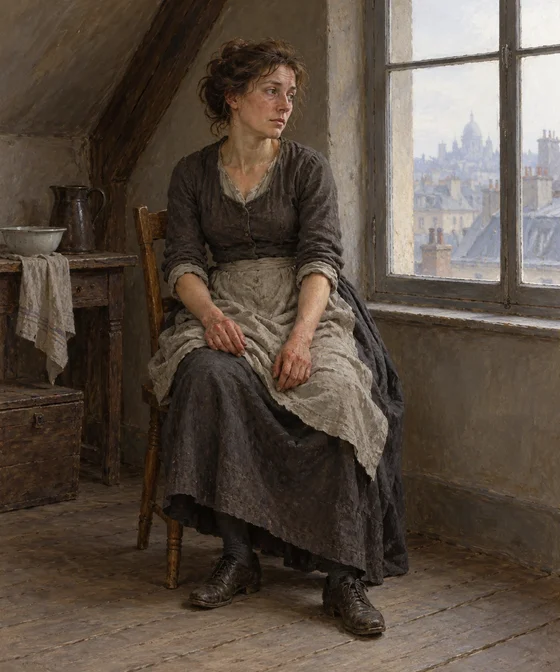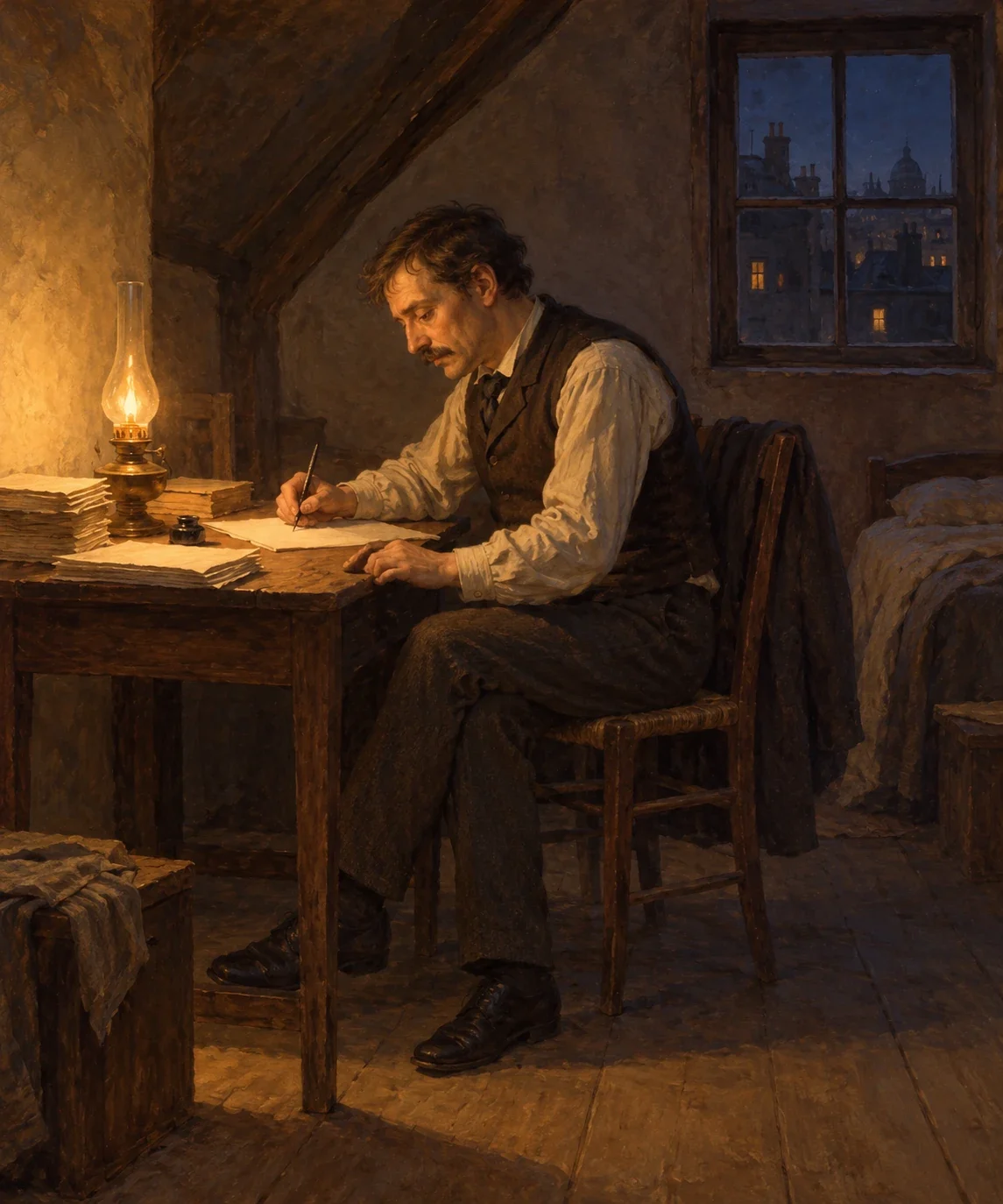
Original AI literary interpretation from the French narrative.
Overview
Monsieur Loisel is Mathilde's unnamed husband, a minor clerk in the Ministry of Public Instruction. Unlike his dissatisfied wife, he delights in their ordinary dinner and expects the invitation he has obtained to make her happy. When she explains that she lacks a dress, he reluctantly gives her the four hundred francs reserved for a gun and outings with friends. He proposes fresh flowers as inexpensive adornment, then suggests borrowing jewellery from Forestier. At the ball he eventually sleeps in a small room while the wives continue enjoying themselves; afterward he tries to keep Mathilde warm and find a cab. These actions establish practical affection without making him the story's sole innocent sufferer.
After the necklace is lost, he retraces their route, visits the police, newspapers and cab companies, and returns exhausted without success. He directs Mathilde to say that the clasp has broken and is being repaired, making him an active participant in concealing what happened. When they choose a replacement costing thirty-six thousand francs, he supplies eighteen thousand inherited from his father and borrows the rest through damaging commitments. The narrative describes his fear of future deprivation and the risk that he cannot honour his promises. It does not establish that Forestier demanded this substitution or knowingly caused their debt.
During the next ten years he supplements his ministry work by preparing a tradesman's accounts in the evening and often copying pages at night. Mathilde takes over demanding household labour after they dismiss the servant and move to attic accommodation. Together they repay the debt and compounded charges. Mathilde later learns from Forestier that the original necklace was imitation, but Loisel is not present for that conversation and his subsequent knowledge or response is not narrated. His first name, exact age and personal likeness are not given. The portrait therefore represents the literary clerk at his explicitly described extra work, rather than an independently identified historical civil servant.
First appearances & development
Individual in Guy de Maupassant’s authored French tale La Parure. English prose here independently summarises the original French; no modern translation is used.
Canon & continuity
All 128 narrative paragraphs and original title, author, publisher, printing and contents framing read; no whole-collection reading claim or native scan inspection.
Selected bibliography
Documented works and useful reading. This is not a list of every appearance.
- 01
Contes du jour et de la nuit - La Parure
Original French transcription. Retained publisher framing has no date; no first-appearance or exact physical-edition year asserted.
Family & connections
A source-supported family tree or inspiration record has not yet been compiled for this profile. Related reading below indicates a connection in subject matter, not a proven lineage or creative influence.
References
Sources supporting this profile. Linked pages have their own scope and editorial standards.
- Primary authored French literary narrativeLa Parure - complete original French tale and retained collection framingResearch access: 2026-10-21
Image credits
AI-generated illustrationOriginal AI literary interpretation from the French narrative.