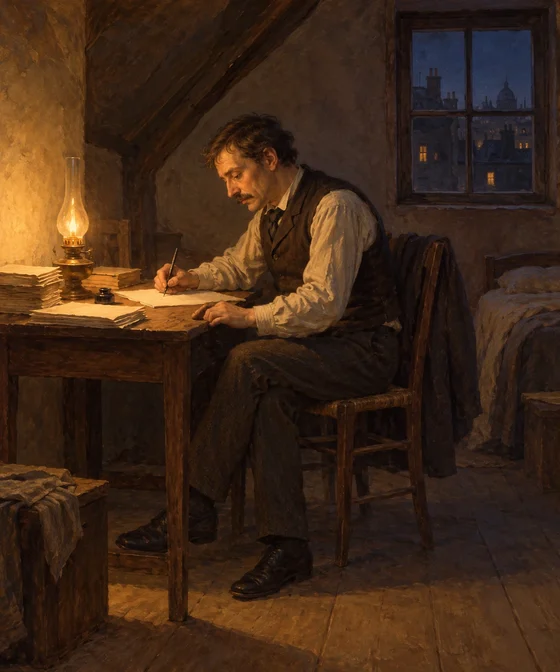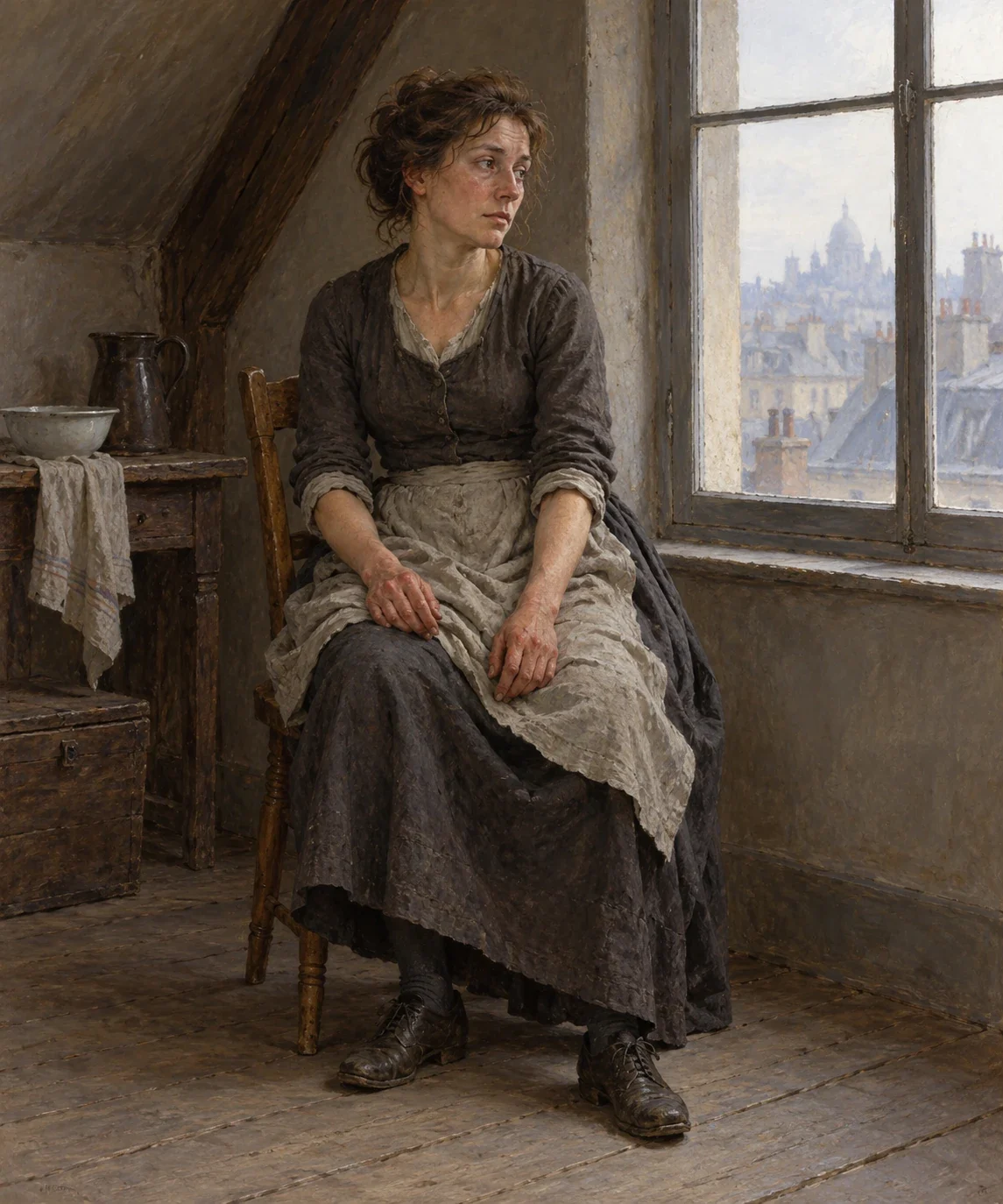
Original AI literary interpretation from the French narrative.
Overview
Mathilde Loisel is the attractive wife of a minor clerk in the Ministry of Public Instruction. She longs for elegant rooms, fine food, admired beauty and wealthy company, while feeling humiliated by the modest home she actually has. Her household initially includes a servant; its circumstances should not be confused with the severe poverty that follows. When her husband obtains a coveted invitation to a ministry evening, she first protests that she has no suitable dress. He gives up the four hundred francs saved for a gun. Still anxious about appearing poor, she borrows a necklace from her wealthy former school friend Mme Forestier after rejecting her husband's suggestion of fresh flowers.
At the ball she is admired and dances with intense delight, but afterward she tries to conceal her ordinary outer garments from women wearing rich furs. Once home, she discovers that the necklace is missing. Her husband searches and they delay telling Forestier by claiming that the clasp needs repair. Unable to recover the original, they buy a similar-looking diamond necklace for thirty-six thousand francs, using his inheritance and extensive borrowing. Forestier accepts the closed case without inspecting it. When she returns the replacement, Mathilde fears that discovery of the substitution would make Forestier regard her as a thief.
For ten years Mathilde undertakes hard domestic labour, bargains over necessities and helps sustain the household while the debt and accumulated interest are paid. She becomes rougher and older-looking, with untidy hair, crooked skirts and red hands, yet still remembers her evening of triumph. On meeting Forestier again she tells the truth with proud relief at having repaid everything. Her friend then reveals that the lost necklace was imitation and worth at most five hundred francs. The narrative ends there, without compensation, reversal or a further response from Mathilde. Its gendered and class-bound generalisations belong to the narration, while the profile follows this particular woman's desire, concealment and endurance.
First appearances & development
Individual in Guy de Maupassant’s authored French tale La Parure. English prose here independently summarises the original French; no modern translation is used.
Canon & continuity
All 128 narrative paragraphs and original title, author, publisher, printing and contents framing read; no whole-collection reading claim or native scan inspection.
Selected bibliography
Documented works and useful reading. This is not a list of every appearance.
- 01
Contes du jour et de la nuit - La Parure
Original French transcription. Retained publisher framing has no date; no first-appearance or exact physical-edition year asserted.
Family & connections
A source-supported family tree or inspiration record has not yet been compiled for this profile. Related reading below indicates a connection in subject matter, not a proven lineage or creative influence.
References
Sources supporting this profile. Linked pages have their own scope and editorial standards.
- Primary authored French literary narrativeLa Parure - complete original French tale and retained collection framingResearch access: 2026-10-21
Image credits
AI-generated illustrationOriginal AI literary interpretation from the French narrative.