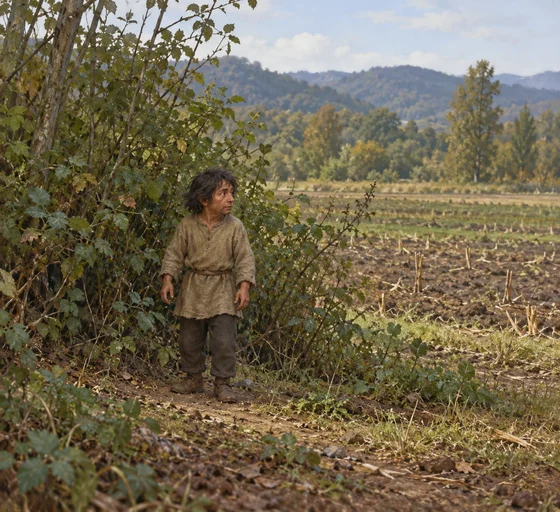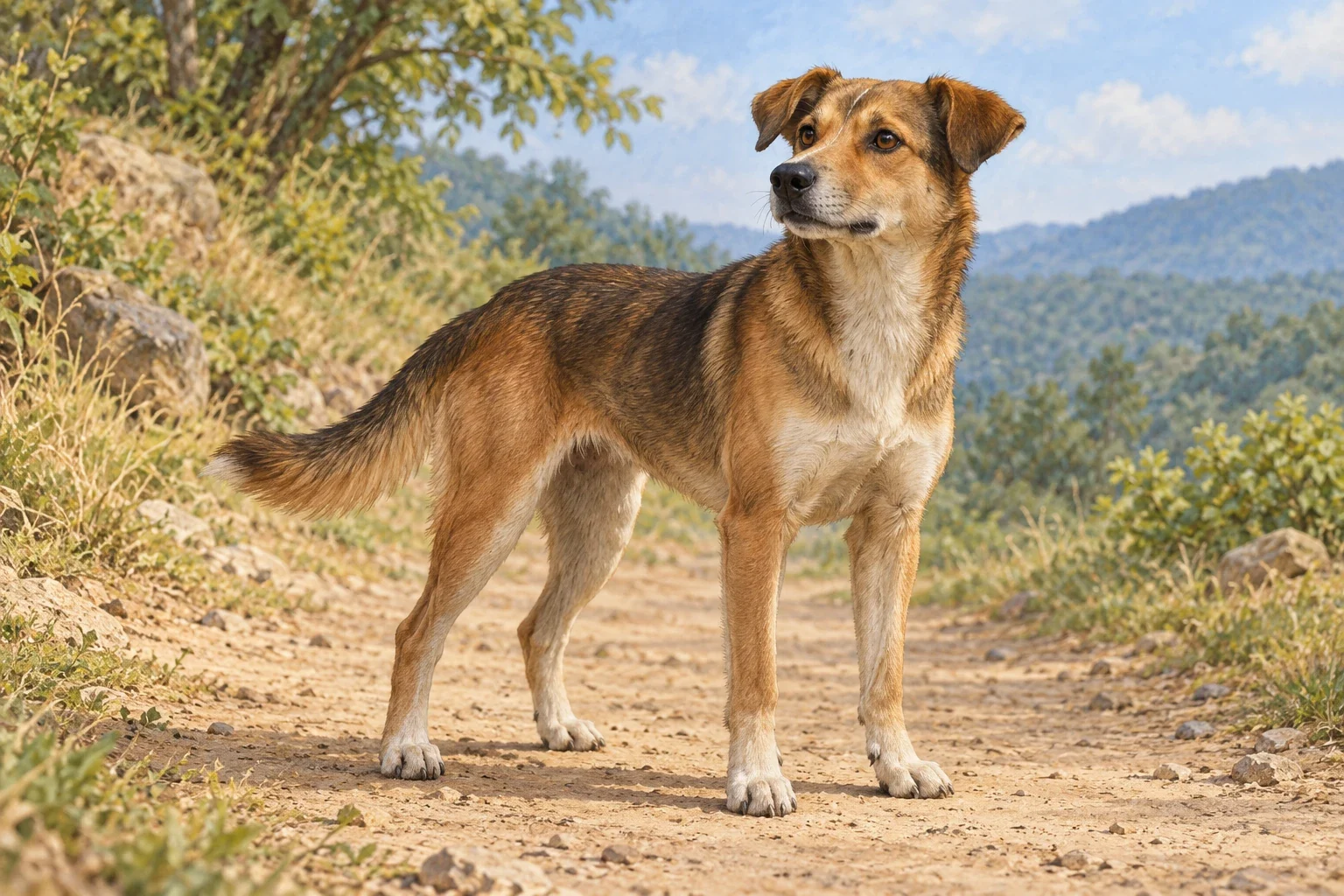
Portrayal of Monga’s Revealing Dog (Jacottet’s Version).
Portrayal selects the complete dog on an ordinary path before the hunting party’s violence. Breed-like features, colour and size are imagined; no body parts, wounds, revived-body effects or claim of modern community belief.
Overview
In Jacottet’s tale XIX, Monga owns a single dog which joins him and his companions on a hunting expedition. The men plan to kill Monga and tell the village that he has become lost. The dog witnesses both the plan and its execution. It follows the killers home carrying a part of its master’s body and sings an account of what happened. The story makes the animal a witness and messenger, not Monga transformed into a dog. Its breed, size, coat, sex and age are not described. The selected narrative’s one dog is kept distinct from the pair of dogs in the Angolan parallel cited by the editor.
The men try to silence it by threatening that it will receive no food the next day. It answers that the people at home will feed it. They kill it, but it comes back to life, resumes carrying the evidence and catches up with them. It then passes them and reaches the village first. The villagers question the physical evidence and hear its sung explanation. When the men arrive and repeat their planned false account, the villagers confront them with the dog’s testimony and kill them. Monga himself is not restored to life in this ending, and no further fate is supplied for the dog.
The collection explicitly distinguishes the language in which the tale was told from its associated song. Jacottet says the story is Totela although it was related to him in Soubiya, while appendix LXVI gives a Totela song with French translation and musical notation. The song again presents the dog’s refusal to be silenced and appeal to Monga’s household. Its retained French transcription names the singer Kaoundou and the original-song transcription has Kaundu; a spelling in the main tale’s OCR is uncertain. The descriptive name used here avoids treating that OCR variation as another animal or as an independently checked native spelling. The account supports narrative loyalty, speech and revival, without making its testimony a contemporary legal practice or its resurrection a zoological claim.
Origins & earliest records
Complete French tale XIX, printed pp. 72-73, its notes, and appendix LXVI song/French translation, pp.172-174. The editor explicitly identifies Totela origin with Soubiya narration.
Records & interpretation
Complete selected French narrative/notes and entire collection introduction read; original-language blocks retained without independent translation. Native PDF access failed once and is held; no native-page inspection claim.
Selected bibliography
Documented works and useful reading. This is not a list of every appearance.
- 01
Études sur les langues du Haut-Zambèze, seconde partie: Textes Soubiya
Selected complete account, printed pp. 72-73 and 172-174. Title transcription reads 1899; catalogue metadata gives 1869 and native title confirmation remains unavailable after an exact PDF access failure. French translation is the narrative basis.
Family & connections
A source-supported family tree or inspiration record has not yet been compiled for this profile. Related reading below indicates a connection in subject matter, not a proven lineage or creative influence.
References
Sources supporting this profile. Linked pages have their own scope and editorial standards.
- Historical primary bilingual collection in original French translationJacottet original Textes Soubiya, retained full OCRResearch access: 2026-10-05
Image credits
AI-generatedPortrayal of Monga’s Revealing Dog (Jacottet’s Version).
Portrayal selects the complete dog on an ordinary path before the hunting party’s violence. Breed-like features, colour and size are imagined; no body parts, wounds, revived-body effects or claim of modern community belief.