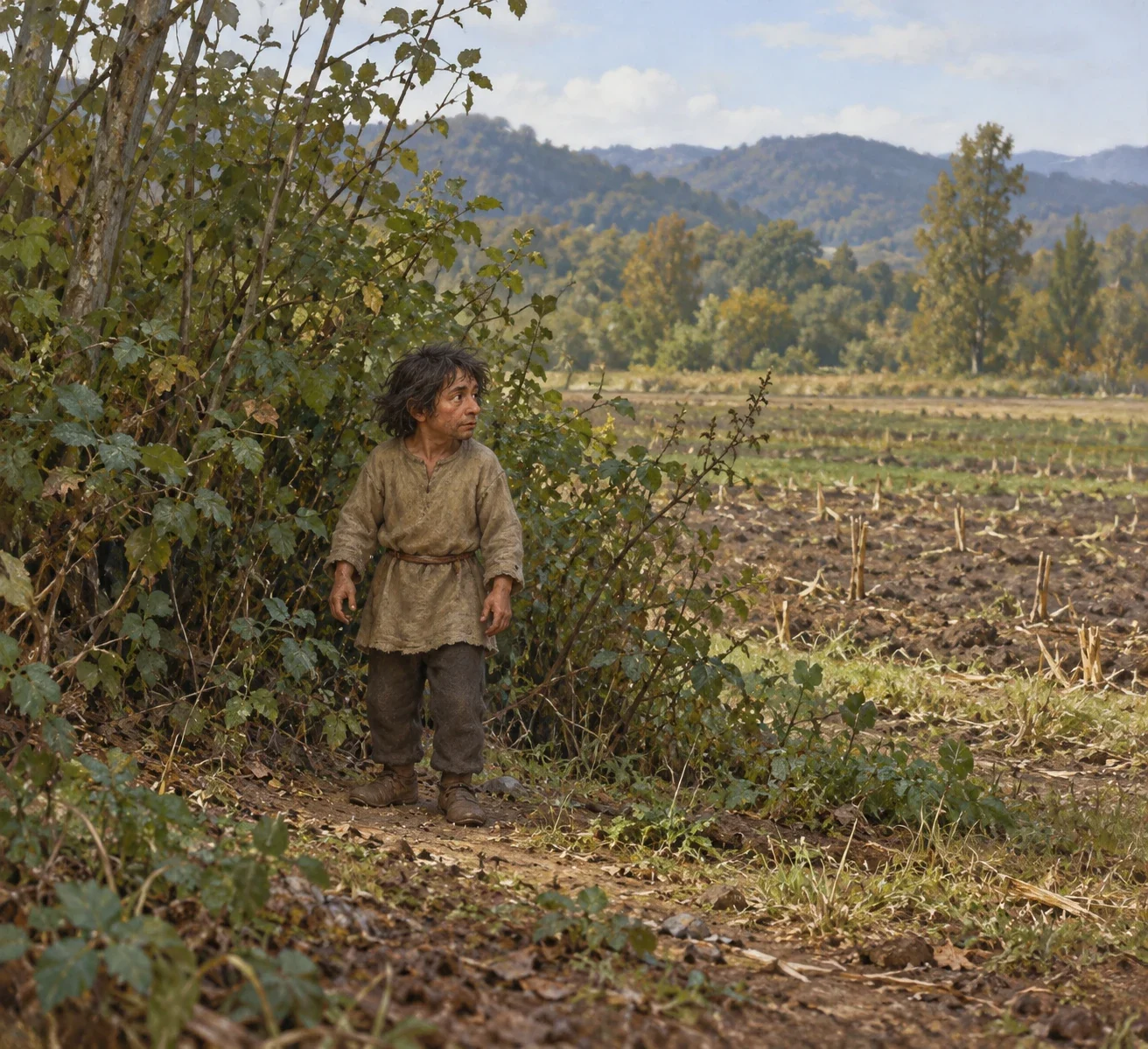
Portrayal of The Kawa-keountou of Jacottet’s Tale.
Portrayal selects the being alone beside the uncleared edge of the field, before capture. Very small human-like form is an explicit interpretation of the dialogue and editor’s suggestion; face, clothes and proportions are imagined, with no child or violence.
Overview
Jacottet’s tale XVIII concerns a fabulous small being called kawa-keountou in the French translation and Kawakeuntu in the corresponding Soubiya text. An editorial note describes its very small size through the diminutive prefix and suggests, rather than establishes, a human-like appearance. The editor says he cannot explain the name’s etymology. Later dialogue refers to its belly, head and back as human. Together these provide a limited basis for a human-like interpretation, while leaving face, clothing, exact stature and other anatomical details undescribed. It is not identified as a particular animal species or as a member of every small-being tradition of the region.
A man and woman clear their field and return home. After they leave, the creature sings and causes the brush to grow back, undoing their work. The man discovers the interference by hiding beneath bundles of wood. He catches the singer, which offers to look after the couple’s child, and spares it. The offer is therefore a means of obtaining release within the narrative. It does not establish a broader customary role as a helpful household guardian. Once entrusted with the child, the being takes it into the forest and kills it, deceiving the mother into sharing some of the resulting food.
The father then uses an extraordinary counter-stratagem: he cuts himself into pieces and places himself in a pot. After the creature eats, the consumed flesh becomes a man again inside it. The man asks where he should emerge. The being rejects the belly, head and back as possible exits, each time calling the relevant part human. The man finally tears his way out through its belly, killing it. The story gives no further restoration of the child or resolution for the mother. Jacottet compares the opening to other tales of a bird undoing a couple’s work, but those comparisons do not turn this being into a bird or supply an otherwise unreported body.
Origins & earliest records
Complete French tale XVIII, printed pp. 70-71, with corresponding Soubiya original and original editorial notes. Individual assignment between Kasala and Samata is not specified here.
Records & interpretation
Complete selected French narrative/notes and entire collection introduction read; original-language blocks retained without independent translation. Native PDF access failed once and is held; no native-page inspection claim.
Selected bibliography
Documented works and useful reading. This is not a list of every appearance.
- 01
Études sur les langues du Haut-Zambèze, seconde partie: Textes Soubiya
Selected complete account, printed pp. 70-71. Title transcription reads 1899; catalogue metadata gives 1869 and native title confirmation remains unavailable after an exact PDF access failure. French translation is the narrative basis.
Family & connections
A source-supported family tree or inspiration record has not yet been compiled for this profile. Related reading below indicates a connection in subject matter, not a proven lineage or creative influence.
References
Sources supporting this profile. Linked pages have their own scope and editorial standards.
- Historical primary bilingual collection in original French translationJacottet original Textes Soubiya, retained full OCRResearch access: 2026-10-05
Image credits
AI-generatedPortrayal of The Kawa-keountou of Jacottet’s Tale.
Portrayal selects the being alone beside the uncleared edge of the field, before capture. Very small human-like form is an explicit interpretation of the dialogue and editor’s suggestion; face, clothes and proportions are imagined, with no child or violence.