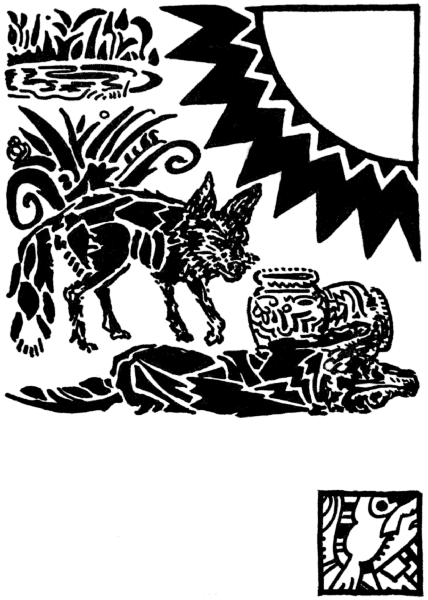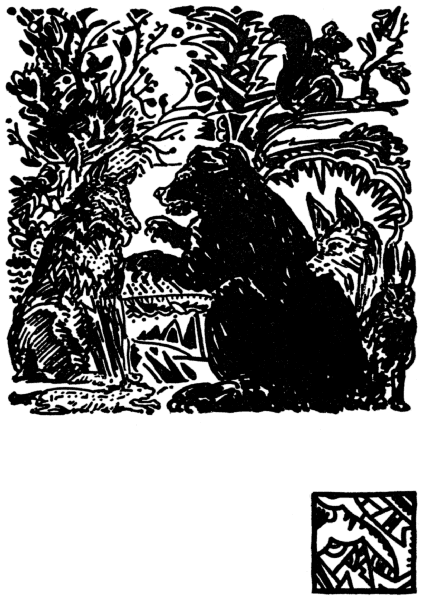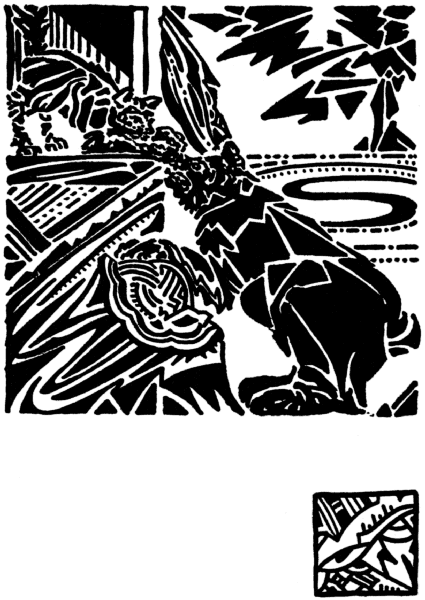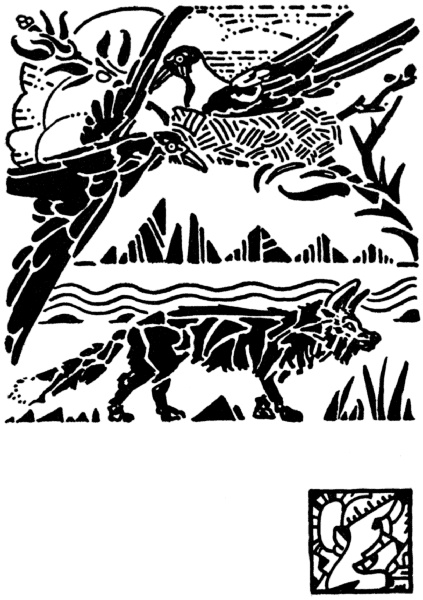
Mikko the fox beneath Harakka’s nest and Varis, Jay Van Everen, 1922
This composition accompanies The Fox and the Crow in Fillmore’s animal cycle. Mikko threatens Harakka’s nest, while Varis exposes his lack of an axe. This fox is the cycle’s trickster, distinct from the human woodsman Mikko and that man’s grateful fox in the earlier title tale.
Overview
Mikko is the recurring fox in Parker Fillmore’s sixteen-adventure nursery epic. He is distinct from the human woodsman called Mikko in the book’s earlier title tale. When forest animals consume a farmer’s corpse and Osmo proposes eating the smallest survivor next, Mikko persuades Pekka that the wolf will follow him on the menu. Their majority vote establishes an uneasy bear–wolf–fox neighbourhood. Farming does not make Mikko industrious: he steals Pekka’s butter while claiming invitations to christenings, smears butter on the sleeping wolf’s nose as false evidence, and invents protective duties to evade clearing and planting.
His methods combine speech, impersonation, intimidation and manipulation of ordinary objects. He extorts two fledglings from Harakka by threatening to fell her tree, although he has no axe. Varis exposes the deception and later escapes his grip through another trick. Mikko deceives Osmo into moving the bear’s dead wife to a storehouse, then eats her; the pursuing bear strikes his tail with a meal-measuring spoon. Fillmore connects the resulting white mark with fox tails. Later, employed as a nurse, Mikko eats Pekka’s three motherless cubs and escapes after persuading the furious father that the exposed paw he is biting is a root.
Mikko also takes clean grain while allocating straw and chaff to his partners, and supplies destructive advice about their porridge. His judgement against a trapped bear is bought with a promise of chickens; the farmer’s wife then beats him when he tries to collect. In the final adventure he genuinely repays a farmer who released him, using ten rattling distaffs and a hunter’s voice to frighten Osmo into lying still, being bound and receiving a fatal axe blow. Mikko eats the carcass. These contradictory acts belong to the same narrated trickster, whose cunning does not ensure success in every encounter.
Origins & earliest records
Parker Fillmore, Mighty Mikko (1922), Mikko the Fox, Adventures I–XVI, pp. 229–315; author’s note vii–xi.
Records & interpretation
Located historical English literary retelling. Fillmore identifies these as his own versions, not translations; the cycle supplies the named characters and narrated actions.
Selected bibliography
Documented works and useful reading. This is not a list of every appearance.
- 01
Mighty Mikko: Mikko the Fox, Adventures I–XVI, pp. 229–315
Animal-cycle witness. Fillmore credits Lydia Tulonen as his Finnish guide and refers generally to Salmelainen’s collections; no individual Finnish manuscript or oral contributor is specified.
Family, evolution & connections
Pekka’s three cubs — Fillmore Adventure XI
Complete Adventure XI, Nurse Mikko, pp.287–291.
Scroll sideways to see all branches. With a keyboard, focus the tree and use the arrow keys.
- Their three unnamed cubs (all die in the adventure)
Explicit wife’s childbirth and Pekka’s repeated children designations. Mother dies after giving birth. The three cubs are unnamed and all are eaten by Mikko; no survival or revival is narrated. Mikko’s paid nursing role does not make him a parent. Animal brother/cousin addresses elsewhere are not used as birth evidence.
References
Sources supporting this profile. Linked pages have their own scope and editorial standards.
- Primary historical literary retelling of folkloreFillmore 1922: Mikko the Fox nursery epicResearch access: 2026-10-05
Image credits
Historical illustrationMikko the fox beneath Harakka’s nest and Varis, Jay Van Everen, 1922
This composition accompanies The Fox and the Crow in Fillmore’s animal cycle. Mikko threatens Harakka’s nest, while Varis exposes his lack of an axe. This fox is the cycle’s trickster, distinct from the human woodsman Mikko and that man’s grateful fox in the earlier title tale.