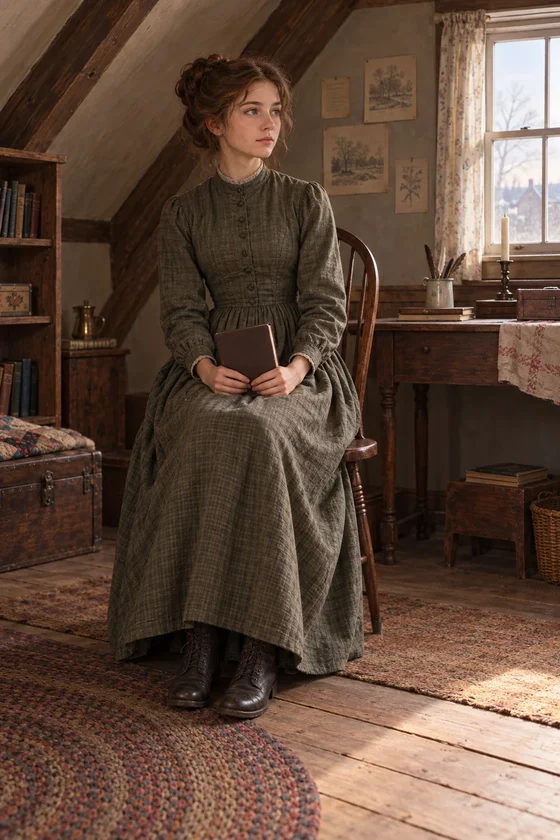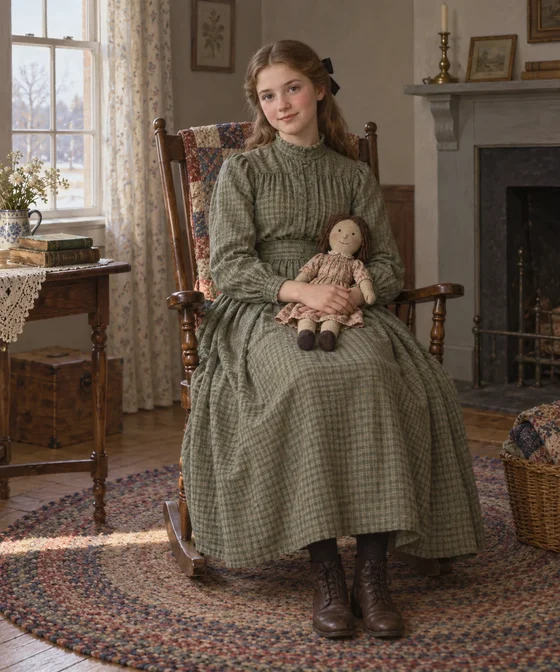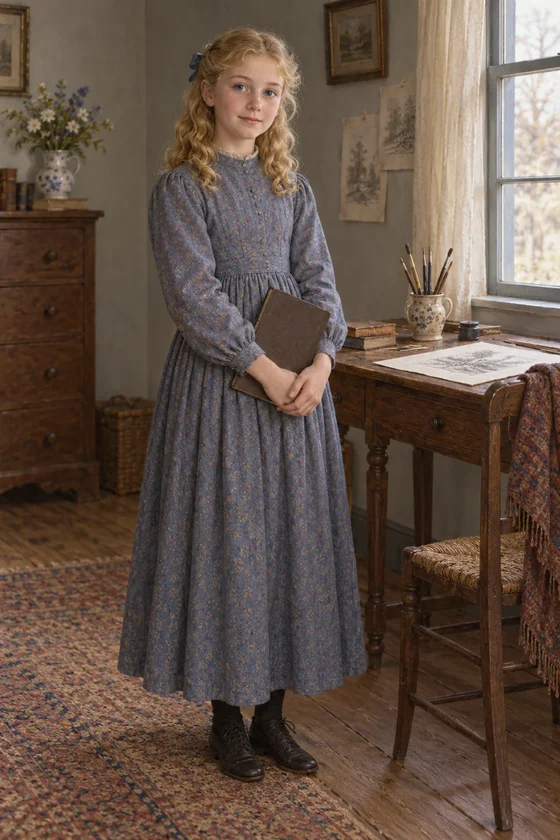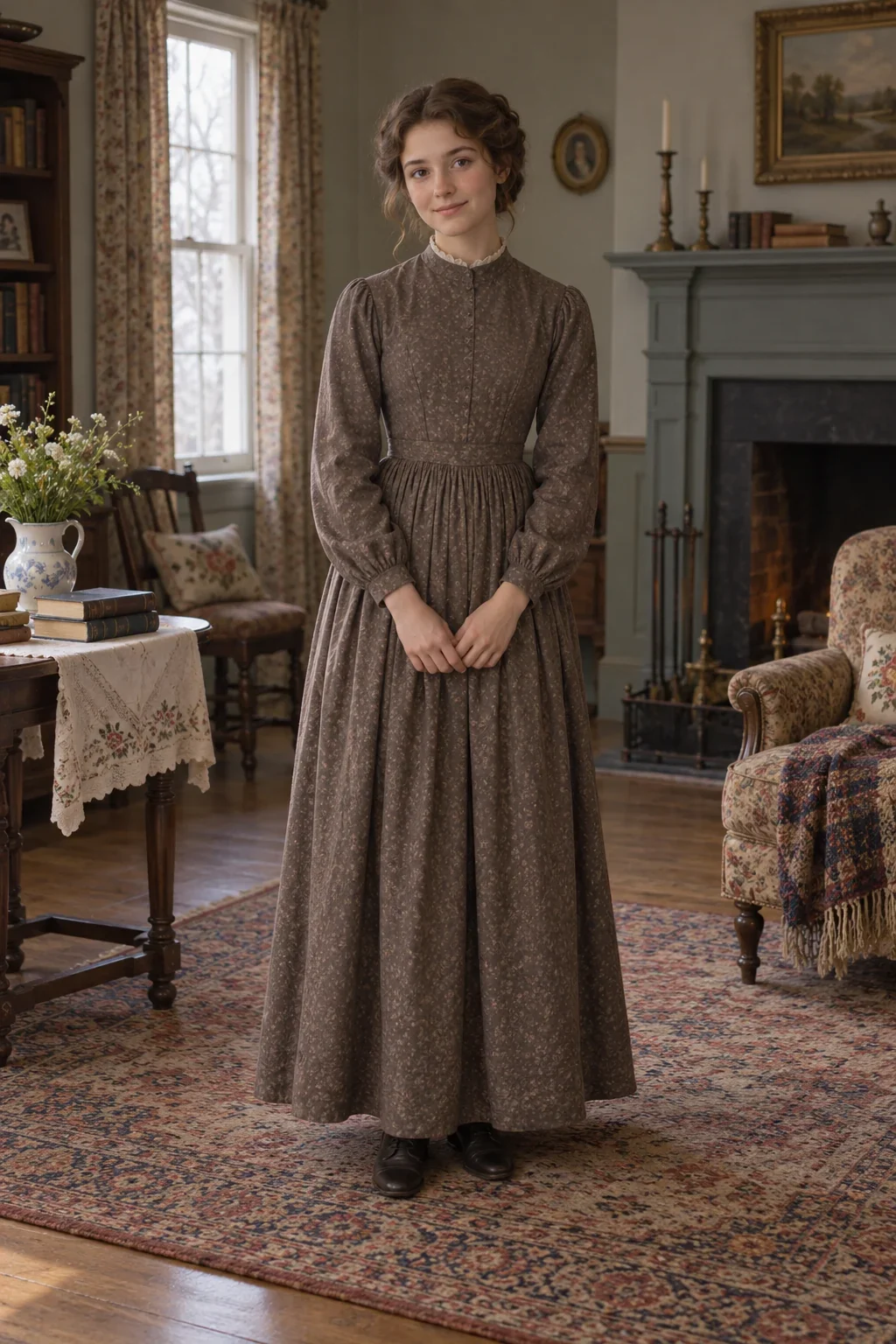
Imagined Meg March in a quiet original-novel portrait.
Unofficial AI interpretation. Meg pauses in the family sitting room. Selected object or posture follows the original novel; exact portrait, unmentioned clothing and scene arrangement are imagined, without an adaptation likeness claim. Full-frame display derivative; no upscaling.
Overview
Meg March is Margaret, the eldest sister in Little Women. At the opening she is sixteen, with soft brown hair, large eyes and an appearance the narration describes as pretty and fair. Her concern for dress and graceful conduct accompanies a wish for a more comfortable life than the family’s present means permit. She works as a governess and helps carry responsibility for younger sisters. Those duties make her more than the household’s conventional beauty. The book places aspirations towards refinement beside the ordinary labour and decisions through which she must determine what kind of adult life she values.
A visit to wealthier acquaintances exposes both the attraction and the discomfort of fashionable society. Meg is dressed and presented in a manner that momentarily separates her from the habits of home. Comments about the March family and Laurie make her aware that admiration can include unwelcome assumptions about marriage and money. Returning to Marmee, she receives advice that does not require pretending she felt no pleasure in the attention. Her experience also differs from Jo’s dislike of conventional feminine expectations. The sisters share affection without expressing identical ambitions, and Meg’s preference for domestic security is not evidence that she lacks judgment or capacity for growth.
John Brooke’s attachment develops through the family’s acquaintance with Laurie and the difficulties surrounding Mr. March’s illness. A missing glove and Laurie’s mischievous letter create awkwardness, but the eventual courtship requires Meg’s own decision. Aunt March’s opposition makes the question of money explicit and strengthens Meg’s determination not to let the aunt dictate her affections. The later wedding is deliberately modest, consistent with the couple’s resources and the values they choose. This is not an account in which a rich suitor removes every practical problem, nor one in which the original story supplies an unexamined command that all women must make Meg’s choice.
Marriage introduces disagreements about expenditure, work and expectations. Meg’s desire for a costly dress fabric and her comparison with wealthier friends produce strain that she has to address honestly with John. Their children, Daisy and Demi, create further demands, and her absorption in care can leave the couple needing to renew their companionship. The narrative gives her mistakes and adjustments rather than ending her character at the wedding. This profile follows both parts of the selected Little Women text and its family conclusion, without importing later sequel events or a fixed adaptation likeness. Meg’s affection, vanity, work and maturing practical sense remain connected elements of the same life, not separate labels that make her simply materialistic or ideally domestic.
First appearances & development
Louisa May Alcott’s Little Women establishes this character through the four March sisters’ work, ambitions, relationships and family changes. This profile follows the selected original narrative and does not combine adaptation continuity with it.
Canon & continuity
Original narrative.
Selected bibliography
Documented works and useful reading. This is not a list of every appearance.
- 01
Little Women
Original.
Family & connections
A source-supported family tree or inspiration record has not yet been compiled for this profile. Related reading below indicates a connection in subject matter, not a proven lineage or creative influence.
References
Sources supporting this profile. Linked pages have their own scope and editorial standards.
- PrimaryLittle WomenResearch access: 2026-10-12
Image credits
Unofficial modern AI interpretationImagined Meg March in a quiet original-novel portrait.
Unofficial AI interpretation. Meg pauses in the family sitting room. Selected object or posture follows the original novel; exact portrait, unmentioned clothing and scene arrangement are imagined, without an adaptation likeness claim. Full-frame display derivative; no upscaling.