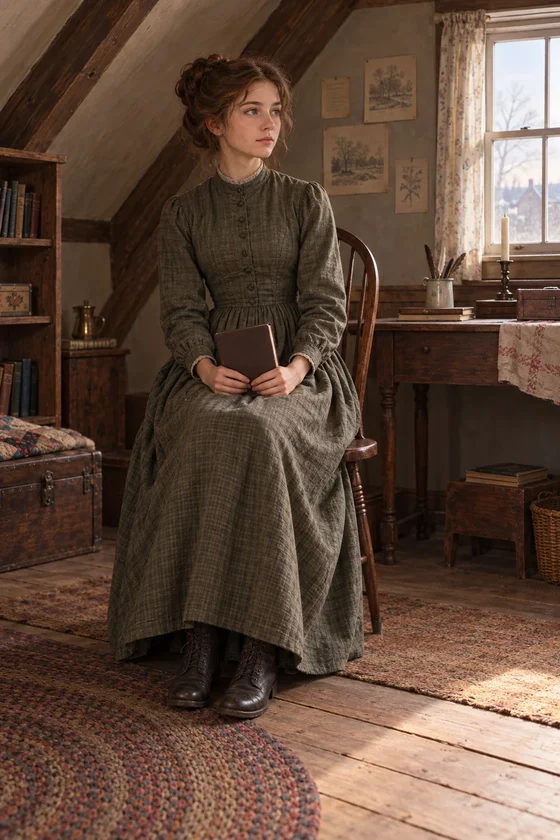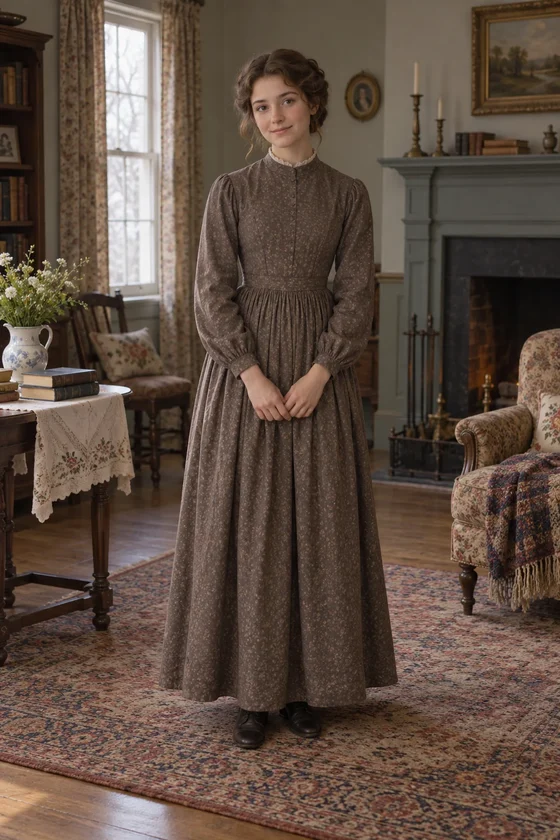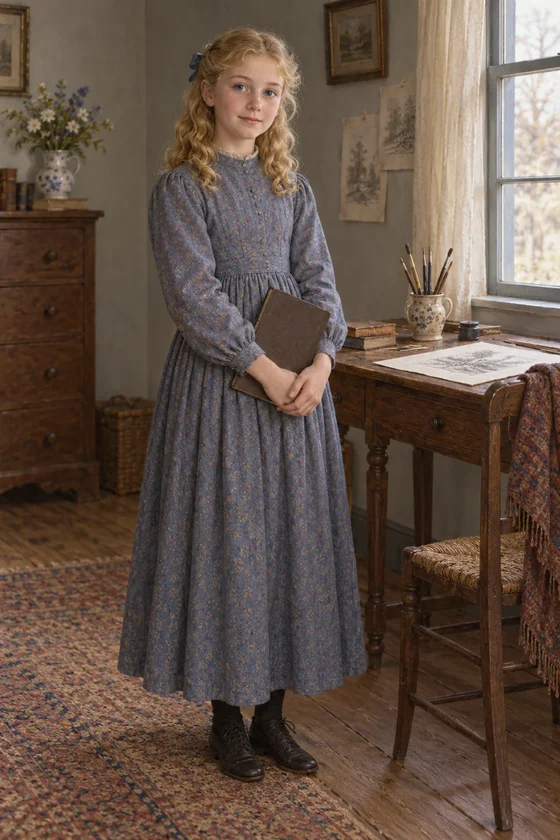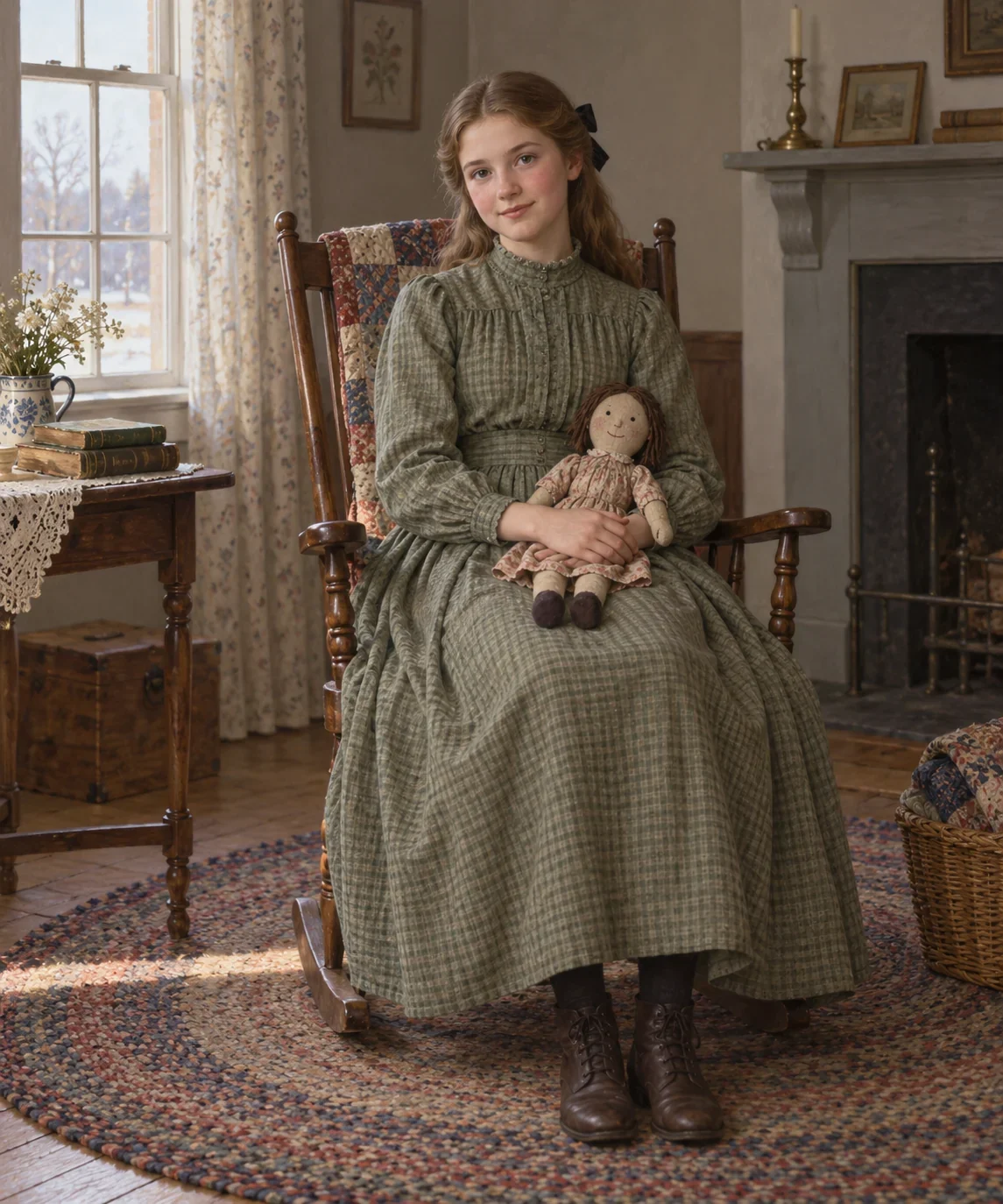
Imagined Beth March in a quiet original-novel portrait.
Unofficial AI interpretation. Beth sits quietly with one of her worn dolls. Selected object or posture follows the original novel; exact portrait, unmentioned clothing and scene arrangement are imagined, without an adaptation likeness claim. Full-frame display derivative; no upscaling.
Overview
Beth March is Elizabeth, the third sister in Little Women. The opening gives her as thirteen, rosy and bright-eyed, with smooth hair, a shy manner and a peaceful expression. Her father’s name for her, Little Miss Tranquility, reflects the family’s understanding of her gentleness. She finds ordinary school attendance so distressing that she studies at home instead. This limited social confidence does not make her idle or without interests. She assists Hannah with household work, continues lessons while her father is away and creates a small imaginative household for the damaged dolls other children have left behind.
Music is a central pleasure, but the Marches’ inadequate piano restricts what she can play. The neighbouring Mr. Laurence offers access to a better instrument in circumstances intended not to frighten her. Her gradual willingness to enter his house changes the relation between the quiet child and the intimidating older neighbour. She makes slippers for him as an expression of gratitude, and his gift of a piano gives her joy beyond what she can readily express. The bond is connected with his memory of his granddaughter, yet Beth remains a distinct child rather than a literal replacement or a supernatural return of the dead girl.
During Marmee’s absence Beth continues visiting the poor Hummel family when others are reluctant to do so. Illness in that household leads to her contracting scarlet fever. The family’s alarm, Jo’s care and Marmee’s return expose how much its ordinary happiness depends on the sister whose work is easy to overlook. Beth survives the immediate crisis, but the later part of the selected book shows that her former strength has not fully returned. Her quietness should not be used to minimise that suffering or to turn her service into a general instruction that children must risk infection to demonstrate kindness.
As her health declines further, Beth understands more of the situation than Jo initially wishes to accept. Their time together by the sea and the conversation about her secret bring fear, love and preparation into the same relationship. Her death affects Jo’s work and the whole family’s understanding of loss. The narrative values a life whose influence is largely domestic and personal, without supplying a future marriage or a hidden public career. This profile follows Parts One and Two of the retained Little Women text, preserving the distinction between survival of the first illness and the later decline. It does not invent a modern medical diagnosis beyond the illness named in the narrative, reproduce a death scene as a portrait or treat adaptation imagery as evidence of her exact face and clothing.
First appearances & development
Louisa May Alcott’s Little Women establishes this character through the four March sisters’ work, ambitions, relationships and family changes. This profile follows the selected original narrative and does not combine adaptation continuity with it.
Canon & continuity
Original narrative.
Selected bibliography
Documented works and useful reading. This is not a list of every appearance.
- 01
Little Women
Original.
Family & connections
A source-supported family tree or inspiration record has not yet been compiled for this profile. Related reading below indicates a connection in subject matter, not a proven lineage or creative influence.
References
Sources supporting this profile. Linked pages have their own scope and editorial standards.
- PrimaryLittle WomenResearch access: 2026-10-12
Image credits
Unofficial modern AI interpretationImagined Beth March in a quiet original-novel portrait.
Unofficial AI interpretation. Beth sits quietly with one of her worn dolls. Selected object or posture follows the original novel; exact portrait, unmentioned clothing and scene arrangement are imagined, without an adaptation likeness claim. Full-frame display derivative; no upscaling.