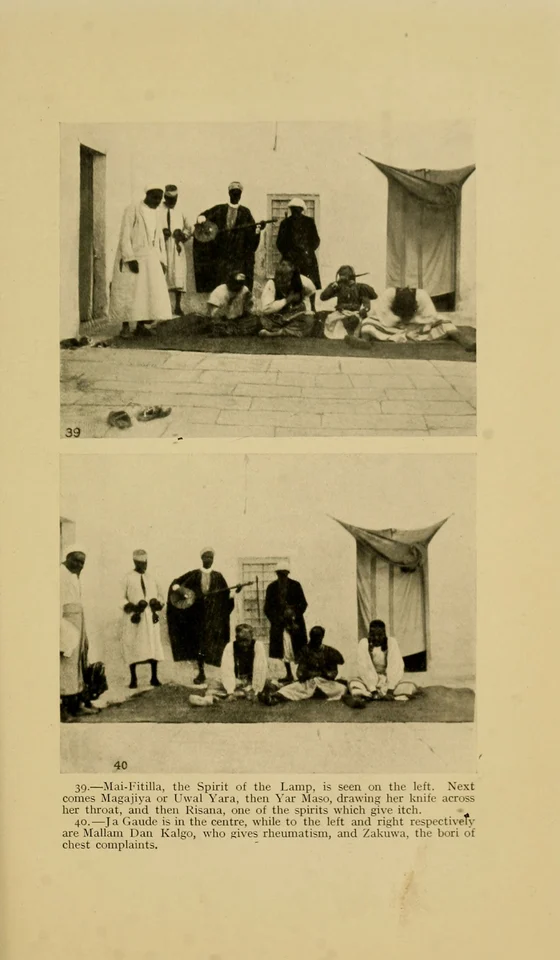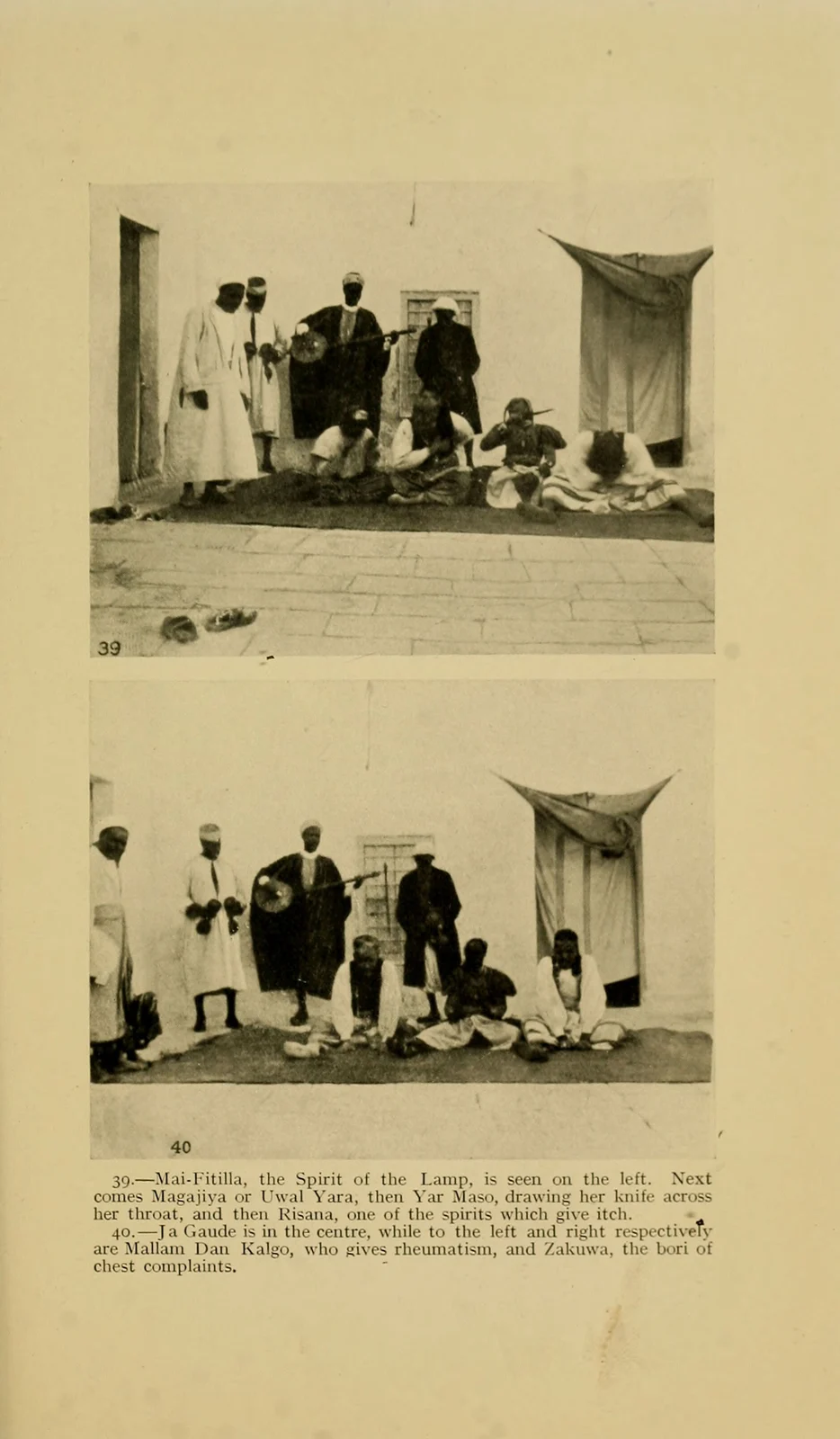
Mallam Dan Kalgo represented at the left of photograph40, 1914
The lower photograph40 identifies Mallam Dan Kalgo at the left of the seated foreground group, beside Ja Gaude. The photograph records the represented role through a human participant; the original caption’s illness claims remain historical attributions.
Overview
Mallam Dan Kalgo is described as another youthful spirit. Tremearne’s account attributes aching limb bones to him, with rheumatism and internal pain suggested uncertainly by the collector. The performance begins with prayer. His representative then alternates foot positions and raises and drops a hand as if riding among enemies and stabbing them.
He later sits, strikes the lower back and stomach, falls to the ground, pushes up on his elbows and drops to one side. The song calls him a chief’s son and husband of ten, explained in the text as four wives and six concubines, and celebrates a pilgrimage accomplished in a day. Other lines describe exhausting kitchen work by enslaved people. Those social claims belong to the recorded praise and its explanations, rather than a biographical record of an independently identified human man.
Origins & earliest records
A. J. N. Tremearne reports interviews and ritual performances during four months in North Africa, alongside comparisons to Nigeria. His foreword credits local assistance and photography but these passages do not identify an individual speaker for every statement.
Records & interpretation
The Ban of the Bori, chapters XXI–XXII, complete selected account pp. 308–309; foreword pp. 13–14 and catalog publication date checked.
Selected bibliography
Documented works and useful reading. This is not a list of every appearance.
- 01
The Ban of the Bori: Demons and Demon-Dancing in West and North Africa
Chapters XXI–XXII, pp. 308–309; role descriptions, performed representation and attributed explanations.
Family & connections
A source-supported family tree or inspiration record has not yet been compiled for this profile. Related reading below indicates a connection in subject matter, not a proven lineage or creative influence.
References
Sources supporting this profile. Linked pages have their own scope and editorial standards.
- Digitized historical ethnographic account with interviews and performance descriptionsTremearne — Mallam Dan KalgoResearch access: 2026-10-05
- Library catalog metadataInternet Archive catalog — The Ban of the BoriResearch access: 2026-10-05
Image credits
Historical ritual performance photographMallam Dan Kalgo represented at the left of photograph40, 1914
The lower photograph40 identifies Mallam Dan Kalgo at the left of the seated foreground group, beside Ja Gaude. The photograph records the represented role through a human participant; the original caption’s illness claims remain historical attributions.