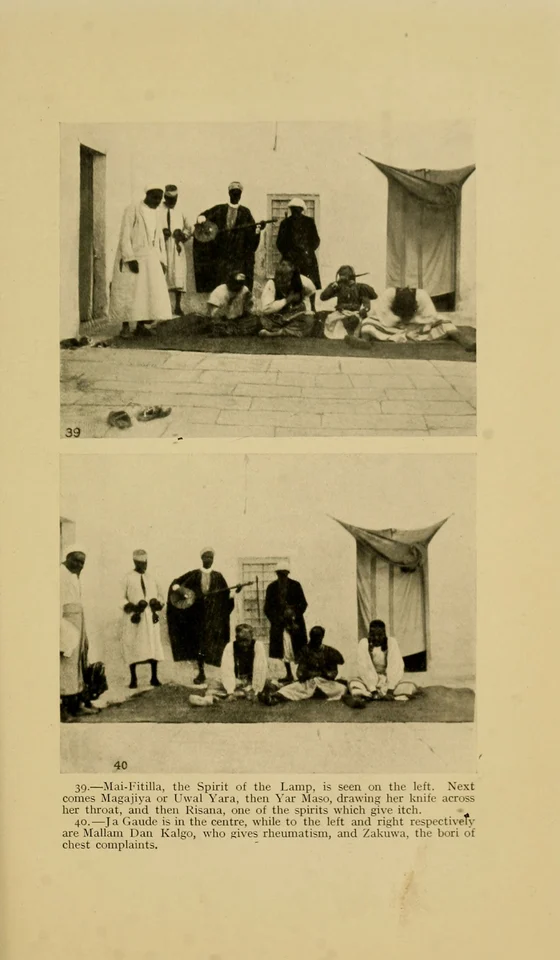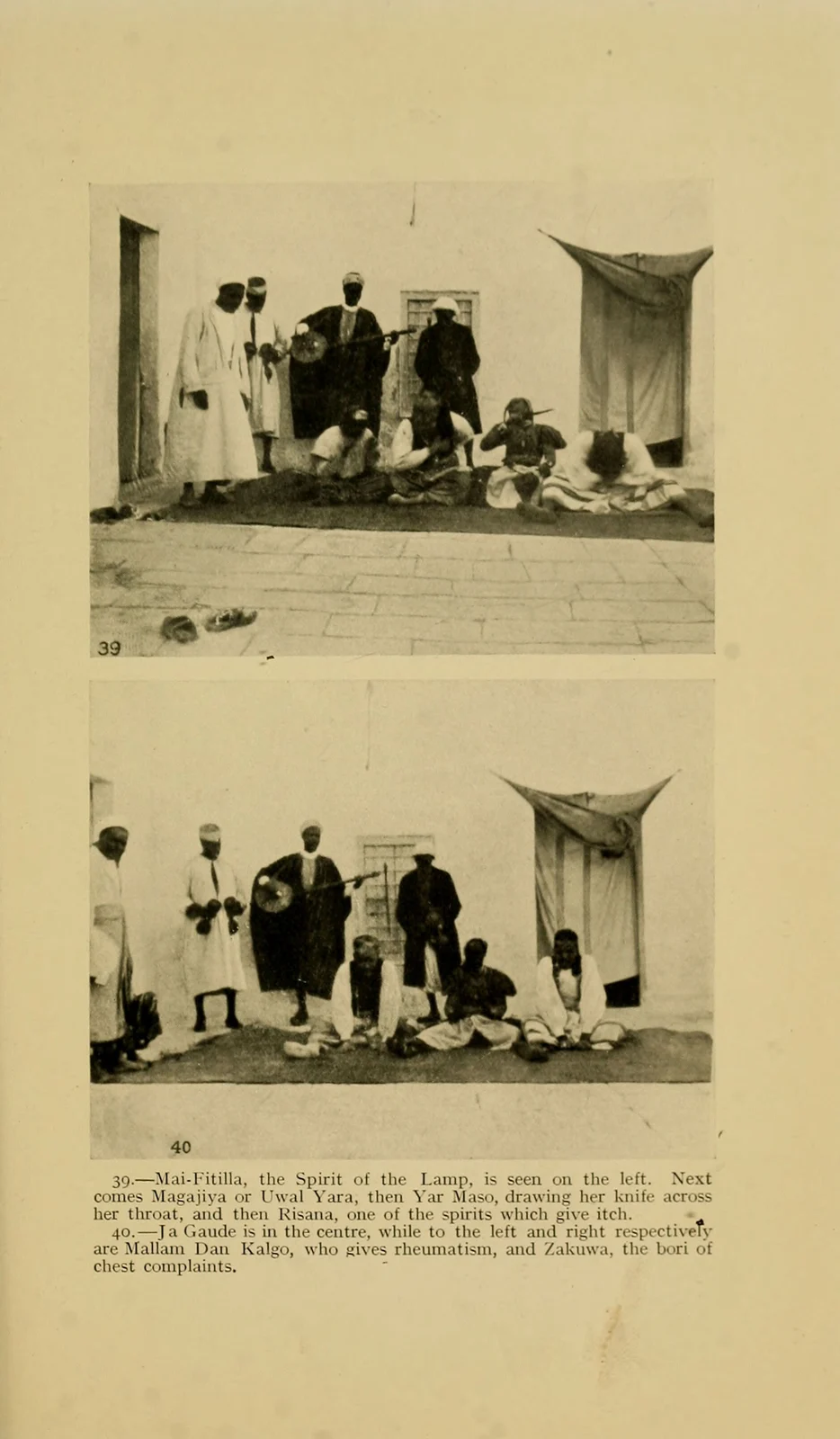
Ja Gaude represented by the central seated participant in photograph40, 1914
The lower photograph40 explicitly identifies Ja Gaude in the centre of the seated foreground group. Musicians stand behind the performers. This is a human ritual representation, not a creature portrait or evidence of literal spirit anatomy.
Overview
Ja Gaude’s relationships are reported inconsistently. One speaker calls him Yerima’s elder brother, while the general account makes him a relative of Ba-Toye; he is also a friend of Duwatsu and Dan Kalgo. Tremearne notes similarities with the fire spirit Ba-Toye but also records that Ja Gaude is said not to be connected with fire. His suggestion of a former counterpart is an interpretation, not a settled identity.
The representative moves around the ring, raises and lowers alternating hands and moves the feet as though climbing. He roars and is supposed to jump forty times, compared with three for other spirits, to display strength. The song combines laughter, threatening expression and cattle-related imagery. Chest complaints are attributed to him, but the collector’s pneumonia-after-burning gloss remains uncertain. The performance supports the climbing and forceful character more directly than a literal flame body.
Origins & earliest records
A. J. N. Tremearne reports interviews and ritual performances during four months in North Africa, alongside comparisons to Nigeria. His foreword credits local assistance and photography but these passages do not identify an individual speaker for every statement.
Records & interpretation
The Ban of the Bori, chapters XXI–XXII, complete selected account pp. 314–315; foreword pp. 13–14 and catalog publication date checked.
Selected bibliography
Documented works and useful reading. This is not a list of every appearance.
- 01
The Ban of the Bori: Demons and Demon-Dancing in West and North Africa
Chapters XXI–XXII, pp. 314–315; role descriptions, performed representation and attributed explanations.
Family & connections
A source-supported family tree or inspiration record has not yet been compiled for this profile. Related reading below indicates a connection in subject matter, not a proven lineage or creative influence.
References
Sources supporting this profile. Linked pages have their own scope and editorial standards.
- Digitized historical ethnographic account with interviews and performance descriptionsTremearne — Ja GaudeResearch access: 2026-10-05
- Library catalog metadataInternet Archive catalog — The Ban of the BoriResearch access: 2026-10-05
Image credits
Historical ritual performance photographJa Gaude represented by the central seated participant in photograph40, 1914
The lower photograph40 explicitly identifies Ja Gaude in the centre of the seated foreground group. Musicians stand behind the performers. This is a human ritual representation, not a creature portrait or evidence of literal spirit anatomy.