A sourced illustration has not yet been added. This gap is included in the coverage record.
Overview
Mallam Ali Geshe is also called Sarikin Fushi, Sarikin Diya, Sidi Ali, Zakuwa and Gadanga. In this account he is Nana Magajiya’s husband and Haukachi’s father, and both cousin and brother-in-law to Yerima. Zakuwa, Lion, is explained through his ferocity; the text does not narrate an animal transformation. Tremearne explicitly says that the Tunisian King of Wrath here is not a bee.
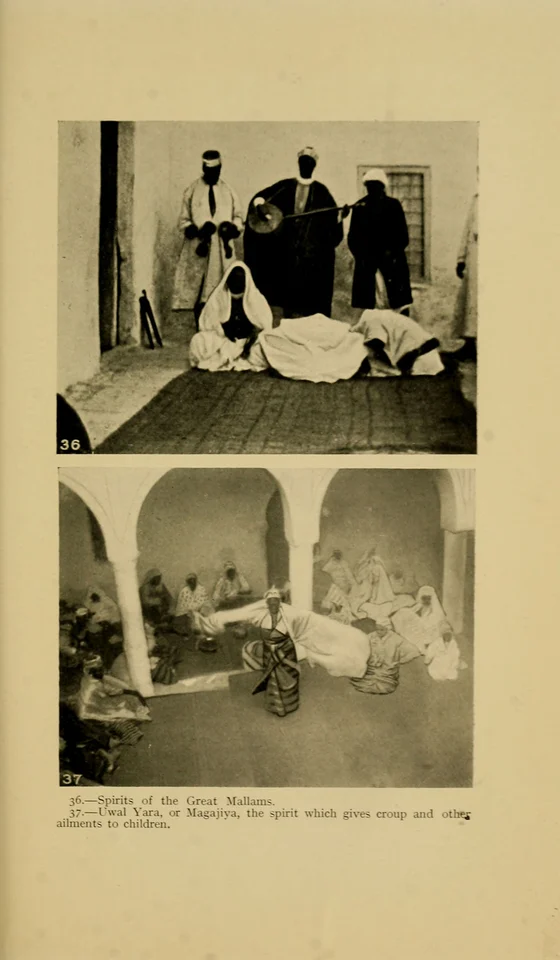
The report associates him with chest complaints and jealous violence involving his human representative and her husband. In the dance, prayer is followed by threefold blows against shoulders, hips and chest, rushing toward a wall and falling onto the chest and shoulders. Songs address his powerful roar and special drum but also refer to the hurt female dancer. The collector describes a woman taking this role in Tunis and connects the spirit’s unpopularity with the harshness attributed to him. These are located performance and possession accounts, not an instruction to reproduce dangerous actions.
Origins & earliest records
A. J. N. Tremearne reports interviews and ritual performances during four months in North Africa, alongside comparisons to Nigeria. His foreword credits local assistance and photography but these passages do not identify an individual speaker for every statement.
Records & interpretation
The Ban of the Bori, chapters XXI–XXII, complete selected account pp. 306–307; foreword pp. 13–14 and catalog publication date checked.
Selected bibliography
Documented works and useful reading. This is not a list of every appearance.
- 01
The Ban of the Bori: Demons and Demon-Dancing in West and North Africa
Chapters XXI–XXII, pp. 306–307; role descriptions, performed representation and attributed explanations.
Family, evolution & connections
Haukachi’s explicitly named parents
Selected named notices in Tremearne’s 1914 historical Bori account, pp. 301–302, 306–307.
Scroll sideways to see all branches. With a keyboard, focus the tree and use the arrow keys.
- Nana Magajiya + Mallam Ali Geshe (two stated parents)
The mother notice names her only child; the Geshe notice independently calls him Haukachi’s father. Joint root groups two parents. Other children she nursed are not added as births. Yerima’s protective care does not make him another biological parent. This is source-specific religious genealogy, not biological descent or universal contemporary doctrine.
Haukachi
The Geshe entry expressly calls him Haukachi’s father, alongside his marriage to Nana Magajiya. The song’s Lion epithet expresses ferocity; this family statement does not make Haukachi a literal lion descendant.
Yerima
The Geshe notice calls him both cousin and brother-in-law to Yerima. It supplies no exact cousin degree or shared ancestor, so neither is invented from the affinal relationship.
Kaura (Tremearne’s Bori youth notice)
Kaura’s notice calls Geshe his foster-father. His birth-father identifications elsewhere are not replaced by this household relationship; lion-associated performance does not establish literal animal descent.
References
Sources supporting this profile. Linked pages have their own scope and editorial standards.
- Digitized historical ethnographic account with interviews and performance descriptionsTremearne — Mallam Ali GesheResearch access: 2026-10-05
- Library catalog metadataInternet Archive catalog — The Ban of the BoriResearch access: 2026-10-05
Image credits
A sourced illustration has not yet been added. This gap is included in the coverage record.