Makara
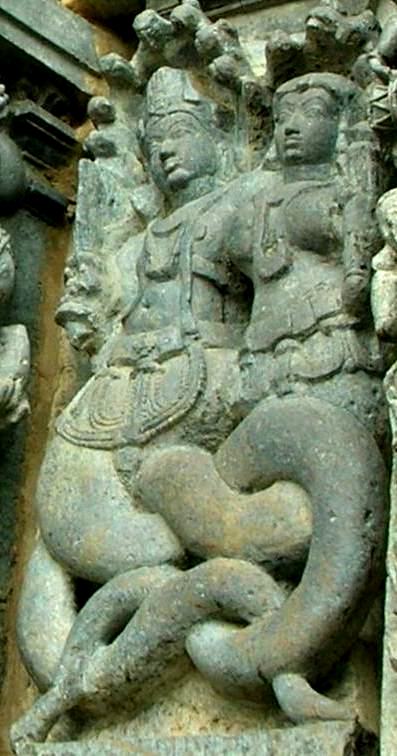
Image associated with the exact linked encyclopedia article; consult credited file description for its interpretation.
Overview
Makara is a composite aquatic being in Hindu and Buddhist art. The Rubin Museum describes a crocodile-like form associated with rivers and lakes, appearing as a divine mount and as ornament around gateways or throne arches. Features and uses vary among the represented regional traditions.
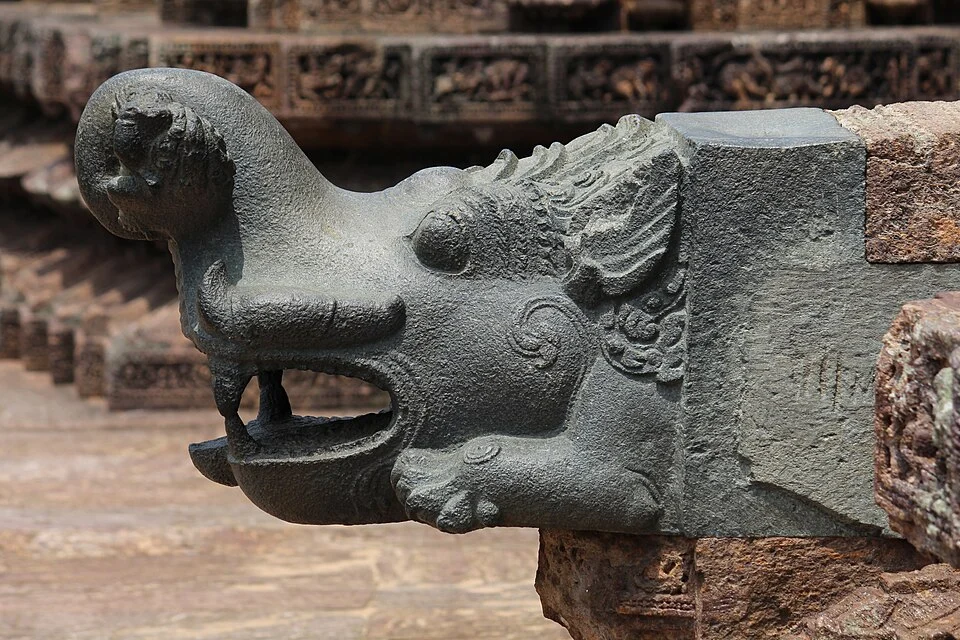
The Metropolitan Museum’s Javanese witness is an andesite water spout dated about the tenth century, 40.3 centimetres high and 35.2 centimetres wide. Its catalogue places it in the Central or Eastern Javanese period. This material object documents one architectural representation, while the separately identified Nepalese pitcher supplies a later regional treatment.
The Rubin Museum’s account supplies a more specific Newar treatment: the aquatic form has teeth and a curling snout compared with an elephant’s trunk, and is associated with rain clouds. On the discussed nineteenth-century Nepalese metal pitcher, makaras flank Durga, while a further makara shape forms the spout. Their water association thus operates through both the vessel’s function and its religious decoration.
Origins & earliest records
South and Southeast Asian religious visual traditions; identified Javanese and Nepalese object witnesses.
Records & interpretation
Actual Met catalogue and Rubin custodial account read, with object dates and regional treatments distinguished.
Selected bibliography
Documented works and useful reading. This is not a list of every appearance.
- 01
Water Spout in the Form of a Makara
Met object 1983.511.3; catalogue date, not first attestation of the supernatural category.
- 02
Pitcher: Vessels as Containers of Potential
Makara terminology and nineteenth-century Nepalese pitcher discussion
Family & connections
A source-supported family tree or inspiration record has not yet been compiled for this profile. Related reading below indicates a connection in subject matter, not a proven lineage or creative influence.
Primary records and illustrations
Water Spout in the Form of a Makara
Metropolitan Museum of Art, Indonesia (Java), ca. 10th century. Museum object 1983.511.3
Institutional object record and public-domain photograph directly inspected. Date, material, accession and subject identification come from the museum, not an inferred historical story.
The Rubin Museum’s account supplies a more specific Newar treatment: the aquatic form has teeth and a curling snout compared with an elephant’s trunk, and is associated with rain clouds. On the discussed nineteenth-century Nepalese metal pitcher, makaras flank Durga, while a further makara shape forms the spout. Their water association thus operates through both the vessel’s function and its religious decoration.
Encyclopedia background
An additional attributed reference, separate from the editorial profile above.
Read the open encyclopedia overview
Makara (Sanskrit: मकर, romanized: Makara) is a legendary sea-creature in Hindu mythology. In Hindu astrology, Makara is equivalent to the Zodiac sign Capricorn.
Makara appears as the vahana (vehicle) of the river goddess Ganga, Narmada, and of the god of the ocean, Varuna. Makara are considered guardians of gateways and thresholds, protecting throne rooms as well as entryways to temples; it is the most commonly recurring creature in Hindu and Buddhist temple iconography, and also frequently appears as a gargoyle or as a spout attached to a natural spring. Makara-shaped earrings called Makarakundalas are sometimes worn by Hindu deities, for example Shiva, Vishnu, Surya, and Chandi. Makara is also the insignia of the love god Kamadeva, who has no dedicated temples and is also known as Makaradhvaja, "one whose flag depicts a makara".
Text from Wikipedia contributors, “Makara”. CC BY-SA 4.0. Extracted introduction; formatting changed. Retrieved 5 October 2026. The source article may have changed since retrieval.
References
Sources supporting this profile. Linked pages have their own scope and editorial standards.
- Museum / primary objectWater Spout in the Form of a MakaraResearch access: 2026-10-05
- Secondary referenceMakara — contextual bibliographyResearch access: 2026-10-05
- Museum accountPitcher: Vessels as Containers of PotentialResearch access: 2026-10-05
Image credits
Reference illustrationMakara
Image associated with the exact linked encyclopedia article; consult credited file description for its interpretation.