
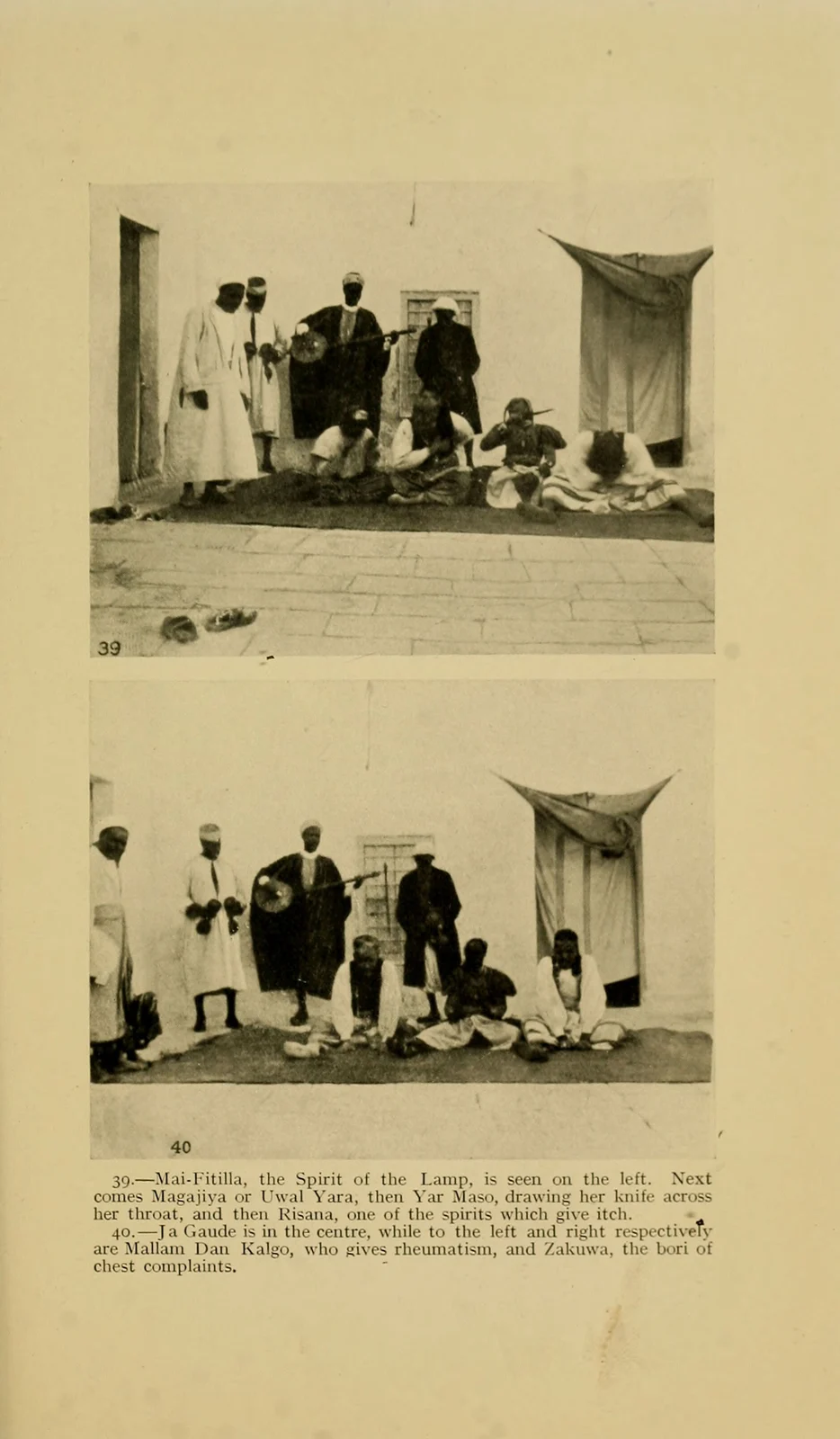
Mai-Fitilla represented by the left seated participant in photograph39, 1914
The upper photograph39 identifies Mai-Fitilla at the left of the seated foreground group. The participant raises the hands toward the mouth in the lamp spirit’s performance. This records human enactment, not a visible flame-bodied spirit.
Overview
Mai-Fitilla, the One with the Lamp, is one of Yerima’s wives. The account assigns her supervision of fires and lights in Jan Gari and oversight of spirit children and servants doing household work. Her possession is associated in the report with a victim’s turned eyes and collapse; at the dance she is said to seize the souls of Yerima’s human partners.
Tremearne describes the representative as supposedly eating fire when an oil-soaked burning string is brought to the mouth without an apparent burn. The speech announces the lamp and fire-eating role. Her song praises a wealthy woman of Medina through scent and kola-nuts and uses a she-elephant comparison. The author warns that she is sometimes confused with Nana Medina because their songs coincide, but distinguishes their attributes. This profile retains the fire and household role without converting the praise animal into a literal body.
Origins & earliest records
A. J. N. Tremearne reports interviews and ritual performances during four months in North Africa, alongside comparisons to Nigeria. His foreword credits local assistance and photography but these passages do not identify an individual speaker for every statement.
Records & interpretation
The Ban of the Bori, chapters XXI–XXII, complete selected account pp. 313–314; foreword pp. 13–14 and catalog publication date checked.
Selected bibliography
Documented works and useful reading. This is not a list of every appearance.
- 01
The Ban of the Bori: Demons and Demon-Dancing in West and North Africa
Chapters XXI–XXII, pp. 313–314; role descriptions, performed representation and attributed explanations.
Family & connections
A source-supported family tree or inspiration record has not yet been compiled for this profile. Related reading below indicates a connection in subject matter, not a proven lineage or creative influence.
References
Sources supporting this profile. Linked pages have their own scope and editorial standards.
- Digitized historical ethnographic account with interviews and performance descriptionsTremearne — Mai-FitillaResearch access: 2026-10-05
- Library catalog metadataInternet Archive catalog — The Ban of the BoriResearch access: 2026-10-05
Image credits
Historical ritual performance photographMai-Fitilla represented by the left seated participant in photograph39, 1914
The upper photograph39 identifies Mai-Fitilla at the left of the seated foreground group. The participant raises the hands toward the mouth in the lamp spirit’s performance. This records human enactment, not a visible flame-bodied spirit.