A sourced illustration has not yet been added. This gap is included in the coverage record.
Overview
Leland’s opening three episodes call Rabbit Mahtigwess and give Ableegumooch as the Mi’kmaq name. He repeatedly invites a host to dine after seeing how easily that animal obtains food. Trying to imitate Otter’s winter fishing nearly drowns him; copying the Woodpecker girls leaves his head injured; attempting Bear’s inexhaustible bodily provision wounds him again. In each episode the original host supplies the food Rabbit cannot obtain, while his grandmother recognizes the familiar pattern.
The following pursuit comes principally from Tomah Josephs’s Passamaquoddy telling of 2 September 1882. Here Rabbit develops magic and repeatedly conceals himself as an apparently hospitable elder. The pursuing wildcat wakes from shelter, meals and comfortable bedding to discover cold ground and broken twigs. Later Rabbit appears as a chief, wounds the guest during a performance and returns as a deceptive doctor. The final refuge is an illusory ship: night-hawks’ cries supply an apparent gun volley, and the wildcat abandons the chase.
Leland inserts the doctor’s explanations for his rabbit-like nose and feet from an Abenaki version told by Josep Cappino, a St Francis narrator, to Miss Alger. His source note also distinguishes an Otter-related accusation in Mi’kmaq material from the Passamaquoddy pursuit. A separate wedding episode makes Rabbit lose his long tail rescuing an older man, split his lip while helping the bride and briefly gain her as a wife before she leaves with Mikumwess. These are adjacent tellings assembled into a sequence, rather than an unqualified single biography.
Origins & earliest records
The first three chapters are identified as Mi’kmaq; the long wildcat pursuit is explicitly Josephs’s 1882 telling with an acknowledged Cappino/Alger insertion. The wedding chapter is labelled Passamaquoddy but supplies no individual narrator. Leland’s broad ancestry claims and comparisons with Manobozho are not treated as proof of identity.
Records & interpretation
Complete selected narrative and attached source notes were inspected. Leland’s editorial comparisons and theories remain separate from the narrated actions.
In the literature
“turned, tail and swam ashore into the dark old forest”
Master Rabbit IV. Relating how the Rabbit became Wise by being Original ...; complete long chase/all notes · Leland English collected retelling; specific credits retained
Rabbit develops his own magic, creating successive lodging, village and doctor illusions to foil Wild Cat. The pursuer becomes colder and wounded. A ship illusion and night-hawk cries mistaken for gunfire finally drive him into the woods; death is not narrated. Mi’kmaq fish-theft motivation and Passamaquoddy denial are kept as alternatives, alongside an Abenaki Sabbath opening.
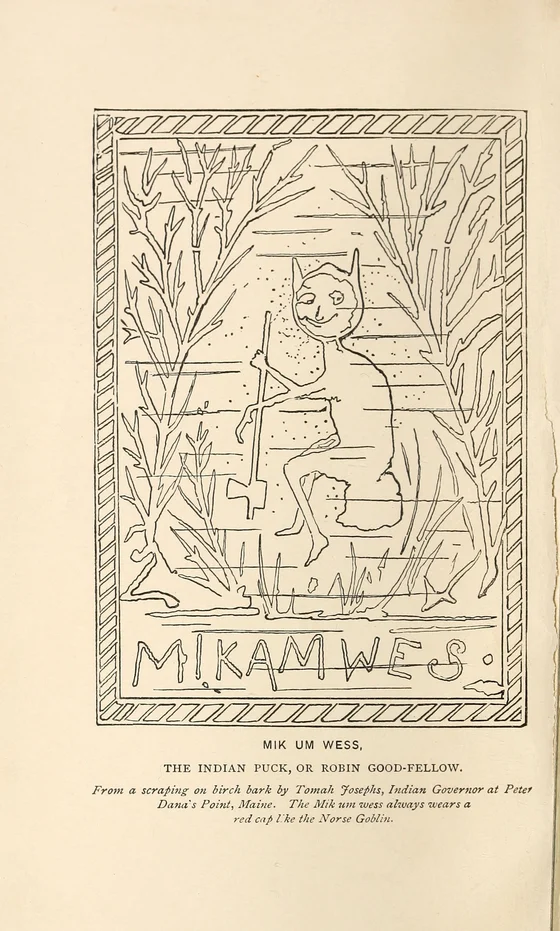
“until she ran away with Mikumwess”
Master Rabbit V. How Master Rabbit went to a Wedding and won the Bride; complete episode · Leland English collected retelling; specific credits retained
Rabbit rescues an old man but loses his long tail and acquires a slender waist. At the man’s wedding his assistance to the bride splits his lip. The bride dances with him, and the old husband departs. She lives with Rabbit temporarily, then runs away with the Mikumwess she originally loved; Rabbit’s marriage is not the final outcome.
Selected bibliography
Documented works and useful reading. This is not a list of every appearance.
- 01
The Algonquin Legends of New England
Master Rabbit chapters I–V; complete selected episodes and source notes.
- 02
The Algonquin Legends of New England — Master Rabbit I. How Master Rabbit sought to rival Keeoony, the Otter
Original work1884; Gutenberg6803 selected transcription, exact source print impression/pages unidentified. Full Preface and Authorities independently read.
Family & connections
A source-supported family tree or inspiration record has not yet been compiled for this profile. Related reading below indicates a connection in subject matter, not a proven lineage or creative influence.
Located primary passages
Specific passages supporting details in this entry, grouped by their published witness.
The Algonquin Legends of New England
Original work1884; Gutenberg6803 selected transcription, exact source print impression/pages unidentified. Full Preface and Authorities independently read.
- Rabbit imitates Otter’s fishing after being fed. He nearly drowns and needs grandmother’s care. Otter supplies fish but leaves without eating because of the imitation.
Master Rabbit I. How Master Rabbit sought to rival Keeoony, the Otter; complete episode
- Woodpecker girls feed Rabbit with tree insects. His imitation wounds his head and fails; a guest supplies their meal. Red headwear reflects bird identity, without a successful Rabbit transformation.
Master Rabbit II. How Mahtigwess ... dined with the Woodpecker Girls; complete episode/all notes
- Bear produces meat from his foot. Rabbit imitates and injures himself without providing dinner. Bear feeds the household and Rabbit takes many days to recover. Rand’s paw-sucking explanation belongs to a footnote.
Master Rabbit III. Of the Adventure with Mooin, the Bear; complete episode/all notes
- Rabbit develops his own magic, creating successive lodging, village and doctor illusions to foil Wild Cat. The pursuer becomes colder and wounded. A ship illusion and night-hawk cries mistaken for gunfire finally drive him into the woods; death is not narrated. Mi’kmaq fish-theft motivation and Passamaquoddy denial are kept as alternatives, alongside an Abenaki Sabbath opening.
- Rabbit rescues an old man but loses his long tail and acquires a slender waist. At the man’s wedding his assistance to the bride splits his lip. The bride dances with him, and the old husband departs. She lives with Rabbit temporarily, then runs away with the Mikumwess she originally loved; Rabbit’s marriage is not the final outcome.
Master Rabbit V. How Master Rabbit went to a Wedding and won the Bride; complete episode
No whole collection, separately recorded oral transcript or separately cited manuscript/comparative edition inspected. Variant/narrator distinctions preserved; no earliest/diffusion/treatment proof claimed.
References
Sources supporting this profile. Linked pages have their own scope and editorial standards.
- Primary textLeland 1884: Master Rabbit chapters I–VResearch access: 2026-10-05
Image credits
A sourced illustration has not yet been added. This gap is included in the coverage record.