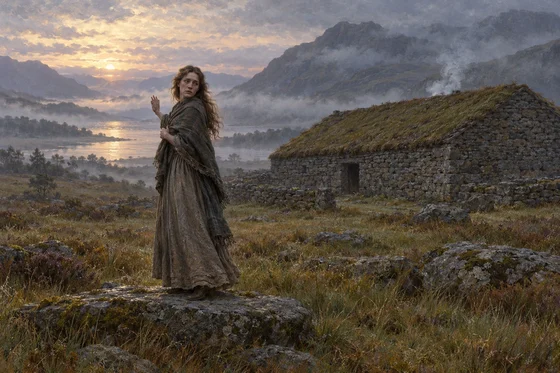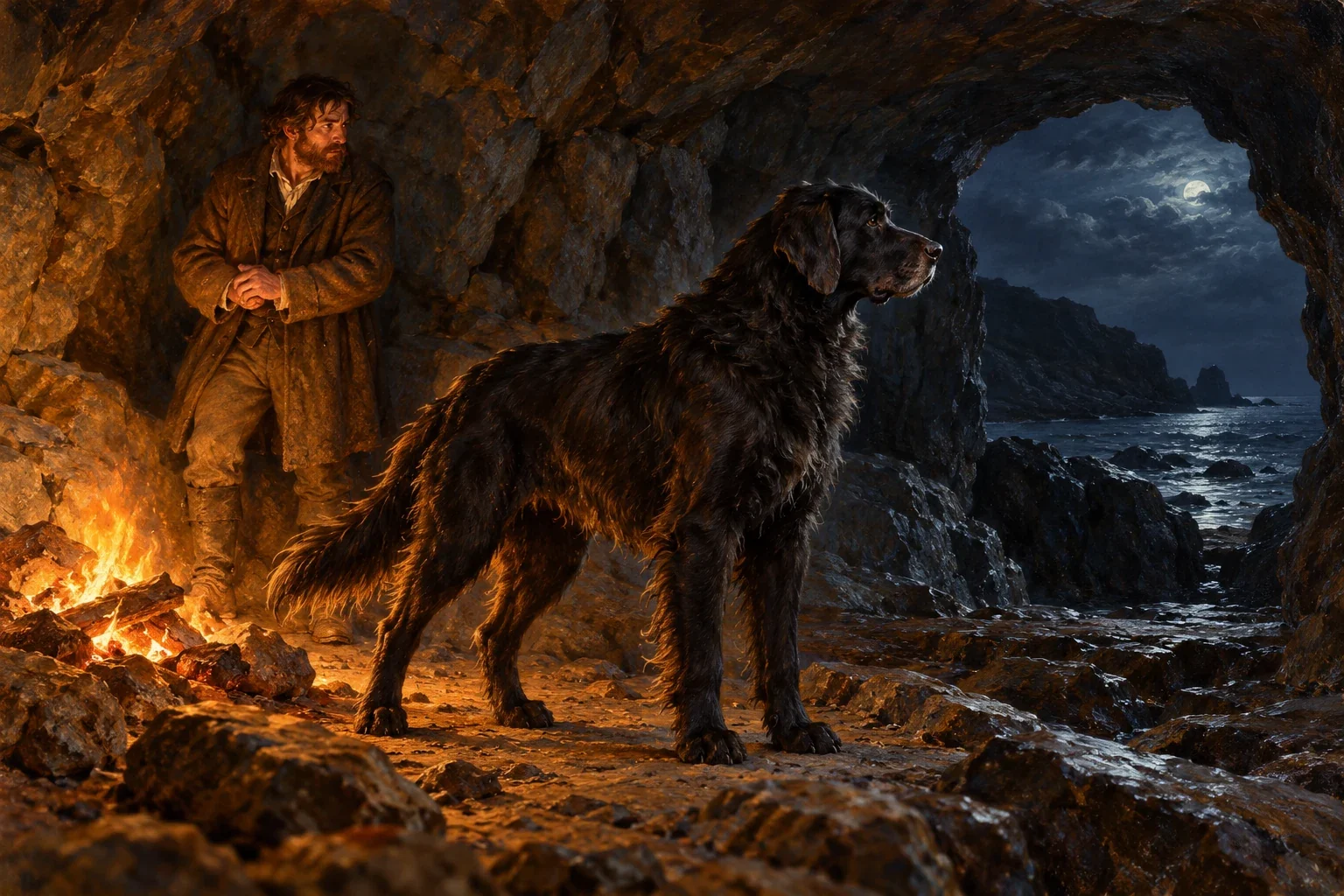
AI-generated interpretation of Macphie’s Black Dog guarding the cave in Campbell’s principal telling. The large black hound and protective role follow the source; breed-like appearance, coat texture, eyes, exact cave, costume and quiet staging are artistic choices. No identified surviving cave or historical portrait is represented.
AI-generated interpretation of Macphie’s Black Dog guarding the cave in Campbell’s principal telling. The large black hound and protective role follow the source; breed-like appearance, coat texture, eyes, exact cave, costume and quiet staging are artistic choices. No identified surviving cave or historical portrait is represented.
Overview
Macphie’s Black Dog is a powerful helper whose usefulness is promised for only one day in Campbell’s Highland account. The principal telling is attributed to Donald Cameron of Ruaig, Tiree, dictated in Gaelic in 1863. It first establishes Macphie’s familiarity with the fairy world: he recognises a woman who alternates with the appearance of a stag and helps drive her away from the lord of Moidart. Later, while returning home after hunting on Colonsay, he finds a lighted dwelling and insists on receiving a particularly beautiful black pup. The grey-headed owner yields, but warns that it will serve him for one day only.
The pup grows exceptionally large and handsome yet refuses ordinary hunting. Visitors urge Macphie to kill an animal that seems useless, but he waits for its day to come. Twice bad weather prevents a party of hunters crossing to Jura. On the third attempt the dog springs into the boat without being called. Macphie and sixteen young men lodge in the Big Cave. After the others wish their sweethearts were present, sixteen women enter. Darkness falls, and the men become silent. When a woman appears ready to attack Macphie, the dog drives the visitors out.
A huge hand then reaches through a hole in the cave roof. The dog attacks the arm, severs it and pursues the unseen assailant outside. At dawn it returns, lies at Macphie’s feet and dies. All his companions are dead. He takes the hand home as evidence within the story and arranges for the bodies to be recovered. The promised service is thus fulfilled through one night’s defence at the cost of the animal’s life; the account does not make the dog itself the killer of the party.
Campbell supplies several different tellings rather than one consistent sequel. In one, the dog and a pursuing mermaid kill each other. Another has the dog return dangerously transformed after fighting a banshi, and Macphie shoots it; note 41 warns that modern articles can appear anachronistically in old tales. A further version ends with the dog disappearing after saving a smaller hunting party. In the last, a fairy woman gives the dog to a shipwrecked Macphie, and it pursues attacking women while he escapes; its fiery return ends when he cuts off its head. These deaths, disappearances and different party sizes remain alternatives, not successive adventures of one animal.
The collector connects the black dog’s expected day with a proverb about a despised helper eventually proving useful. He also discusses a related Elle-woman story and a possible association with historical Macphies of Colonsay, but offers a conjecture about the romance’s central figure rather than a verified biography of this supernatural owner. The selected witness preserves the complete principal narrative and its comparative endings without assigning a breed, green coat or fixed anatomy from other fairy-hound traditions.
Origins & earliest records
John Gregorson Campbell, Superstitions of the Highlands and Islands of Scotland, Glasgow: James MacLehose and Sons, 1900. Macphie’s Black Dog, pp 109–122; complete collector framing, principal telling, comparative versions and note 41.
Records & interpretation
Complete selected unit, all appended versions and attached apparatus. Collection title and editorial framing retained.
Selected bibliography
Documented works and useful reading. This is not a list of every appearance.
- 01
Superstitions of the Highlands and Islands of Scotland
Macphie’s Black Dog, pp 109–122; complete collector framing, principal telling, comparative versions and note 41.
Family & connections
A source-supported family tree or inspiration record has not yet been compiled for this profile. Related reading below indicates a connection in subject matter, not a proven lineage or creative influence.
References
Sources supporting this profile. Linked pages have their own scope and editorial standards.
- Historical primary folklore collectionCampbell1900 — complete selected account and apparatusResearch access: 2026-10-27
Image credits
AI-generated illustrationAI-generated interpretation of Macphie’s Black Dog guarding the cave in Campbell’s principal telling. The large black hound and protective role follow the source; breed-like appearance, coat texture, eyes, exact cave, costume and quiet staging are artistic choices. No identified surviving cave or historical portrait is represented.
AI-generated interpretation of Macphie’s Black Dog guarding the cave in Campbell’s principal telling. The large black hound and protective role follow the source; breed-like appearance, coat texture, eyes, exact cave, costume and quiet staging are artistic choices. No identified surviving cave or historical portrait is represented.