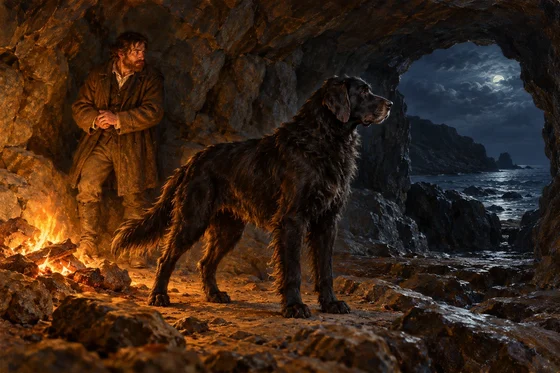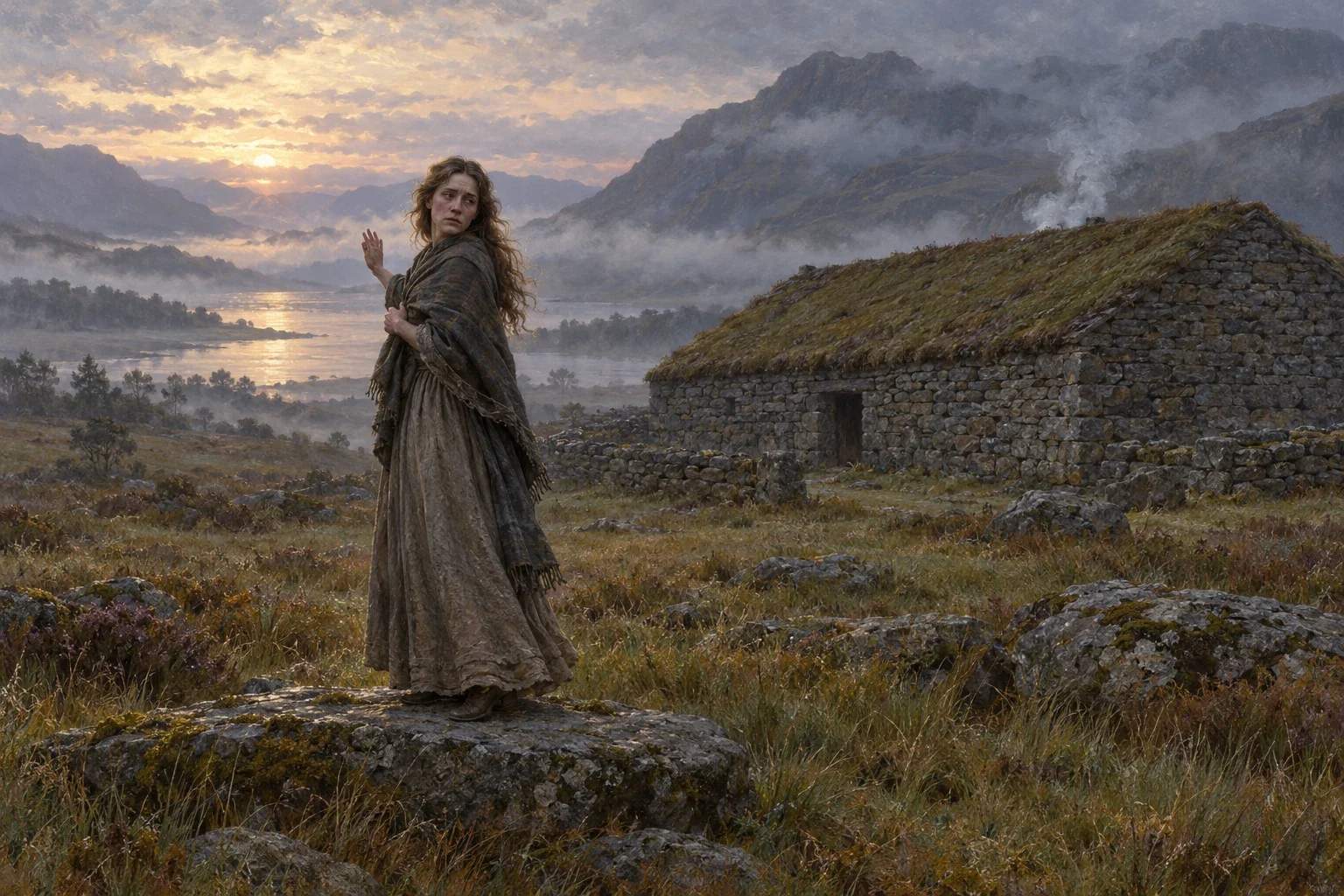
AI-generated interpretation of the Glaistig beside the completed building in the Lianachan account. Her exact appearance, dress, raised-hand pose, barn design and landscape are imaginative. The disputed green-flame ending is not depicted or generalized, and this is not an ethnographic reconstruction or image of an inherited illness.
AI-generated interpretation of the Glaistig beside the completed building in the Lianachan account. Her exact appearance, dress, raised-hand pose, barn design and landscape are imaginative. The disputed green-flame ending is not depicted or generalized, and this is not an ethnographic reconstruction or image of an inherited illness.
Overview
The Glaistig of Lianachan is a supernatural woman compelled to build for the man who captures her. Campbell first gives a concise prose account: a strong man called Kennedy or MacCuaric meets her while returning from setting a salmon net, locks his arms around her and refuses to release her until she builds a substantial barn. She completes it in one night. At parting she combines blessing and curse: his family will grow like rushes but wither like ferns. The narrator describes children reaching impressive growth and then declining prematurely; this is the legend’s explanation, not a medical history.
Campbell then translates a fuller, slightly different verse version from An Duanaire, page 123. Here MacCuaric is riding home from the smithy and binds the woman before him on his horse with the wizard belt of Fillan. She first offers cattle and good fortune, which he dismisses as insufficient. She then promises a strong house protected against fire, water, weapons, raiders and fairy harm. Her cry summons helpers, who pass stones from the shore and cut the necessary wood. By grey dawn the roof is turfed and smoke rises from the finished building.
The man keeps an iron coulter in the fire for protection. Once released, the Glaistig offers her hand through the window with the concealed intention of drawing him to the fairy dwelling. Her palm sticks to the hot iron instead. From a stone outside she curses his descendants, then speaks of her pain and leaps away in green flame over a peak. That spectacular departure belongs to the verse, not to the brief prose account or a universal Glaistig appearance.
The attached notes are consequential. Note 50 connects the man’s two names with a clan head-dress; it does not establish two separate captors. Note 51 questions whether the verse’s final lines indicate a modern composition rather than popular tradition, adding the collector’s view that Highland supernatural beings do not depart in flame. The account therefore retains two mediated forms of one local legend and Campbell’s doubt about the second form. Its anonymous poem is not presented as a directly verified Gaelic transcript or as evidence for an actual inherited illness.
Origins & earliest records
John Gregorson Campbell, Superstitions of the Highlands and Islands of Scotland, Glasgow: James MacLehose and Sons, 1900. At Lianachan, pp 168–171; complete prose and fuller translated verse, notes 50–51. Underlying An Duanaire not independently collated.
Records & interpretation
Complete selected unit, all appended versions and attached apparatus. Collection title and editorial framing retained.
Selected bibliography
Documented works and useful reading. This is not a list of every appearance.
- 01
Superstitions of the Highlands and Islands of Scotland
At Lianachan, pp 168–171; complete prose and fuller translated verse, notes 50–51. Underlying An Duanaire not independently collated.
Family & connections
A source-supported family tree or inspiration record has not yet been compiled for this profile. Related reading below indicates a connection in subject matter, not a proven lineage or creative influence.
References
Sources supporting this profile. Linked pages have their own scope and editorial standards.
- Historical primary folklore collectionCampbell1900 — complete selected account and apparatusResearch access: 2026-10-27
Image credits
AI-generated illustrationAI-generated interpretation of the Glaistig beside the completed building in the Lianachan account. Her exact appearance, dress, raised-hand pose, barn design and landscape are imaginative. The disputed green-flame ending is not depicted or generalized, and this is not an ethnographic reconstruction or image of an inherited illness.
AI-generated interpretation of the Glaistig beside the completed building in the Lianachan account. Her exact appearance, dress, raised-hand pose, barn design and landscape are imaginative. The disputed green-flame ending is not depicted or generalized, and this is not an ethnographic reconstruction or image of an inherited illness.