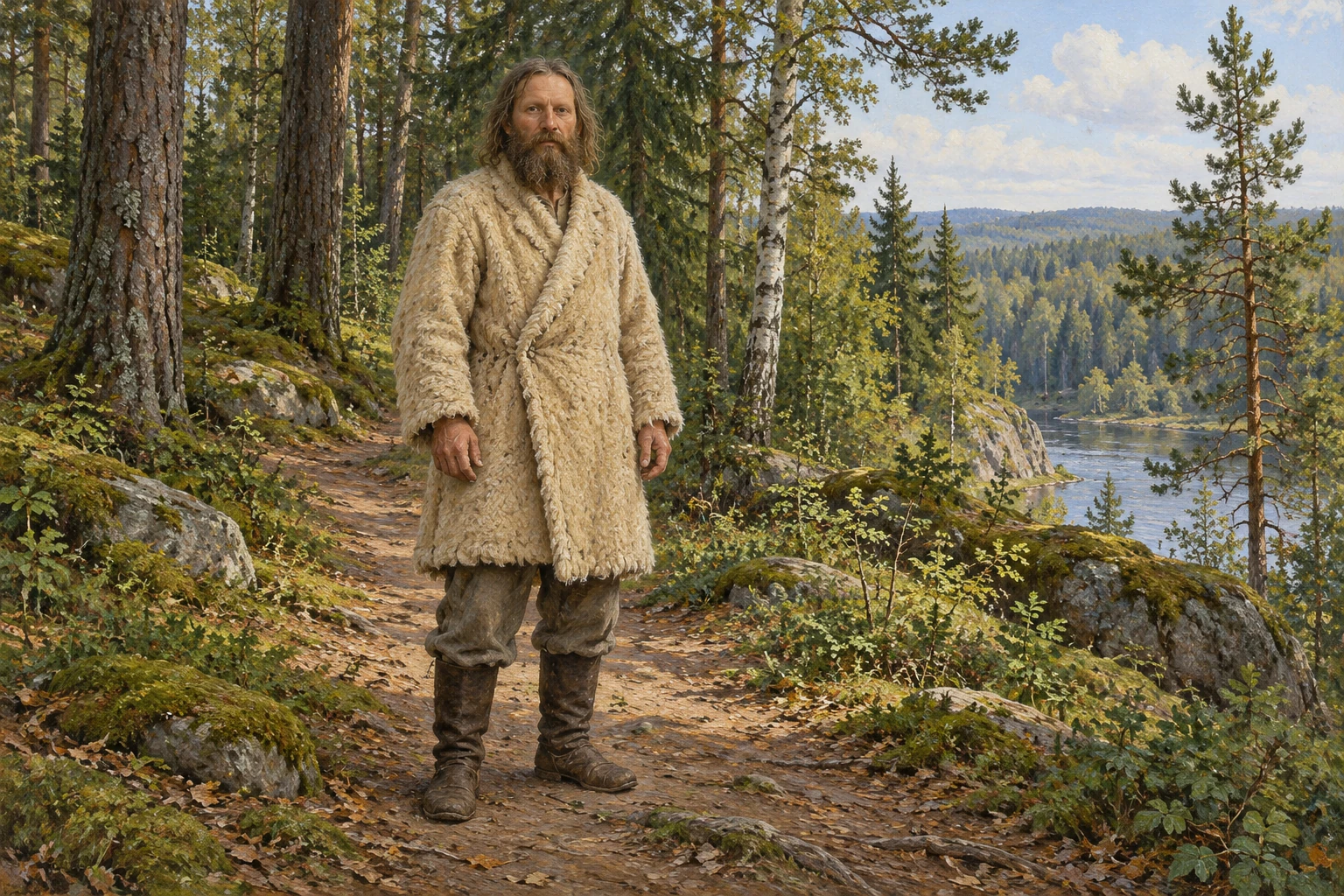
AI-generated interpretation of the human peasant guise in Ralston’s 1872 Lyeshy discussion. The ungirdled sheepskin and bare brow follow that reported guise; face, hair, beard, clothing colours, trousers, boots, pose, trees, riverside setting and lighting are imagined. Other reported forms are not combined here, and no authentic regional costume or historical portrait is claimed.
One reported guise in a nineteenth-century English compilation, not a universal Leshy appearance or a recreation of the Witcher design.
Overview
Ralston’s 1872 discussion gathers contrasting Lyeshy reports rather than describing one fixed woodland creature. Its opening gives the forest spirit changes of shape and size, from taller than the trees to smaller than grass. A peasant guise wears an ungirdled sheepskin with its left skirt over the right. Other descriptions lack eyebrows and eyelashes, sometimes give a single eye, or present a horned, shaggy figure with goatlike feet and clawed fingers. Ralston compares that last form with medieval devil imagery. These are reported alternatives, not features that must all appear together.
The account locates differences in particular regions. In the Kief and Chernigof governments it distinguishes ashy woodland giants from cornfield beings whose height follows the crop and its remaining stubble. Reports from Olonetsk and Archangel concern relations with cattle keepers, while the account labelled Little-Russian makes the spirit a protector of wolves. Ralston also describes forest animals as the Lyeshy’s flocks. A report attached to squirrel migrations in 1843 explains them as the transfer of animals lost in a wager between spirits; it is a recorded explanation, not a zoological finding.
An Archangel story has two Lyeshies defeat and bind a third in a dispute over forest rights. A merchant frees the captive, who rewards him with a whirlwind journey home and later assistance. Elsewhere the spirit drives an unwanted visitor from a woodland hut through wind, noise and shaking trees. Hunters seek favour with food, tobacco or a share of their quarry. The discussion therefore includes bargaining, protection, gratitude and hostility, rather than making every encounter an unprovoked attack.
The traveller’s danger often comes from deception. The spirit imitates animal calls, laughter, crying or groaning; an apparent echo can lead a listener toward dangerous ground. It may change landmarks, resemble a familiar tree, or appear as another traveller and leave its companion in a swamp or ravine. Ralston records reversed shoe linings and inside-out clothing as responses to bewilderment. His further account of bread and salt left after a woodland illness describes a reported ritual and expectation of cure, not a demonstrated medical remedy.
The closing pages also describe female forest beings and households. In one Little-Russian story a woman covers a crying forest baby with her cloak. Its mother rewards her with coals that become gold. Other reports give Lyeshies human wives and associate their wedding processions with storms, damaged buildings and fallen trees. These family accounts and the merchant’s rescue distinguish this discussion from Ralston’s separate Russian Fairy Tales narrative in which a hunter kills an abductor and rescues a missing woman.
Origins & earliest records
W. R. S. Ralston, The Songs of the Russian People, as Illustrative of Slavonic Mythology and Russian Social Life. London: Ellis & Green, 1872, pp. 153–160.
Records & interpretation
Complete bounded Lyeshy discussion read from its opening on p.153 through its final marriage-and-bath report on p.160. Pages 153–154 also visually inspected in the original scan. No full-book or original-language field-record reading claimed.
Selected bibliography
Documented works and useful reading. This is not a list of every appearance.
- 01
The Songs of the Russian People, as Illustrative of Slavonic Mythology and Russian Social Life
Complete Lyeshy discussion pp. 153–160; preceding Vodyany and following Storyland Beings excluded.
Family, evolution & connections
Leshen (The Witcher)
Ralston’s 1872 woodland-spirit discussion is an additional historical Leshy witness for the existing Leshen comparison family. This records a folklore comparison; it does not identify a book used by the Witcher creators or transfer the game creature’s anatomy into the historical account.
Leshy
Ralston’s 1872 Songs discussion assembles regional forest-spirit reports, including the freed captive’s gratitude, misleading voices and a forest mother’s reward. It provides a distinct historical treatment beside the existing Leshy entry; reported alternatives are not combined into one fixed creature.
References
Sources supporting this profile. Linked pages have their own scope and editorial standards.
- Historical English folklore discussionRalston, The Songs of the Russian People (1872), Lyeshy discussion, pp.153–160Research access: 2026-10-25
Image credits
Modern interpretation of one reported woodland-spirit guiseAI-generated interpretation of the human peasant guise in Ralston’s 1872 Lyeshy discussion. The ungirdled sheepskin and bare brow follow that reported guise; face, hair, beard, clothing colours, trousers, boots, pose, trees, riverside setting and lighting are imagined. Other reported forms are not combined here, and no authentic regional costume or historical portrait is claimed.
One reported guise in a nineteenth-century English compilation, not a universal Leshy appearance or a recreation of the Witcher design.