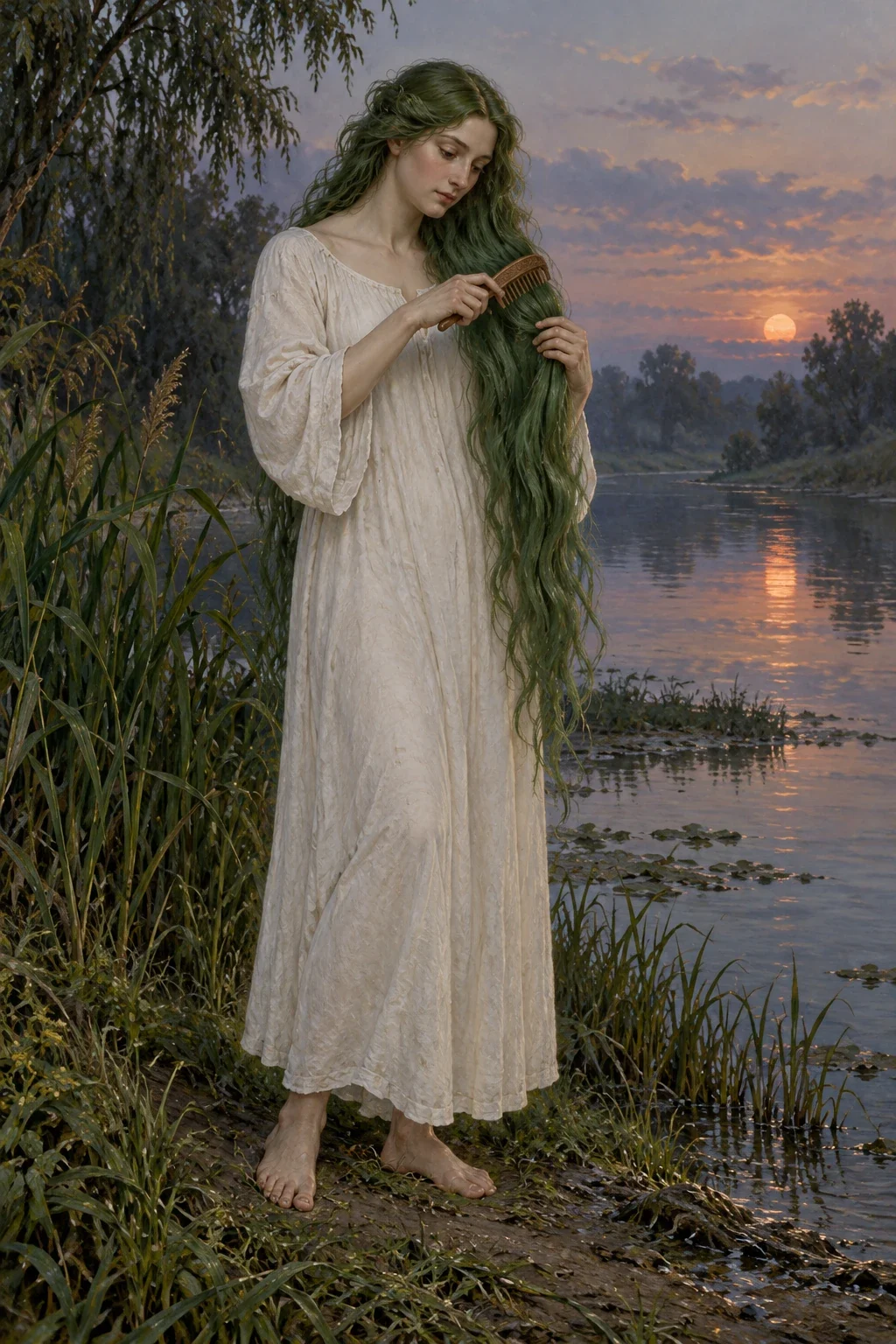
AI-generated imagined adult Rusalka in the green-haired, white-shift form described by Ralston. The setting and individual face are imagined; this is neither his little-Rusalkas passage nor the contrasting Saratof form.
Imagined adult Rusalka in the green-haired, white-shift form described by Ralston. The setting and individual face are imagined; this is neither his little-Rusalkas passage nor the contrasting Saratof form. Artistic interpretation, not a verified portrait, specimen or game artwork.
Overview
Ralston’s 1872 discussion presents Rusalkas as female water spirits, then follows their activities beyond the riverbank into woods and fields. His opening description gives them long green hair and either leaves or a loose white shift without a girdle. They comb their hair on the banks or cling to mill-wheels. The account also makes them dangerous: people drawn into their company may be tickled to death, strangled or drowned. These are beliefs reported in a historical compilation, not observations of actual beings.
Their appearances and occupations vary with place and season. Ralston describes requests for linen, gifts of garments and thread hung on trees, and restrictions on washing, sewing or related work during the period around Whitsuntide. He reports dancing that leaves richer circles of grass, encounters with shepherds playing music, and activity among standing grain. The discussion includes ceremonies for expelling them: a straw figure is carried with song and dance, attacked or defended by the participants, then torn apart or cast into water in different versions. The seasonal practices are not reduced to one universal rite.
A distinct passage concerns little Rusalkas appearing as seven-year-old girls. Ralston reports that these are thought to be ghosts of stillborn children or children who died before baptism. Adult Rusalkas may steal such children after death and carry them to watery dwellings. For seven successive Whitsuntides, the souls ask to be christened. A person who pronounces the baptismal formula, or an annually performed religious service, can release the soul; otherwise it joins the Rusalkas permanently after the stated period. The account also mentions children cursed before baptism and other dead who lacked Christian burial. These categories remain attributed to the selected passage rather than becoming a rule about every Slavic spirit.
The same discussion records a striking regional contrast. In the Saratof area, Rusalkas are described as hairy, humpbacked and clawed, carrying an iron hook. Other passages associate them with questions, riddles and wandering lights near graves or marshes. The contrast prevents the opening beautiful maiden from becoming compulsory anatomy. Ralston’s connections with western fairies and his proposed name derivations are his comparative interpretations. This profile preserves his particular nineteenth-century compilation and its named regional differences without treating it as a single timeless account shared by all Russian, Ukrainian, Belarusian or other Slavic traditions.
Origins & earliest records
W. R. S. Ralston, The Songs of the Russian People, as Illustrative of Slavonic Mythology and Russian Social Life, London: Ellis & Green, 1872, pp.139–146.
Records & interpretation
Complete selected Rusalkas discussion and its footnotes read in the retained 1872 scan, from its introduction on p.139 to the transition to Servian Vilas on p.146. No complete-book or original-language field-collection reading is claimed.
Selected bibliography
Documented works and useful reading. This is not a list of every appearance.
- 01
The Songs of the Russian People, as Illustrative of Slavonic Mythology and Russian Social Life
Complete Rusalkas discussion, pp.139–146; subsequent Vila, Poludnitsa and Vodyany discussions excluded.
Family, evolution & connections
Botchling (The Witcher)
Ralston’s pp.144–145 describe little Rusalkas as dead children whose souls may be released through baptismal words or religious service. This is a limited dead-child-spirit comparison; no Polish poroniec identity, shared anatomy, identical rite or creator-source route is established.
References
Sources supporting this profile. Linked pages have their own scope and editorial standards.
- Historical English folklore discussionRalston, The Songs of the Russian People (1872), Rusalkas discussion, pp.139–146Research access: 2026-10-24
Image credits
AI-generated source-specific cultural interpretationAI-generated imagined adult Rusalka in the green-haired, white-shift form described by Ralston. The setting and individual face are imagined; this is neither his little-Rusalkas passage nor the contrasting Saratof form.
Imagined adult Rusalka in the green-haired, white-shift form described by Ralston. The setting and individual face are imagined; this is neither his little-Rusalkas passage nor the contrasting Saratof form. Artistic interpretation, not a verified portrait, specimen or game artwork.