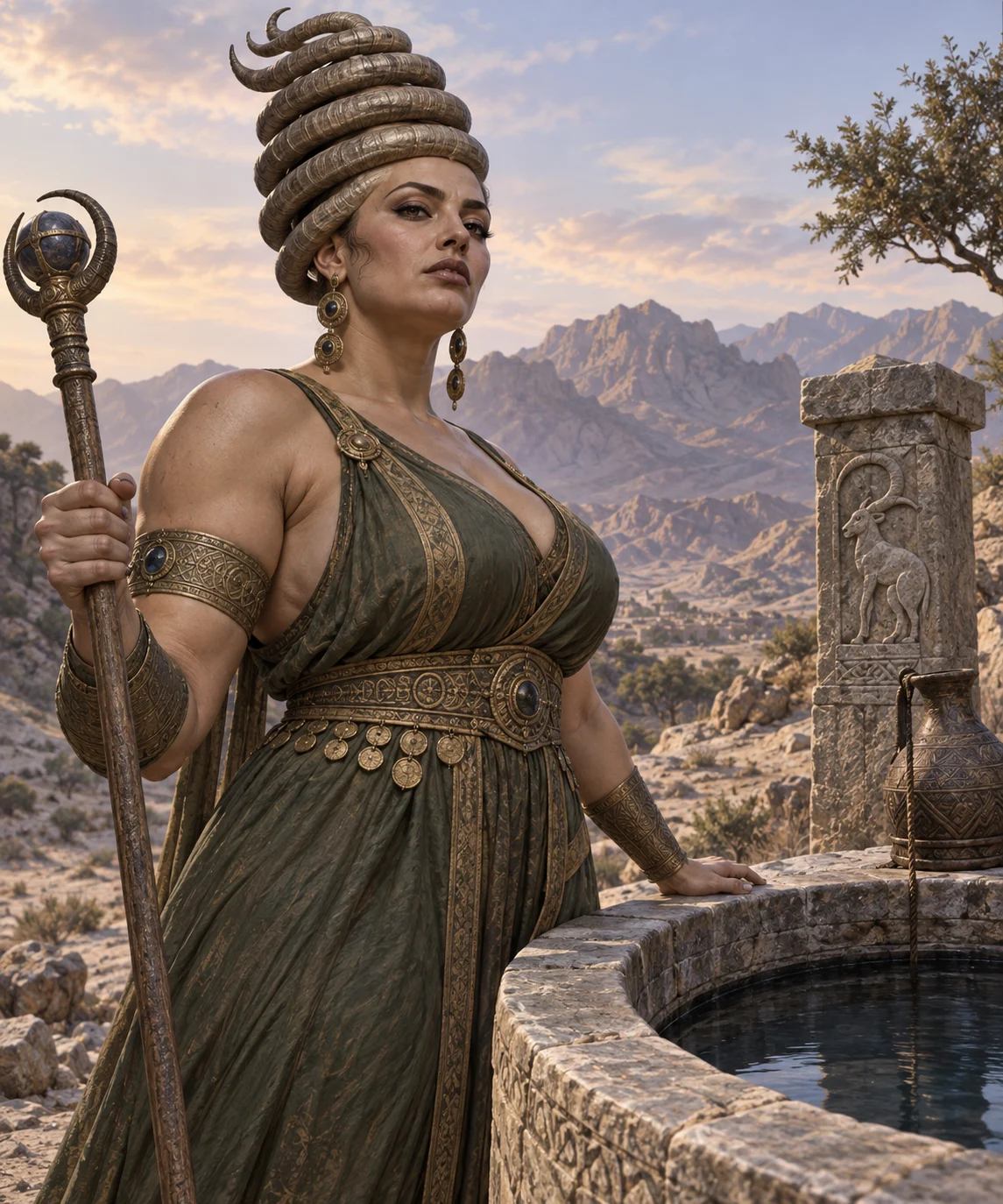
AI imagined eldest div sister with seven encircling horn coils beside her own well
AI-generated unofficial original narrative interpretation. AI-generated interpretation of the eldest sister at her own well; seven horn coils follow this Kermani tale. Face, clothing, well and coil design imagined; the geographically separate sisters are not assembled together. Staff, ornaments and well carving are imagined; selected portrait rather than whole body reconstruction. Not a historical reconstruction or community portrait.
Overview
Seven div sisters live in separate wells a year’s journey apart, each with seven sons. Their horns coil once around the head for each thousand years of life: the eldest has seven coils. They hide a visiting prince from their human-eating sons by turning him successively into household objects, including a needle and a skin rug.
Each demands marriage and possession of the sought princess in return for help. The eldest supplies objects that become obstacles through prayers invoking God and the prophet Suleman. These protect the prince during his escape with the orange containing the princess. The sisters’ explicit horn-age pattern belongs to this Kermani tale, not to every Persian div.
Origins & earliest records
Kermani storytelling, Iran
Records & interpretation
Complete XXII, pp. 135–147, directly read in original-edition OCR; regional contents checked.
3D model
An original procedural model made for the Mythscribe World Builder. It is an interpretation based on this entry, not a historical source or a depiction from the records cited here.
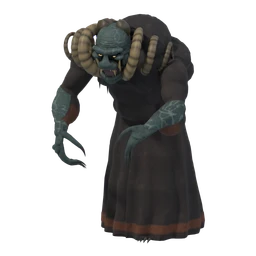
Procedural folklore creature kit · 37,833 triangles · 2.1 MB
Opens mythscribe.cloud in a new tab. Sign-in is required.
Selected bibliography
Documented works and useful reading. This is not a list of every appearance.
- 01
Persian Tales
Kermani tales; XXII, The Story of the Orange and Citron Princess, pp. 135–147
Family & connections
A source-supported family tree or inspiration record has not yet been compiled for this profile. Related reading below indicates a connection in subject matter, not a proven lineage or creative influence.
Primary records and illustrations
D. L. R. Lorimer and E. O. Lorimer, Persian Tales (London: Macmillan, 1919)
Kermani tales. XXII, pp. 135–147
Full narrative read in cached original-edition OCR, including the final reunion and punishment. Page headers and contents checked. No unsupported Persian spelling supplied; human racial caricature not adopted.
References
Sources supporting this profile. Linked pages have their own scope and editorial standards.
- Historical translated folktaleLorimer, Persian Tales (1919), XXII, pp. 135–147Research access: 2026-10-05
Image credits
AI-generated interpretationAI imagined eldest div sister with seven encircling horn coils beside her own well
AI-generated unofficial original narrative interpretation. AI-generated interpretation of the eldest sister at her own well; seven horn coils follow this Kermani tale. Face, clothing, well and coil design imagined; the geographically separate sisters are not assembled together. Staff, ornaments and well carving are imagined; selected portrait rather than whole body reconstruction. Not a historical reconstruction or community portrait.