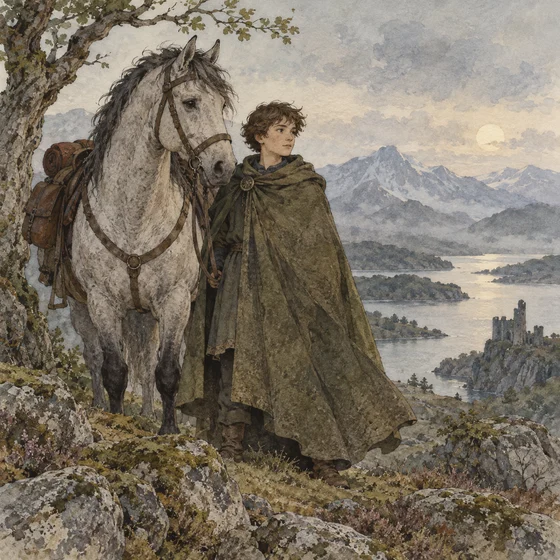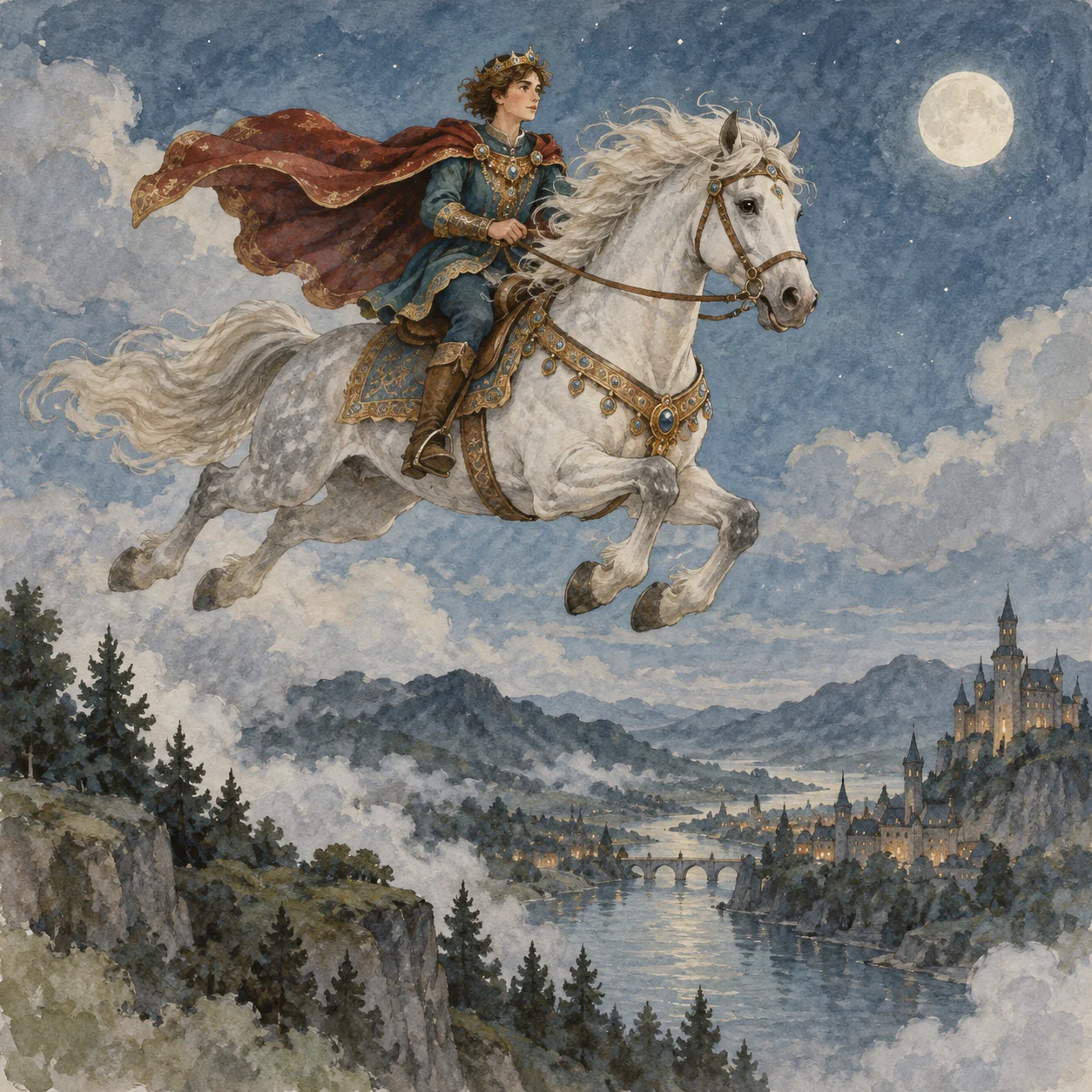
A wingless horse carries a prince through the air.
Original AI-generated interpretation; undescribed appearance, colours and setting are imagined. Not ethnographic evidence.
Overview
Qeytas repeatedly weeps as he warns his young owner about a stepmother’s attempts to kill him with poisoned meals and a concealed pit. When she arranges for the colt himself to be slaughtered as a supposed remedy, he plans their escape: the prince rides him in royal clothes, laden with jewels, and the horse rises into the air.
In another country he advises the prince to disguise himself as a gardener’s assistant and leaves hairs from his mane that summon him when burned. Later, Qeytas identifies the head and feet of a hunted bird as the parts that can cure the local king. His guidance helps reveal his rider’s royal identity. The text explicitly grants flight, speech, foreknowledge and disappearance, but does not describe wings.
Origins & earliest records
Kermani storytelling, Iran
Records & interpretation
Complete tale and all continuation pages directly read; original edition contents checked for regional division and locators.
3D model
An original procedural model made for the Mythscribe World Builder. It is an interpretation based on this entry, not a historical source or a depiction from the records cited here.
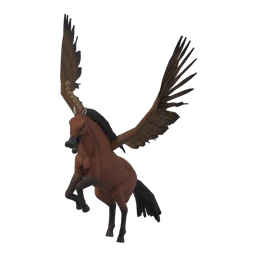
Procedural folklore creature kit · 31,051 triangles · 1.8 MB
Opens mythscribe.cloud in a new tab. Sign-in is required.
Selected bibliography
Documented works and useful reading. This is not a list of every appearance.
- 01
Persian Tales
Kermani tales; VII, pp. 33–42
Family & connections
A source-supported family tree or inspiration record has not yet been compiled for this profile. Related reading below indicates a connection in subject matter, not a proven lineage or creative influence.
Primary records and illustrations
D. L. R. Lorimer and E. O. Lorimer, Persian Tales (London: Macmillan, 1919)
Kermani tales. Tale VII, pp. 33–42
Complete narrative, including every continuation page, read; historical scan OCR contents confirms regional ordering. Individual narrator not supplied. Modern site presentation is not treated as a new authored tale.
References
Sources supporting this profile. Linked pages have their own scope and editorial standards.
- Historical translated folktaleD. L. R. and E. O. Lorimer, Persian Tales (1919), tale VII, pp. 33–42Research access: 2026-10-05
- Historical translated folktaleD. L. R. and E. O. Lorimer, Persian Tales (1919), tale VII, pp. 33–42 (continued)Research access: 2026-10-05
- Historical editionOriginal 1919 scan: Internet Archive persiantales00loriialaResearch access: 2026-10-05
Image credits
Modern interpretationA wingless horse carries a prince through the air.
Original AI-generated interpretation; undescribed appearance, colours and setting are imagined. Not ethnographic evidence.