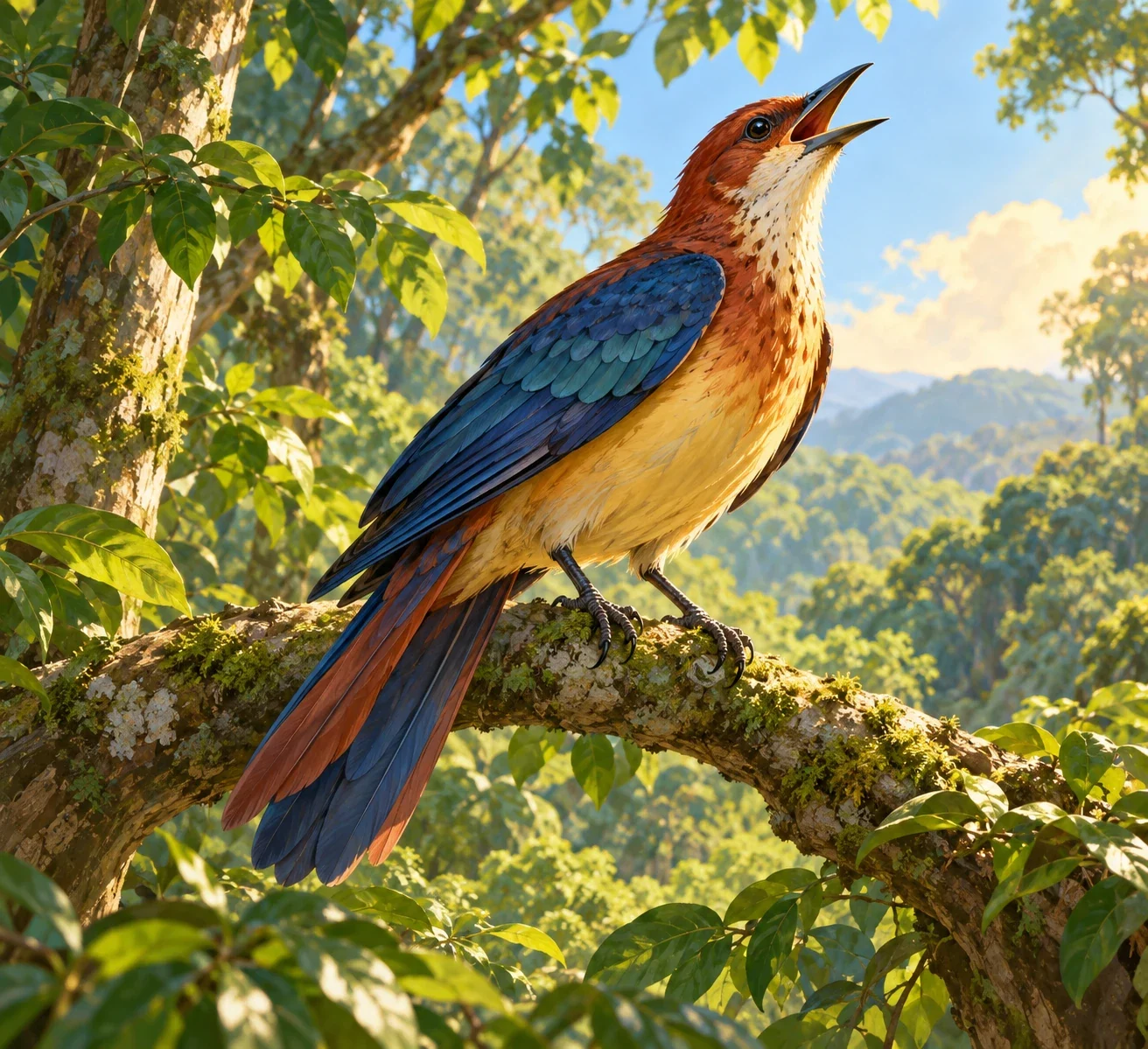
AI-generated interpretation of Little Garee answering the dominant bird’s song in George Edwards’s recorded Antiguan tale. Plumage, bird form, proportions and forest are editorial choices; the source does not specify species or colours. No present-day performance is reconstructed.
AI-generated interpretation of Little Garee answering the dominant bird’s song in George Edwards’s recorded Antiguan tale. Plumage, bird form, proportions and forest are editorial choices; the source does not specify species or colours. No present-day performance is reconstructed.
Overview
Little Garee enters a forest already dominated by Big Garee. The older bird sings proudly from a tree, frightening the other birds into hiding. A young Garee grows into a large bird and receives the name Little Garee. The name therefore should not be read as a measurement proving that he remains tiny. When a reward is offered for killing Big Garee, Little Garee answers the older bird’s song instead of hiding. The reply provokes a challenge, which he accepts. The recorded performance repeats the song for both birds, making the answering voice the first open break in the older bird’s unopposed rule.
Little Garee places a pot of boiling oil beneath his tree and conceals it from his opponent. During their fight he pushes Big Garee into the pot. After the oil cools, the defeated bird is carried to the court-house and displayed. That sequence establishes the younger bird’s actual victory before another figure tries to take credit. It is a violent action in the story, not a species characteristic or a practical account of how birds hunt. No plumage colour, identified bird species or exact body measurements are supplied for Little Garee.
Nancy dresses in a little coat and hat, takes a stick and publicly claims that he killed the great bird. The claim initially impresses the onlookers, but Little Garee hears it. Instead of accepting the imposture, he challenges Nancy to lift the defeated bird. Nancy cannot raise even a wing, while Little Garee lifts the whole bird and receives the reward. The audience has already been told who won the fight, so the final demonstration exposes a false claimant rather than revealing a previously unknown victor. Nancy remains a contextual trickster in this account and is not made into a separate new profile under his Antiguan name.
The ending joins resistance to an intimidating ruler with a second dispute over recognition. Little Garee succeeds first against an opponent who silences other birds and then against someone who claims an achievement he did not perform. His victory involves both a concealed trap and a public test of strength. The text’s ordinary human vocabulary, including its reference to a little finger in the proposed test, belongs to an anthropomorphic animal story. It does not provide enough information to reconstruct a literal hybrid anatomy or identify the figure as a particular zoological species.
Origins & earliest records
John H. Johnson published A Great Bird of the Forest as tale 36 in Folk-Lore from Antigua, British West Indies, Journal of American Folk-Lore 34(131),1921, pages 80–81. He attributes the repertoire to George W. Edwards, a native of Greenbay, Antigua who had lived in New York for ten years. The introduction describes about twenty-five nighttime visits during 1920 and credits Edwards’s wife and occasionally friends with helping recall material. Johnson’s title is editorial: he says the storyteller supplied no titles. Antigua is the source-community association, while New York is the recording location; neither fixes the story’s unnamed forest within a modern border.
Records & interpretation
The complete tale, its reward ending and the article’s full introductory framing were read. Printed page 81 was checked in the preserved scan, confirming Nancy’s false claim and Little Garee’s successful lifting test. The source’s comparative note mentions a St Kitts variant with an eagle and without Nancy’s claim; that comparison does not identify the selected Garee as an eagle or replace Edwards’s ending. Johnson’s judgments about memory, migration and narrative disintegration are attributed historical collector opinions, not accepted facts about the worth or authenticity of Edwards’s storytelling.
Selected bibliography
Documented works and useful reading. This is not a list of every appearance.
- 01
Folk-Lore from Antigua, British West Indies
Journal of American Folk-Lore 34(131), pp.40–88; complete tale 36, pp.80–81, with full introduction and comparative note. Story titles supplied by publication, not narrator.
Family & connections
A source-supported family tree or inspiration record has not yet been compiled for this profile. Related reading below indicates a connection in subject matter, not a proven lineage or creative influence.
References
Sources supporting this profile. Linked pages have their own scope and editorial standards.
- Historical recorded Antiguan narrative with named narratorEdwards–Johnson 1921, complete A Great Bird of the Forest, pp.80–81; introductory framing, pp.40–43Research access: 2026-10-23
Image credits
AI-generated illustrationAI-generated interpretation of Little Garee answering the dominant bird’s song in George Edwards’s recorded Antiguan tale. Plumage, bird form, proportions and forest are editorial choices; the source does not specify species or colours. No present-day performance is reconstructed.
AI-generated interpretation of Little Garee answering the dominant bird’s song in George Edwards’s recorded Antiguan tale. Plumage, bird form, proportions and forest are editorial choices; the source does not specify species or colours. No present-day performance is reconstructed.