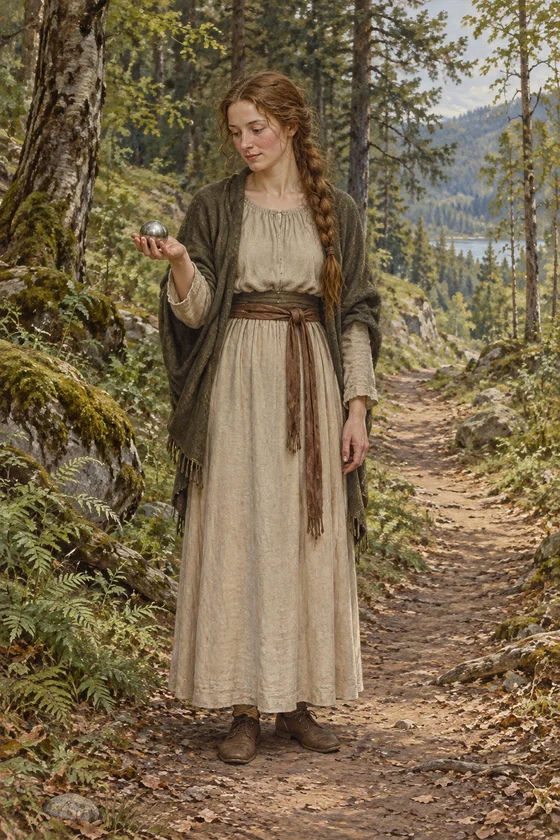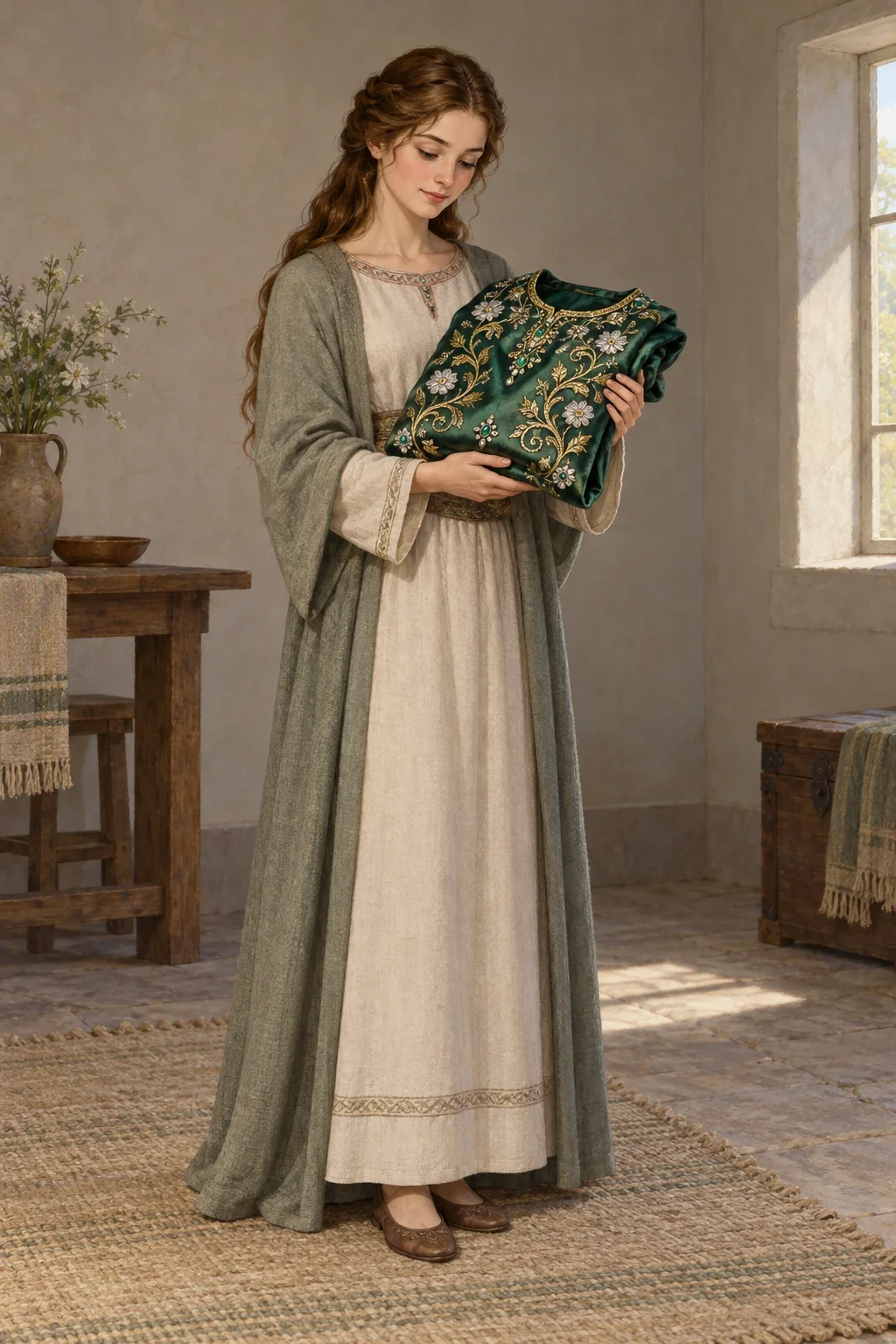
AI-generated narrative interpretation of grown Lineik after completion of the third, green tunic. Face, clothing, room and embroidery arrangement are artistic choices, not an authenticated Icelandic portrait or costume.
Historical adapted juvenile English witness; Hall adaptation and narrative identity limits preserved.
Overview
Lineik and her brother Siegfrid are the children of King Ring and Queen Gytha. Before dying, their mother asks the king to protect their place in his affections and avoid choosing a new wife from an isolated island. A minister nevertheless returns with a beautiful stranger and her supposed daughter Laufey. The king marries the stranger, neglects his children and allows her growing power at court. Before a voyage he warns the siblings to flee if he does not return, describing two hollow trees that can be fastened from inside.
After a storm kills the king, Siegfrid dreams of his drowned father leaving his crown beside him. The siblings take this as warning and escape. Their pursuing stepmother appears immense and fierce; setting a wood alight delays her long enough for them to reach the trees. Lineik enters the tree with bronze-coloured leaves. Its bark hides her from outside sight while allowing her to observe and speak with her brother. When Prince Tellus later visits in search of Lineik, the stepmother substitutes Laufey as the princess.
Tellus carries Laufey away and, encountering the unusual trees, has them brought aboard his ship and placed in his room. He asks his supposed bride to make blue, red and green silk tunics, each finer than the last. Laufey has never learned needlework and weeps over the task. At her brother’s urging, Lineik emerges and helps her, although she remembers the stepmother’s attempt on their lives. The green wedding tunic is so richly worked with gold, silver and stones that little of the original fabric remains visible.
Tellus discovers the women together and learns Lineik’s identity. Laufey explains that the wicked queen abducted her as a child and compelled her obedience; she was not truly the woman’s daughter. Lineik joins her appeal for forgiveness rather than demanding her death. She also refuses to agree to marriage until the usurper is removed. Siegfrid and Tellus recover the kingdom and execute the ogress. Lineik then marries Tellus, while Laufey marries Siegfrid. The outcome turns their imposed rivalry into mutual aid without making Lineik a tree spirit or a goddess.
Origins & earliest records
Mrs. A. W. Hall’s 1897 Icelandic Fairy Tales is explicitly translated and edited for juvenile readers. Her complete preface says that she eliminated material she considered objectionable while seeking to preserve local character. The inspected volume does not identify the original narrator, field locality or underlying edition for this tale. This is therefore a selected historical adapted English witness, not an independently collated oral transcript or evidence of current community belief.
Records & interpretation
Complete Lineik and Laufey, printed pp.95–115, and complete preface pp.5–6 in the preserved historical witness.
Selected bibliography
Documented works and useful reading. This is not a list of every appearance.
- 01
Icelandic Fairy Tales
London, Frederick Warne & Co., and New York. Title page visually checked. E. A. Mason credited for original illustrations, which are not reused as new public art.
Family & connections
A source-supported family tree or inspiration record has not yet been compiled for this profile. Related reading below indicates a connection in subject matter, not a proven lineage or creative influence.
References
Sources supporting this profile. Linked pages have their own scope and editorial standards.
- Historical adapted English traditional narrativeHall1897 — complete Lineik and Laufey and prefaceResearch access: 2026-10-23
Image credits
AI-generated narrative illustrationAI-generated narrative interpretation of grown Lineik after completion of the third, green tunic. Face, clothing, room and embroidery arrangement are artistic choices, not an authenticated Icelandic portrait or costume.
Historical adapted juvenile English witness; Hall adaptation and narrative identity limits preserved.