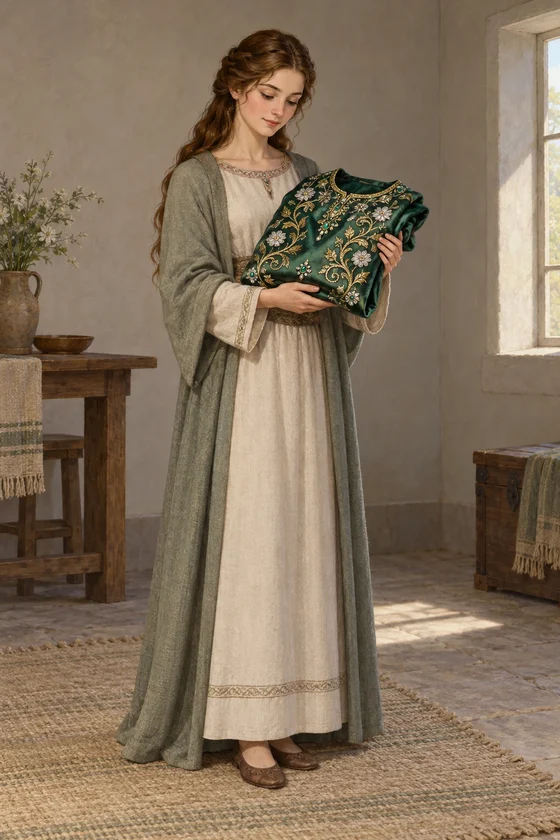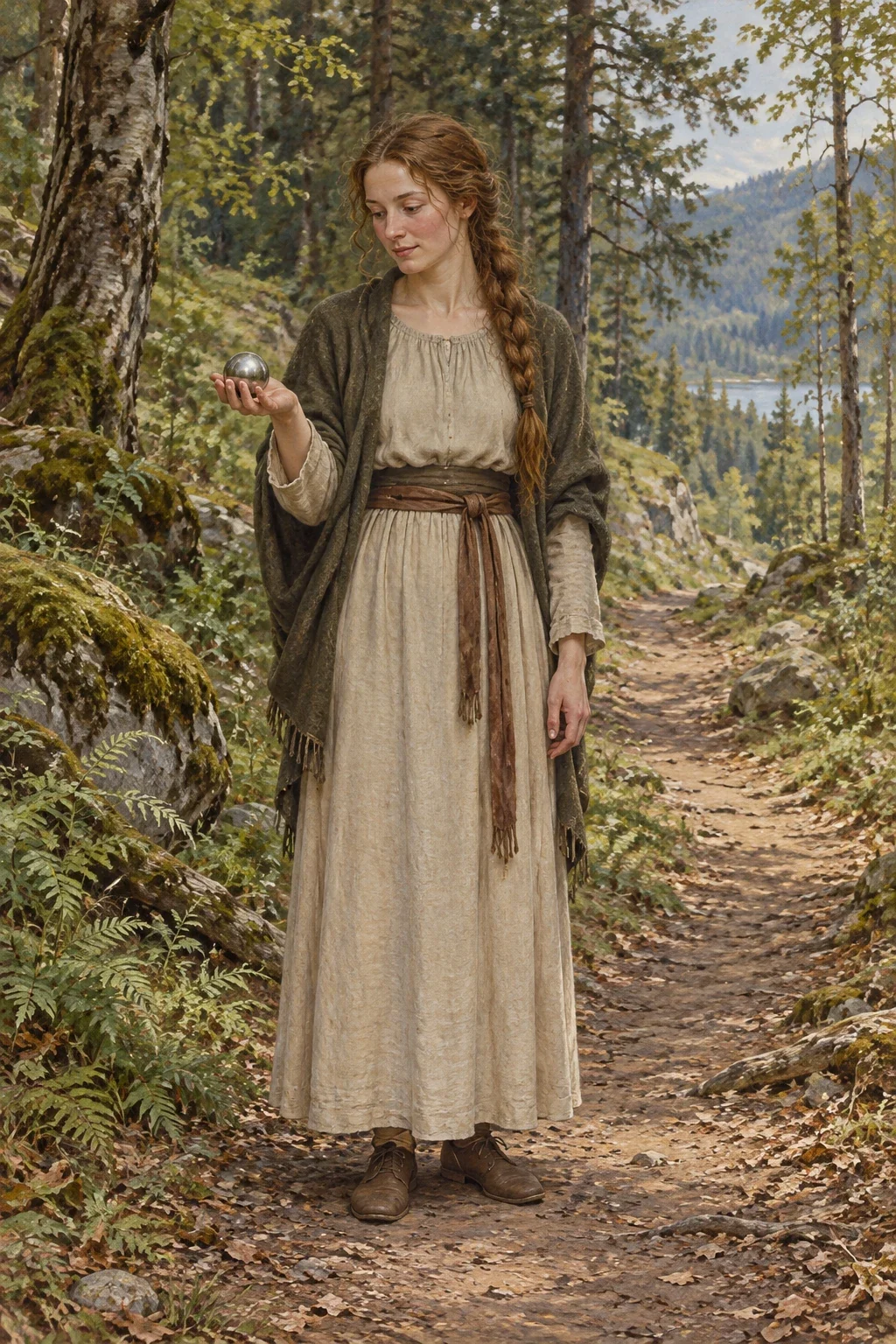
AI-generated narrative interpretation of grown Ingebjörg with the little silver ball. Face, clothing and woodland are artistic choices; no real person, national dress or place is authenticated.
Historical adapted juvenile English witness; Hall adaptation and narrative identity limits preserved.
Overview
A childless queen wishes for a daughter as beautiful as drops of blood on snow after a white bird scratches her cheek. The bird promises fulfilment, but the magician Surtur declares that the child will bring sorrow unless she returns good for evil. Ingebjörg is born and grows into a beloved princess. Her mother’s affection turns to jealousy and hatred. Later her godmother explains that Surtur, angry after the queen rejected him, caused this change through drops made from a dragon’s tooth; this explanation belongs to the narrative.
The distressed princess isolates herself after her mother says that she is destined to marry a terrible giant and burn her father’s castle. An old woman in a peaked hat draws her into the woods, listens to her fears and reveals herself as her godmother. She says that the palace cannot be saved but the people can. Following her advice, Ingebjörg persuades the king to go riding, sends the servants away and helps remove the treasure. When the girl reaches for oil above the hearth, she slips; the spilled oil ignites and the empty palace burns.
The godmother gives her a silver ball to follow into the forest and instructs her to see the owner of a hut before he sees her. Ingebjörg obeys and encounters a giant returning with a dead bear. Despite his fierce appearance, he speaks kindly and lets her stay in exchange for household work. For three days she hears terrible night noises without entering the outer room, while dreaming of a handsome prince. When she hears her godmother calling, she returns to find her mother tied to a stake, falsely condemned for the fire and missing treasure.
Ingebjörg interrupts the execution and explains her own actions, saving the queen. The giant brings back the fleeing Surtur. Remembering the silver ball, she throws it towards the giant; he catches it and becomes the prince seen in her dreams. Surtur is executed, her mother’s jealousy ends, and Ingebjörg marries the prince. She later rules with him. Her aid comes through this particular helper, sequence of instructions and object: the tale does not establish that she can transform any being or that every silver ball has such power.
Origins & earliest records
Mrs. A. W. Hall’s 1897 Icelandic Fairy Tales is explicitly translated and edited for juvenile readers. Her complete preface says that she eliminated material she considered objectionable while seeking to preserve local character. The inspected volume does not identify the original narrator, field locality or underlying edition for this tale. This is therefore a selected historical adapted English witness, not an independently collated oral transcript or evidence of current community belief.
Records & interpretation
Complete Ingebjörg, printed pp.147–156, and complete preface pp.5–6 in the preserved historical witness.
Selected bibliography
Documented works and useful reading. This is not a list of every appearance.
- 01
Icelandic Fairy Tales
London, Frederick Warne & Co., and New York. Title page visually checked. E. A. Mason credited for original illustrations, which are not reused as new public art.
Family & connections
A source-supported family tree or inspiration record has not yet been compiled for this profile. Related reading below indicates a connection in subject matter, not a proven lineage or creative influence.
References
Sources supporting this profile. Linked pages have their own scope and editorial standards.
- Historical adapted English traditional narrativeHall1897 — complete Ingebjörg and prefaceResearch access: 2026-10-23
Image credits
AI-generated narrative illustrationAI-generated narrative interpretation of grown Ingebjörg with the little silver ball. Face, clothing and woodland are artistic choices; no real person, national dress or place is authenticated.
Historical adapted juvenile English witness; Hall adaptation and narrative identity limits preserved.