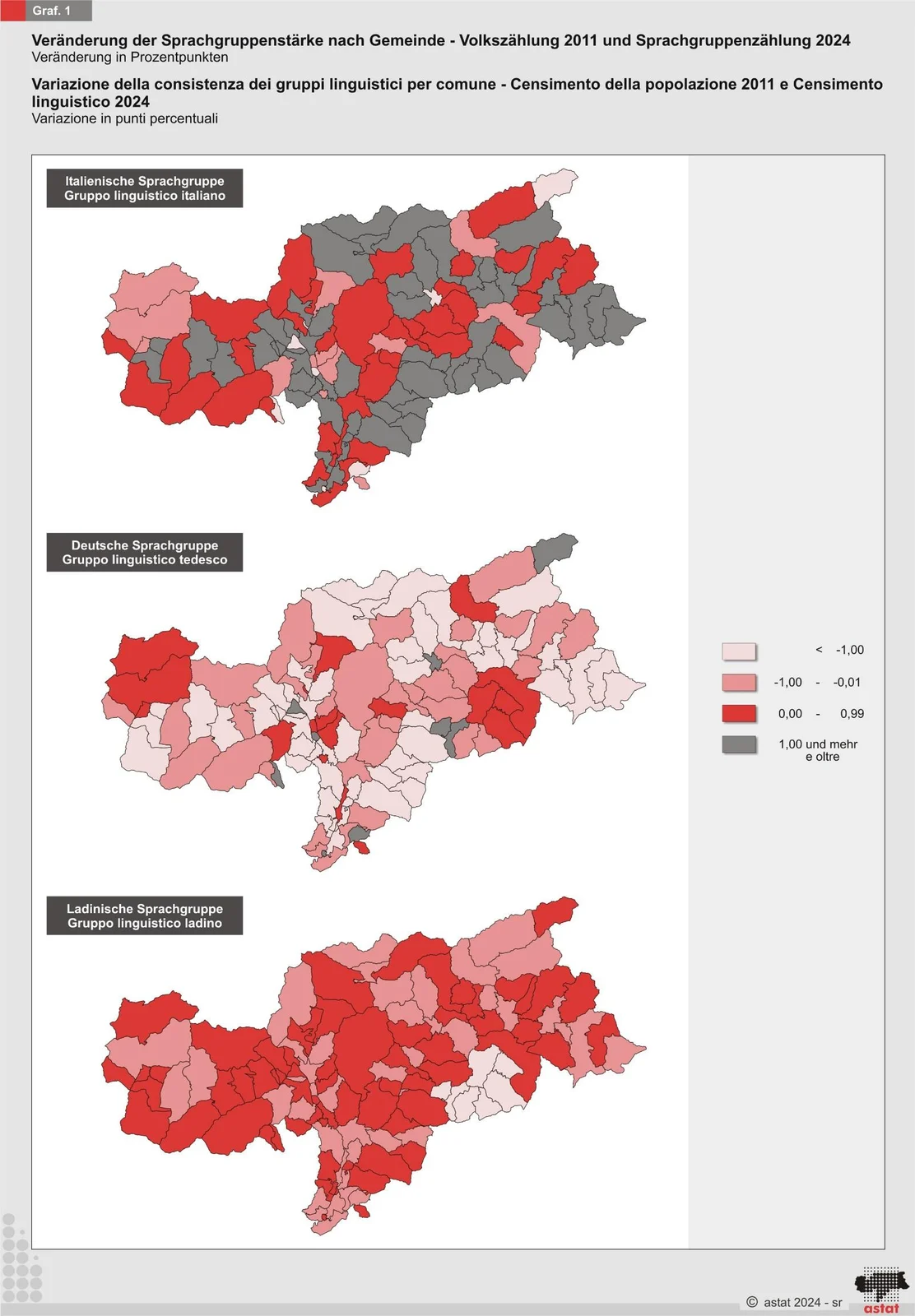
Three South Tyrol municipality maps show 2011–2024 percentage-point changes for Italian, German and Ladin language groups.
ASTAT graphic for South Tyrol (Bolzano province) only, comparing the 2011 census with the 2024 language-group census by municipality. It shows percentage-point changes in declared group affiliation, not Ladin territory, speaker numbers, or communities in Fassa or elsewhere in the Dolomites. Complete embedded PDF graphic. Compressed for display.
Overview
Ladin cultural communities are living groups in the Dolomites who maintain a minority language and culture. They are distinct from Sephardic Ladino speakers. Local idioms remain the basis of everyday speech, so the community is plural rather than uniform, even where a common written form exists.
The documented modern history of the Ladin communities runs through language institutions. The Union Generela di Ladins dla Dolomites records the newspaper Nos Ladins from 1949, later La Usc di Ladins, along with advocacy for Ladin radio and television. In 1988, cultural institutes commissioned a shared written standard. The SPELL project began in 1994, followed by a grammar in 2001 and a dictionary in 2002.
The Union uses Ladin Standard. Its own history notes that regional and provincial approval had not followed when that account was written, so the account does not settle the current legal status of the standard. Separately, the Ladin Cultural Institute of the Autonomous Province of Trento protects Ladin language and culture through research and training. It also runs a museum in Fassa with local sections.
History & identity
The selected evidence documents twentieth-century cultural organisations and language planning; these milestones do not date the origin of Ladin communities.
Sources & representation
A community language organisation, plus a provincial government page that was machine-translated into English and last modified in 2025.
Selected bibliography
Documented works and useful reading. This is not a list of every appearance.
- 01
Language History
Selected bibliography; community account of press history and standardisation.
- 02
Ladin Cultural Institute - Istitut cultural ladin
Selected bibliography; provincial description of the institute, last modified 2025.
Language & cultural connections
Source-supported language and cultural connections have not yet been compiled for this profile.
References
Sources supporting this profile. Linked pages have their own scope and editorial standards.
- Community organisation web pageLanguage HistoryResearch access: 2026-10-06
- Government web page, machine-translated EnglishLadin Cultural Institute - Istitut cultural ladinResearch access: 2026-10-06
Image credits
Dated statistical map graphicThree South Tyrol municipality maps show 2011–2024 percentage-point changes for Italian, German and Ladin language groups.
ASTAT graphic for South Tyrol (Bolzano province) only, comparing the 2011 census with the 2024 language-group census by municipality. It shows percentage-point changes in declared group affiliation, not Ladin territory, speaker numbers, or communities in Fassa or elsewhere in the Dolomites. Complete embedded PDF graphic. Compressed for display.