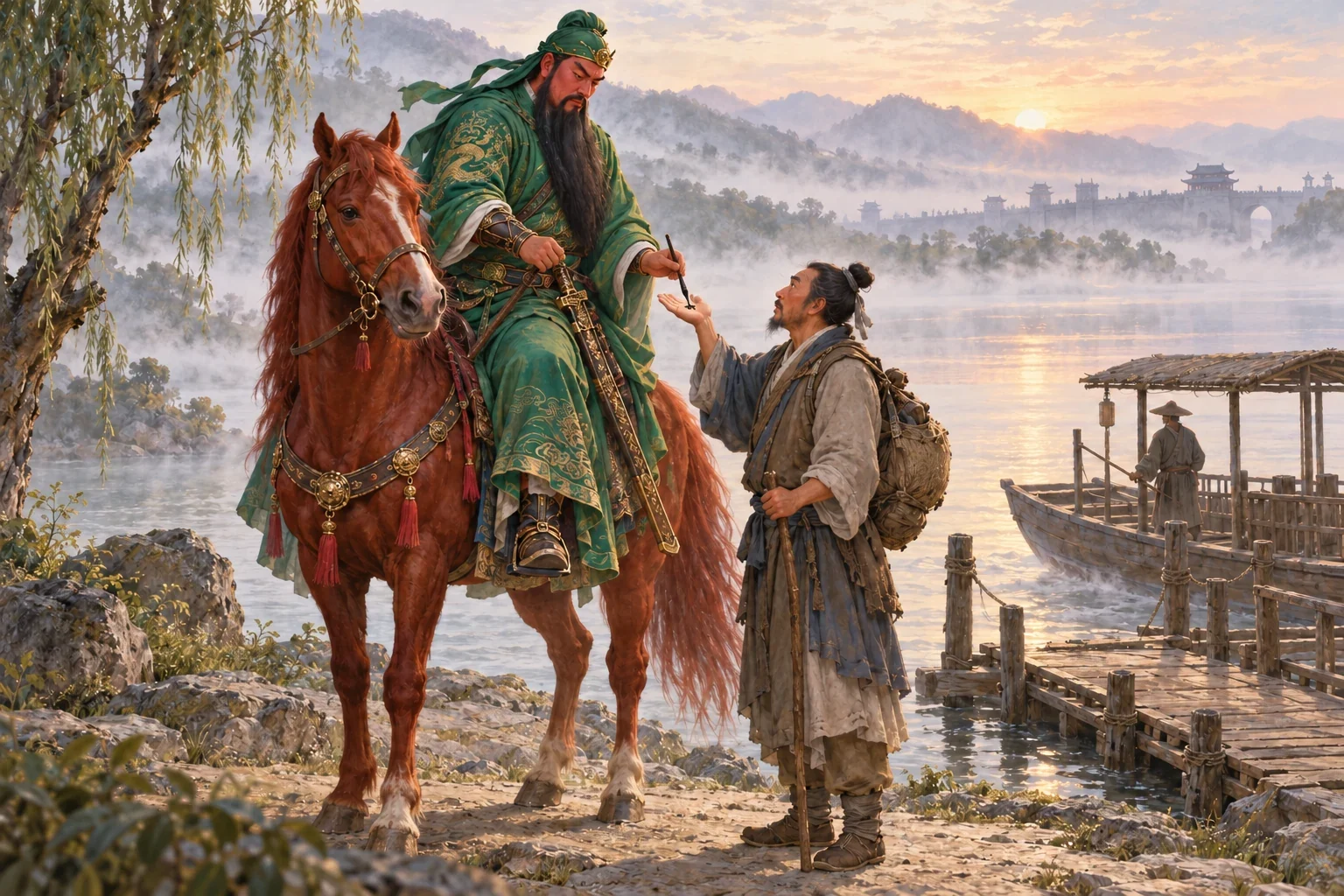
AI-generated interpretation of Kwan marking a traveller’s palm during the dream encounter in GaleXXXVIII. Red face, green robes, long beard, red horse and the marking action follow the account; faces, clothing details, sword design, setting, ink-mark shape and dawn lighting are artistic choices. The mark is not a documented sacred character. This is not historical or ethnographic evidence.
AI-generated interpretation of Kwan marking a traveller’s palm during the dream encounter in GaleXXXVIII. Red face, green robes, long beard, red horse and the marking action follow the account; faces, clothing details, sword design, setting, ink-mark shape and dawn lighting are artistic choices. The mark is not a documented sacred character. This is not historical or ethnographic evidence.
Overview
Kwan appears as the God of War in two Korean accounts translated by James S. Gale and attributed to Im Bang. The Temple to the God of War places his worship within the war fought in the reign of Son-jo. A Ming commander credits Kwan with military help and urges the Korean ruler to establish temples of gratitude. The narrative describes shrines south and east of the city, then centres on disagreement about the southern site. These are the account’s explanations of a sacred landscape, rather than independent proof that a deity determined the military outcome.
Yi Hang-bok, responsible for the consultation, receives a powerfully built military visitor who asks to speak privately. After the stranger leaves, Yi tells a friend that the caller was a messenger of the God of War. The message concerns the unresolved site: a mistaken location would deny the god peace for the ages to come. Yi promises his efforts, warns the friend against repeating the encounter, and secures the approved site. The story presents a divine messenger, not a stated bodily appearance of Kwan himself.
The Magic Invasion of Seoul gives Kwan a direct dream appearance. A man crossing the Han River sees a majestic, red-faced, long-bearded figure in green, armed with a great sword and mounted on a red horse. The figure marks his palm and instructs him to intercept seven horses carrying hampers. On waking, the witness finds the ink still wet. The accompanying official and attendants throw themselves into the river when shown the sign, fulfilling the dream’s prediction that they would kill themselves. The witness reports to the authorities, who burn the guarded hampers without first opening them.
As the baskets break in the fire, countless tiny figures of men and horses spill out. The narrator identifies them as a magician’s preparations for an invasion and credits Kwan’s warning with saving the city. The concluding offerings give the episode an explicitly devotional outcome. The identity of the magician and the meaning or shape of the palm-mark are not supplied. Nor should the tiny soldiers become a separate species detached from their magical manufacture. Read together, the temple and invasion stories distinguish Kwan, his messenger, human witnesses and conjured attackers while preserving their linked account of divine protection.
Origins & earliest records
Im Bang accounts in Korean Folk Tales: Imps,Ghosts and Fairies, translated James S.Gale, London J.M.Dent/New York E.P.Dutton,1913. Chapters 31,38.
Records & interpretation
Complete selected chapters, including biographical framing, read from preserved PG51002 HTML. Title and entire preface also read. No attached footnotes in selected units. Korean manuscript not independently collated.
Selected bibliography
Documented works and useful reading. This is not a list of every appearance.
- 01
- 02
Family & connections
A source-supported family tree or inspiration record has not yet been compiled for this profile. Related reading below indicates a connection in subject matter, not a proven lineage or creative influence.
References
Sources supporting this profile. Linked pages have their own scope and editorial standards.
- Public-domain historical translationGale1913 chapter31Research access: 2026-10-27
- Public-domain historical translationGale1913 chapter38Research access: 2026-10-27
Image credits
AI-generated interpretationAI-generated interpretation of Kwan marking a traveller’s palm during the dream encounter in GaleXXXVIII. Red face, green robes, long beard, red horse and the marking action follow the account; faces, clothing details, sword design, setting, ink-mark shape and dawn lighting are artistic choices. The mark is not a documented sacred character. This is not historical or ethnographic evidence.
AI-generated interpretation of Kwan marking a traveller’s palm during the dream encounter in GaleXXXVIII. Red face, green robes, long beard, red horse and the marking action follow the account; faces, clothing details, sword design, setting, ink-mark shape and dawn lighting are artistic choices. The mark is not a documented sacred character. This is not historical or ethnographic evidence.