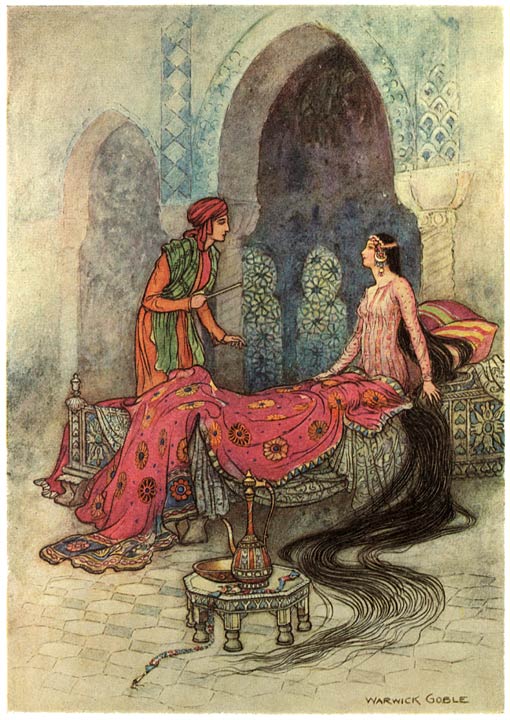
Keshavati awakens on the bed beside Champa Dal, Warwick Goble, 1912
The awakened princess sits beside Champa Dal, her abundant hair flowing from the bed. Goble represents the gold-stick restoration episode; Keshavati is the human captive, not one of her Rakshasa captors.
Overview
Keshavati, named for her abundant hair, is the surviving princess of a country consumed by Rakshasas. An old member of the company preserves her while controlling her life: a silver stick kills her and a gold stick restores her. Champa Dal discovers the sticks and wakes her, then hides during the Rakshasas’ nightly return. By questioning her protector, Keshavati learns the external-life secret that allows him to destroy the company.
After marrying Champa, she loses a hair seven cubits long while bathing. It floats away tied to a shell and attracts Sahasra Dal’s attention. A disguised Rakshasi abducts her; Keshavati delays the unwanted encounter by declaring a six-month vow. Champa finds her and publicly recounts their history, securing their reunion. Her temporary death and restoration belong to the sticks’ magic; the text identifies her as a human princess, not a Rakshasi.
Origins & earliest records
Bengali oral storytelling translated by Lal Behari Day
Records & interpretation
Complete relevant tale, attached notes,1883 preface and1912 edition credits directly read.
Selected bibliography
Documented works and useful reading. This is not a list of every appearance.
- 01
Folk-Tales of Bengal
IV, The Story of the Rakshasas, pp.77–88; complete tale61–88 and notes; first edition1883, illustrationsWarwickGoble
Family, evolution & connections
Champa Dal in Day IV
Champa Dal is Keshavati’s husband, confirmed in the rescue and final reunion. The maid-servant’s claim to be her maternal aunt is a kidnapping deception, not established family membership.
Primary records and illustrations
Lal Behari Day, Folk-Tales of Bengal (Macmillan,1912; first edition1883)
IV. IV, The Story of the Rakshasas, pp.77–88; complete tale61–88 and notes
Complete tale and footnotes read, pluspreface andeditionhistory. Bengali oral informants described collectively, individual teller of this tale not identified. Original paraphrase; no source-image verification claimed.
References
Sources supporting this profile. Linked pages have their own scope and editorial standards.
- Historical translated oral narrative and collector notesLal Behari Day, Folk-Tales of Bengal (1912), IV, The Story of the Rakshasas, pp.77–88; complete tale61–88 and notesResearch access: 2026-10-05
Image credits
Historical illustrationKeshavati awakens on the bed beside Champa Dal, Warwick Goble, 1912
The awakened princess sits beside Champa Dal, her abundant hair flowing from the bed. Goble represents the gold-stick restoration episode; Keshavati is the human captive, not one of her Rakshasa captors.