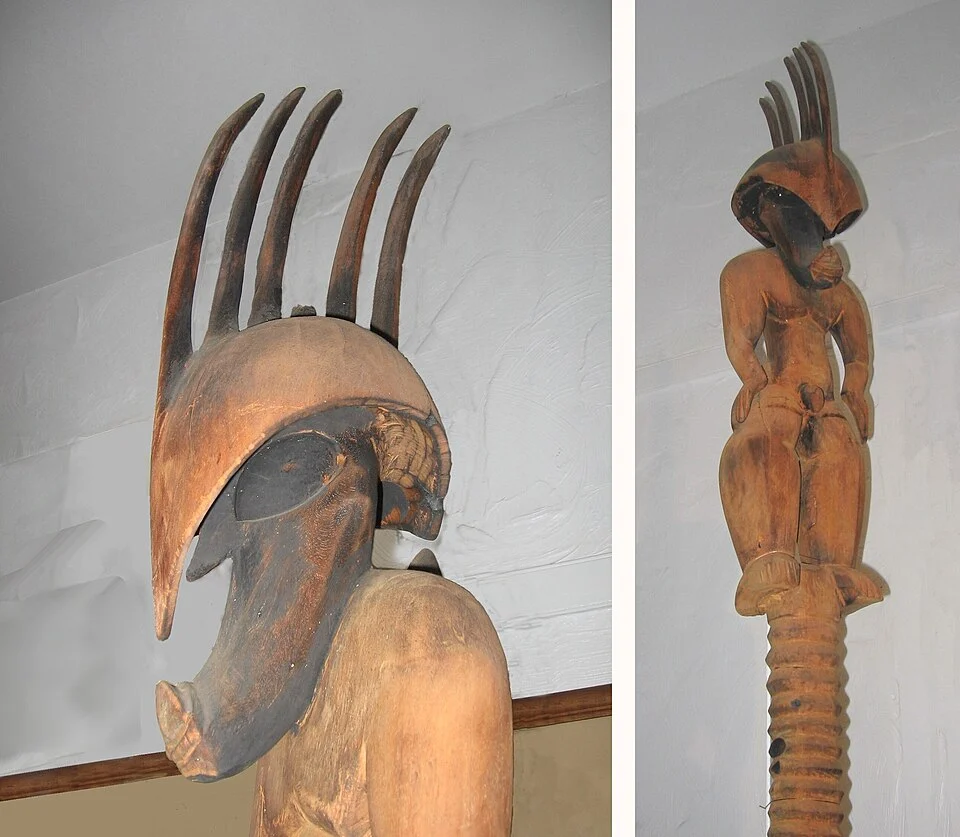
Kamapuaʻa
Image associated with the exact linked encyclopedia article; consult credited file description for its interpretation.
Overview
In this version, Kamapuaʻa steals Olopana’s fowls and is captured, but breaks his bonds and defeats the men carrying him away. Olopana then leads a force against him, driving him into the narrow gorge at Kaliuwaʻa. Its steep walls seem to make escape impossible. Kamapuaʻa changes into a huge pig and places his back against the precipice, creating a living ladder for the surviving members of his company.
The account identifies the smooth channels in the cliff as marks of his back and connects nearby rocks, water and trees with further actions. It therefore joins transformation, resistance and protection of followers with a named place. Other Kamapuaʻa narratives concern different episodes, including relationships with Pele. The collector’s dismissive comments about Hawaiian belief and his sweeping explanations of volcanic activity are not adopted as historical or scientific conclusions.
Origins & earliest records
Thrum’s 1907 volume reproduces this chapter from The Hawaiian Spectator without naming an individual author in its heading. The selected publication provides a traceable witness to the Kaliuwaʻa episode; its date is not the beginning of the transmitted story. Earlier newspaper context and Hawaiian-language versions require separate examination.
Records & interpretation
The inspected narrative describes the pig transformation, cliff ascent and locally identified traces. It also contains the collector’s naturalistic explanation of the rock channels, demonstrating editorial mediation. These competing interpretations are evidence of how the place was presented in print, not zoological demonstration of a giant pig or geological proof of divine action.
Selected bibliography
Documented works and useful reading. This is not a list of every appearance.
- 01
Hawaiian Folk Tales, XVIII: Kaliuwaa
Selected inspected chapter; a dated collected witness, not a comprehensive bibliography.
- 02
Hawaiian Folk Tales: A Collection of Native Legends
Chicago: A.C. McClurg,1907; selected contributor credited.
Family, evolution & connections
Kamapuaʻa’s parents in the NPS account
Selected Hawaiʻi Volcanoes National Park moʻolelo.
Scroll sideways to see all branches. With a keyboard, focus the tree and use the arrow keys.
- Hina and Kahikiula (joint parents)
Explicitly named parents. Versions vary. Unnamed grandmother and siblings are excluded. This is genealogy, not animal ancestry.
Hina and Kahikiula
The National Park Service’s Kamapuaʻa account identifies Hina as his mother and Kahikiula as his father before describing his discovery in hog form. It expressly warns that versions of moʻolelo can vary significantly. This connection therefore records the selected parentage rather than treating it as a universal genealogy or merging this Hina with similarly named figures from other traditions.
ʻAmaʻu fern
Hawaiʻi Volcanoes National Park describes ʻamaʻu as one of Kamapuaʻa’s kino lau, and its fern page repeats that he sometimes takes this form. The same page describes young red fronds turning green. This records a named plant association in the supplied moʻolelo context, not creative-origin testimony or biological descent; the source does not supply an exact scientific species name.
Located primary passages
Specific passages supporting details in this entry, grouped by their published witness.
Hawaiian Folk Tales: A Collection of Native Legends
Chicago: A.C. McClurg,1907; selected contributor credited.
- Kamapuaa changes into a hog and steals Olopana’s fowls.
- Kamapuaa bursts his captors’ bonds and kills all but one messenger.
- In hog form Kamapuaa provides a ladder up a precipice so his army can escape.
Documents this credited English collected version, not a universal account of Hawaiian tradition. European terms such as crocodile are historical translator choices, not evidence of native fauna. Collector racial or cultural generalizations are not adopted.
References
Sources supporting this profile. Linked pages have their own scope and editorial standards.
- Primary textHawaiian Folk Tales, XVIII: KaliuwaaResearch access: 2026-10-05
Image credits
Reference illustrationKamapuaʻa
Image associated with the exact linked encyclopedia article; consult credited file description for its interpretation.