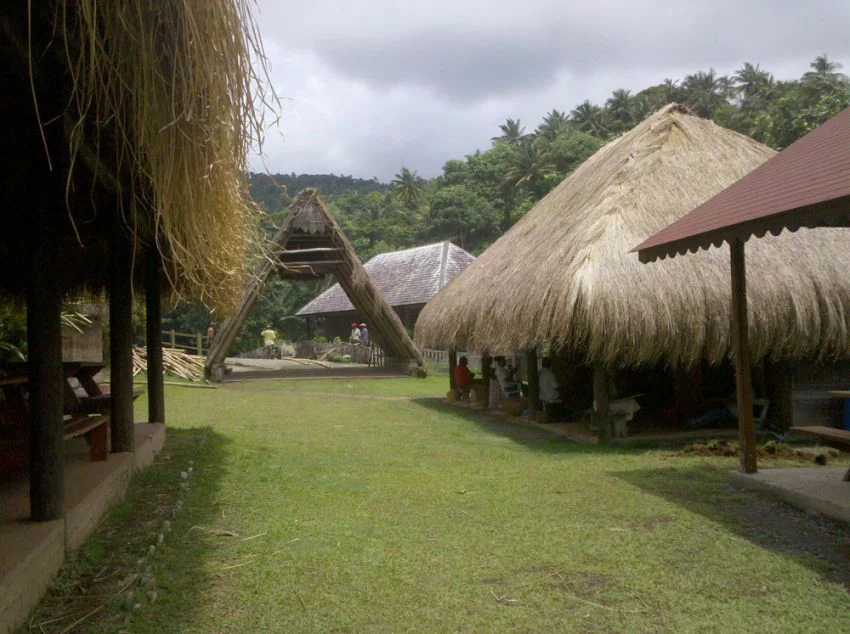
Thatched structures and grassy paths at Kalinago Barana Autê cultural village in Dominica, as pictured in the 7toucans listing
Kalinago Barana Autê is a cultural village in Dominica presenting Kalinago history and traditions. This photograph shows thatched structures and paths within that visitor site. It documents a particular heritage setting, rather than the homes or appearance of every Kalinago person. The listing does not supply a photograph date.
Overview
The Kalinago of Dominica are a living Indigenous community, with the Kalinago Territory as an important homeland. Its public portal presents contemporary residents through locally owned hospitality, guiding, food businesses and artisan work. It places cultural renewal alongside education and recovery from Hurricane Maria in 2017. This profile concerns the Dominica community; it does not make Kalinago, Garifuna and every historical population called Carib interchangeable, nor assume that a visitor-facing portal encompasses every resident’s experience.
The territory’s account places its establishment as communal land in 1903 within a longer history of colonial dispossession. That institutional date is not the beginning of the people. It also recalls the colonial suspension of the chief’s office between 1930 and 1953 while elders continued to be recognized as leaders. The same website combines historical narrative, hospitality promotion and an explicitly legendary account of Bakwa. These different forms of public storytelling should retain their distinct evidentiary roles.
A government contract notice provides a precise example of recent language work. It names Prosper Paris as the consultant for training primary-school students in the Kalinago Territory, with a four-month contract signed on 19 March 2026. Its stated purpose is knowledge transfer and cultural preservation. The award documents a funded teaching commitment; it does not demonstrate completed lessons or measure how many fluent speakers resulted. Language learning and Kalinago identity should not be collapsed into a single test of belonging.
Contemporary children’s publishing provides another route of cultural presentation. UNDP’s notice describes The Jewel of the Kalinago: The Adventures of Nago and Miri and We Are Kalinago, produced with the Kalinago Council and Dominica’s government. It identifies the comic as a present-day story drawing on traditions and the colouring book as a portrayal of heritage. The notice records their launch on 3 July 2023. These are educational publications, not evidence that all community members hold every belief depicted.
Historical writing is represented bibliographically by Helen Pauline Francis-Seaman’s An Unconquerable Spirit, edited by Alan Cobley. The publisher describes a study of resistance, land and colonial power across several Eastern Caribbean communities. Its description and contents were consulted, not the complete book. Accordingly, the volume is a route for further reading rather than independent verification here of all the historical arguments it advances.
History & identity
Territorial self-presentation, a dated government teaching award, a collaborative publication notice and publisher bibliography.
Sources & representation
Complete selected public page bodies read. No linked comic, colouring book or historical volume inspected; no language recordings evaluated.
Selected bibliography
Documented works and useful reading. This is not a list of every appearance.
- 01
The Jewel of the Kalinago: The Adventures of Nago and Miri; We Are Kalinago
Launch year, 3 July; publication notice only.
- 02
An Unconquerable Spirit
Publisher description and contents only; page has no explicit imprint date.
- 03
Kalinago Iatiwa: Nou Sé Kalinago, We Are Kalinago
Selected official17-page PDF; printed publication year unverified.
Language & cultural connections
Source-supported language and cultural connections have not yet been compiled for this profile.
Located primary passages
Specific passages supporting details in this entry, grouped by their published witness.
Kalinago Iatiwa: Nou Sé Kalinago, We Are Kalinago
Selected official PDF.
- The publication frames Kalinago life through both heritage and contemporary change. Its acknowledgements identify Council participation, elders, schools and named cultural contributors. This educational collaboration offers a present-facing account, rather than treating the community as confined to the past.
Physical PDF3: complete About This Book and Acknowledgements.
No contributor assigned authorship of individual pages. Illustrations, language accuracy and historical claims not independently assessed. Native403 and screenshot failures retained; no local-PDF or visual-inspection claim.
References
Sources supporting this profile. Linked pages have their own scope and editorial standards.
- Community or institutional primary sourceKalinago TerritoryResearch access: 2026-10-05
- Community or institutional primary sourceLanguage training contract noticeResearch access: 2026-10-05
- Community or institutional primary sourceUNDP publication noticeResearch access: 2026-10-05
- Community or institutional primary sourceIan Randle publisher catalogueResearch access: 2026-10-05
Image credits
Contextual cultural heritage-site photographThatched structures and grassy paths at Kalinago Barana Autê cultural village in Dominica, as pictured in the 7toucans listing
Kalinago Barana Autê is a cultural village in Dominica presenting Kalinago history and traditions. This photograph shows thatched structures and paths within that visitor site. It documents a particular heritage setting, rather than the homes or appearance of every Kalinago person. The listing does not supply a photograph date.