
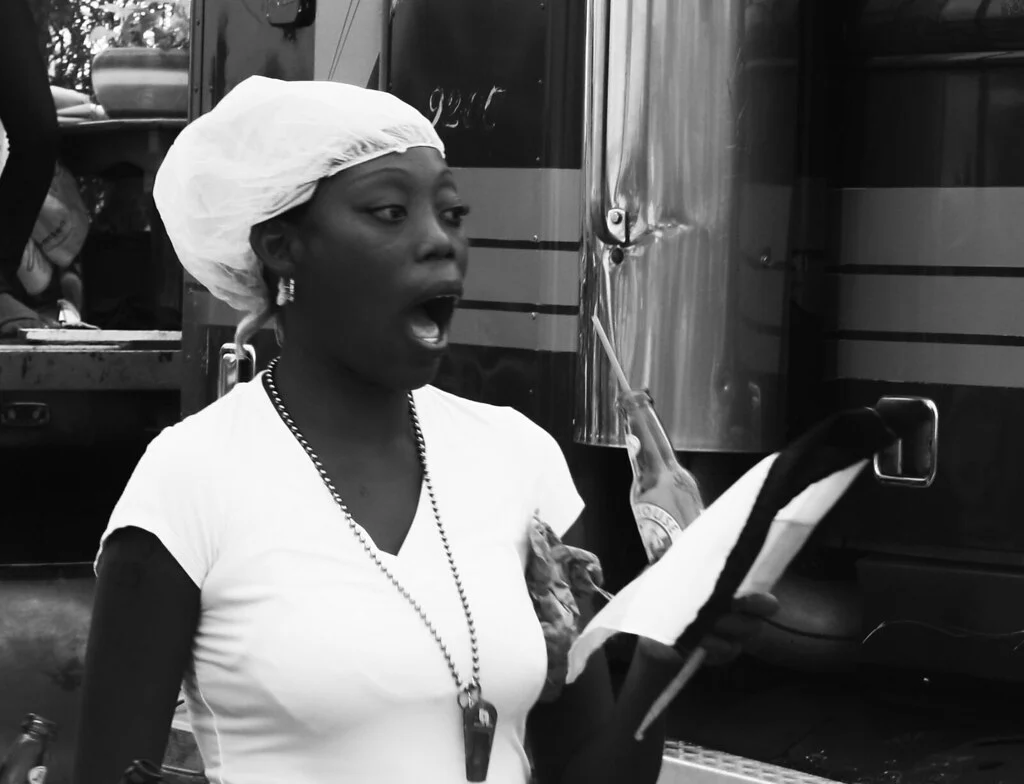
A woman identified as Garifuna by photographer Jimelovski Platano Macho, holding papers in a black-and-white 2010 photograph
The photographer identifies this particular woman as Garifuna. She holds papers in a black-and-white image taken in November 2010. Her name and the occasion are not given in the original photo record; the portrait does not define a representative appearance for Garifuna communities.
Overview
Garifuna communities connect Caribbean and Central American histories with extensive diaspora life. The Smithsonian’s 2013 community presentation identifies Carib, Arawak and West African ancestral contributions and locates communities in Honduras, Guatemala, Belize, Nicaragua, Saint Vincent and the United States. These histories describe the formation of a people, not a biological racial formula. Garifuna identity also crosses state borders: nationality, organizational membership and knowledge of the language are related but different matters.
The Garifuna Nation organization’s historical account, credited to Wellington C. Ramos, remembers Yurumein, or Saint Vincent, as a homeland and emphasizes forced displacement after British military conquest. It traces imprisonment on Baliceaux and arrival on Roatán in April 1797, followed by further settlement across Central America and beyond. This is an explicitly engaged community account, connecting historical memory to present demands for collective rights. Its assertion of continuing nationhood is identified here as the organization’s position, rather than treated as a legal ruling or proof that every Garifuna community belongs to one contemporary government.
Performance carries historical and linguistic knowledge through specific people and places. The Smithsonian’s community page identifies Los Angeles Wanaragua chief Flavio Alvarez and describes Christmas and New Year visits in which dancers travel between homes. It also names singers, foodways specialists, drummers and language teachers participating in the 2013 festival. Their different roles show why a people cannot be represented by a single costume or performance genre. A public festival presentation is one selected encounter, not a complete inventory of community life.
A 2019 UNICEF photo essay documents a particular youth initiative in Belize: the Habinahan Wanaragua Steering Committee organized a fourteen-week course culminating in a December 2018 competition in Dangriga. Children learned costume and mask preparation as well as performance, with elders transmitting practical knowledge. This account supplies concrete evidence of organized intergenerational teaching; it does not establish that all young Garifuna share the same training or that cultural transmission happens only on a stage.
Elisa Hough’s separate Smithsonian festival article introduces singer and educator James Lovell’s use of music to teach Garifuna to young people. It provides an attributed route into contemporary oral and musical expression and links a recorded explanation and performance. The written introduction is the witness used here; the recording has not been transcribed or treated as a fully inspected literary text. These named educators and community organizations make ongoing cultural work visible without collapsing regional differences into a timeless tradition.
Poet Wingston González offers an individual account of language change in José García Escobar’s August 2018 interview, translated from Spanish. Recalling childhood in Livingston, he describes shifting from Garifuna to Spanish under pressure to succeed at school, then finding different possibilities in literary Spanish. His musical influences include local performers, hip-hop and other international genres. By 2018 he was using translation to relearn Garifuna: his proposed Waníchigu initiative faced financial obstacles, and the translations he discussed were work in progress. His account makes language recovery visible as an adult creative practice rather than a simple opposition between inherited tradition and outside influence. It is a dated recollection of one writer’s experience, not a claim that every Garifuna child followed the same path or that the proposed publications were completed.
History & identity
Caribbean community formation and the remembered Yurumein homeland; forced displacement in1797 is a historical turning point, not the beginning of all cultural life.
Sources & representation
Community-authored historical account and complete selected Smithsonian and UNICEF written page bodies. Linked audio not listened to or transcribed; no contemporary population estimate inferred.
Selected bibliography
Documented works and useful reading. This is not a list of every appearance.
- 01
History
Undated community historical and advocacy account; political claims remain attributed.
- 02
Festival Audio: Teaching Garifuna Music and Language
Written introduction inspected; linked audio is a further primary resource, not a quoted transcript.
Language & cultural connections
Source-supported language and cultural connections have not yet been compiled for this profile.
References
Sources supporting this profile. Linked pages have their own scope and editorial standards.
- Community organizationGarifuna Nation: HistoryResearch access: 2026-10-05
- MuseumSmithsonian: Garifuna community presentation,2013Research access: 2026-10-05
- Institutional documentationUNICEF: Wanaragua youth program,2019Research access: 2026-10-05
- MuseumSmithsonian: James Lovell teaching introduction,2013Research access: 2026-10-05
- Author interview translated by José García EscobarGonzález interview, Asymptote, 2018Research access: 2026-10-05
Image credits
Contextual community portrait photographA woman identified as Garifuna by photographer Jimelovski Platano Macho, holding papers in a black-and-white 2010 photograph
The photographer identifies this particular woman as Garifuna. She holds papers in a black-and-white image taken in November 2010. Her name and the occasion are not given in the original photo record; the portrait does not define a representative appearance for Garifuna communities.