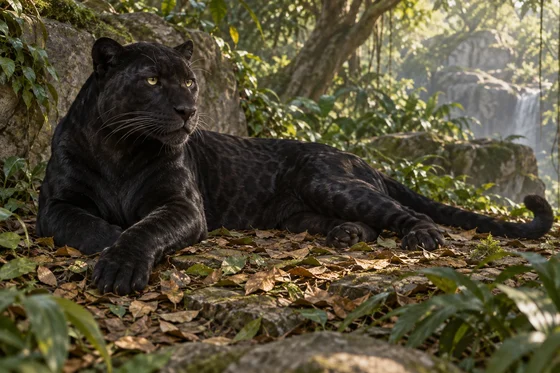
AI-generated interpretation of Kaa resting on a warm ledge after shedding his skin.
Original AI interpretation of Kipling’s verbal description. Precise scale pattern, eye colour, pose and background arrangement are imagined; no adaptation design or copied illustration is used.
Overview
Kaa’s Hunting introduces its python through the anxiety of Baloo and Bagheera, who need help retrieving the abducted Mowgli. Baloo identifies Kaa as the creature the tree-dwelling Bandar-log fear and says he climbs as well as they do. The narrator subsequently shows a large, blunt-nosed head, a body thirty feet long, and a freshly shed skin mottled brown and yellow. Kaa is not a venomous snake: his dangerous power lies in his strength and enclosing coils. These are features of Kipling’s individual literary character, not a scientific account of the abilities or maximum size of all rock pythons.
Baloo and Bagheera find him warming himself on a ledge after ten days spent changing his skin. He is hungry and willing to discuss hunting, although his size and deliberate manner make haste difficult to demand of him. Bagheera reports insults supposedly shouted by the monkeys, provoking the python without openly commanding him. Kaa also responds to Baloo’s account of love for the man-cub, saying that he too has known love. Their conversation makes him a courteous but dangerous ally with his own appetite and pride, rather than a tool the rescuers simply control.
On the journey Kaa keeps pace with Bagheera across level ground; the panther gains at a stream, but the snake recovers the distance afterward. At the abandoned city called the Cold Lairs, he crosses the west wall and strikes the monkeys attacking Baloo. The narration compares the force of his closed-mouth blow to a heavy weapon driven by a composed intelligence. He then finds a weakness in the marble screen imprisoning Mowgli, tests the distance and breaks the stonework with repeated head-first blows. Mowgli escapes through the opening, formally thanks him and offers future help. Kaa answers the boy’s courtesy and warns him to leave before the next part of the night.
The Hunger Dance changes the nature of the rescue. Kaa turns in circles and makes loops, figures of eight and changing geometric shapes with his body while humming. The monkeys say they cannot move without his order; when he tells them to approach, even Baloo and Bagheera step forward. Mowgli watches without sharing their response and uses his hands to bring his companions away. The story supplies a supernatural or heightened literary effect through movement, sound and compelled attention; it does not describe glowing eyes, projected light or a visible magical beam. Kaa remains both the rescuer to whom Mowgli owes his life and a predator whose performance frightens the other rescuers.
First appearances & development
Kipling’s Kaa’s Hunting in The Jungle Book. This profile uses the original English story and does not import adaptation designs or later plot changes.
Canon & continuity
Complete original story preserved with paragraph indices. Descriptions distinguish narrator-observed form and action from the other characters’ initial reports.
Selected bibliography
Documented works and useful reading. This is not a list of every appearance.
- 01
The Jungle Book
Original English narrative; no modern catalogue summary used.
Family & connections
A source-supported family tree or inspiration record has not yet been compiled for this profile. Related reading below indicates a connection in subject matter, not a proven lineage or creative influence.
References
Sources supporting this profile. Linked pages have their own scope and editorial standards.
- Primary literary textKaa’s HuntingResearch access: 2026-10-17
Image credits
AI-generatedAI-generated interpretation of Kaa resting on a warm ledge after shedding his skin.
Original AI interpretation of Kipling’s verbal description. Precise scale pattern, eye colour, pose and background arrangement are imagined; no adaptation design or copied illustration is used.