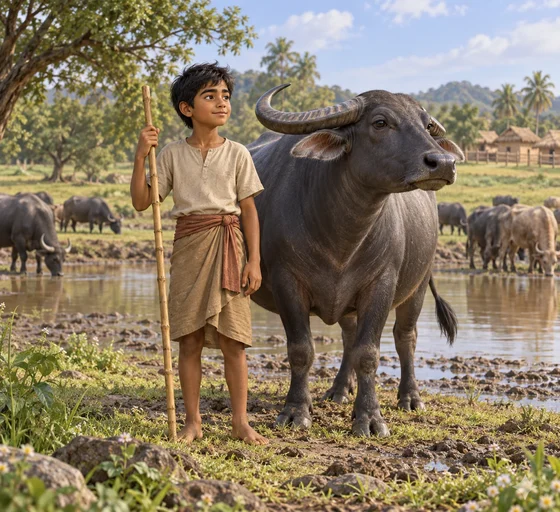
AI-generated interpretation of Hathi beside the drought-shrunken Waingunga.
Original AI interpretation of Kipling’s Hathi. Precise elephant anatomy, visible side of the scar, pose and river composition are imagined; the original stories supply the grey form, yellow tusks, old white scar and water-truce setting.
Overview
In How Fear Came, prolonged drought reduces the Waingunga to the Jungle’s remaining water supply. Hathi recognizes the exposed Peace Rock and proclaims the Water Truce, as his father had done fifty years earlier. The narrator calls him a wild elephant who lives for a hundred years and more. At the pool he and his sons are gaunt and grey in the moonlight; when he steps forward to speak, he is lean, wrinkled and yellow-tusked. These details describe an individual in the fictional Jungle. They do not turn the book’s age statement into a general longevity rule for real elephants.
Hathi acts as the truce’s warden. Predators and animals they usually hunt can drink in the same place because killing at the drinking places is forbidden during the emergency. When Bagheera makes an unwelcome remark about hunting, Hathi calls for peace. Later Shere Khan arrives fresh from killing a human and lets the blood taint the water. Hathi questions him, allows him to finish drinking, then orders him away for boasting while humans and animals alike are suffering. His three sons move forward, but the tiger leaves without a fight. His authority is shown through restraint and enforcement, not merely announced in a title.
When Mowgli asks about the tiger’s asserted right to kill on one special night, Hathi tells an origin narrative. In his account, Tha, the first elephant, formed the Jungle, and the first tiger’s killing of a buck brought death and eventually fear into its life. Hathi presents this as a tale handed down to him; Bagheera’s aside questions how much it has grown in the telling. The episode makes Hathi a keeper and interpreter of story as well as law. Its creation account belongs inside Kipling’s fictional world and is not presented here as a verified tradition of a real community.
Letting in the Jungle reveals another side of him. Mowgli summons Hathi by naming the Sack of the Fields of Bhurtpore. A long white scar on his slaty side corroborates the account of an elephant wounded by a stake in a pit-trap. Hathi admits that he and his three sons subsequently destroyed crops and roofs until five villages were abandoned. When Mowgli asks for a similar campaign against the village that mistreated Messua, Hathi initially objects that he has no quarrel with those people. He asks whether there will be killing, recalls his earlier bloodied tusks and agrees after connecting Mowgli’s grievance with his own injury.
The campaign proceeds through the villagers’ food and shelter. Hathi and his sons help gather and direct grazing animals, break the field-watch platforms and consume the remaining crops. Hathi opens a store of grain with his tusks. After the inhabitants finally leave in the rains, the elephants tear down the buildings and push together against the outer wall until it falls. The narrative therefore does not leave him as only a gentle guardian: the same patient strength that protects common access to water can also organize sustained displacement. This is a description of his literary actions, not approval of the villagers’ dispossession.
First appearances & development
Kipling’s original Mowgli stories, here bounded to How Fear Came and Letting in the Jungle in The Second Jungle Book. No military rank or costume from an adaptation is assigned.
Canon & continuity
Both complete original stories preserved with paragraph indices. Direct action, character memory and the embedded origin tale are distinguished.
Selected bibliography
Documented works and useful reading. This is not a list of every appearance.
- 01
The Second Jungle Book
Original English narrative; no modern catalogue summary used.
Family & connections
A source-supported family tree or inspiration record has not yet been compiled for this profile. Related reading below indicates a connection in subject matter, not a proven lineage or creative influence.
References
Sources supporting this profile. Linked pages have their own scope and editorial standards.
- Primary literary textHow Fear Came and Letting in the JungleResearch access: 2026-10-17
Image credits
AI-generatedAI-generated interpretation of Hathi beside the drought-shrunken Waingunga.
Original AI interpretation of Kipling’s Hathi. Precise elephant anatomy, visible side of the scar, pose and river composition are imagined; the original stories supply the grey form, yellow tusks, old white scar and water-truce setting.