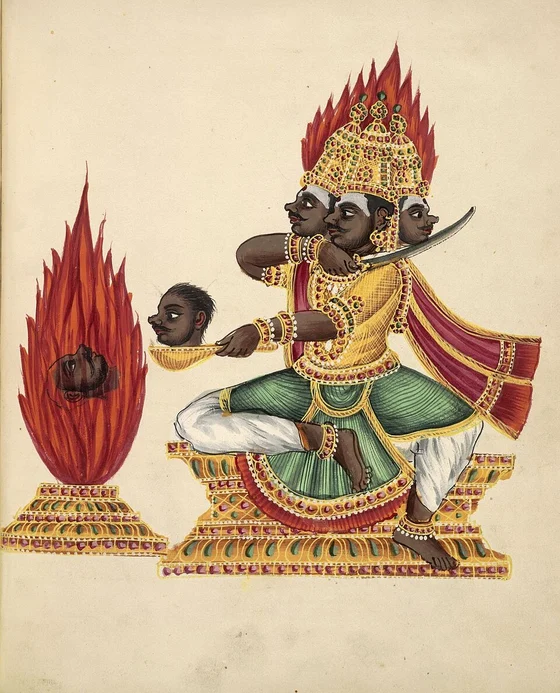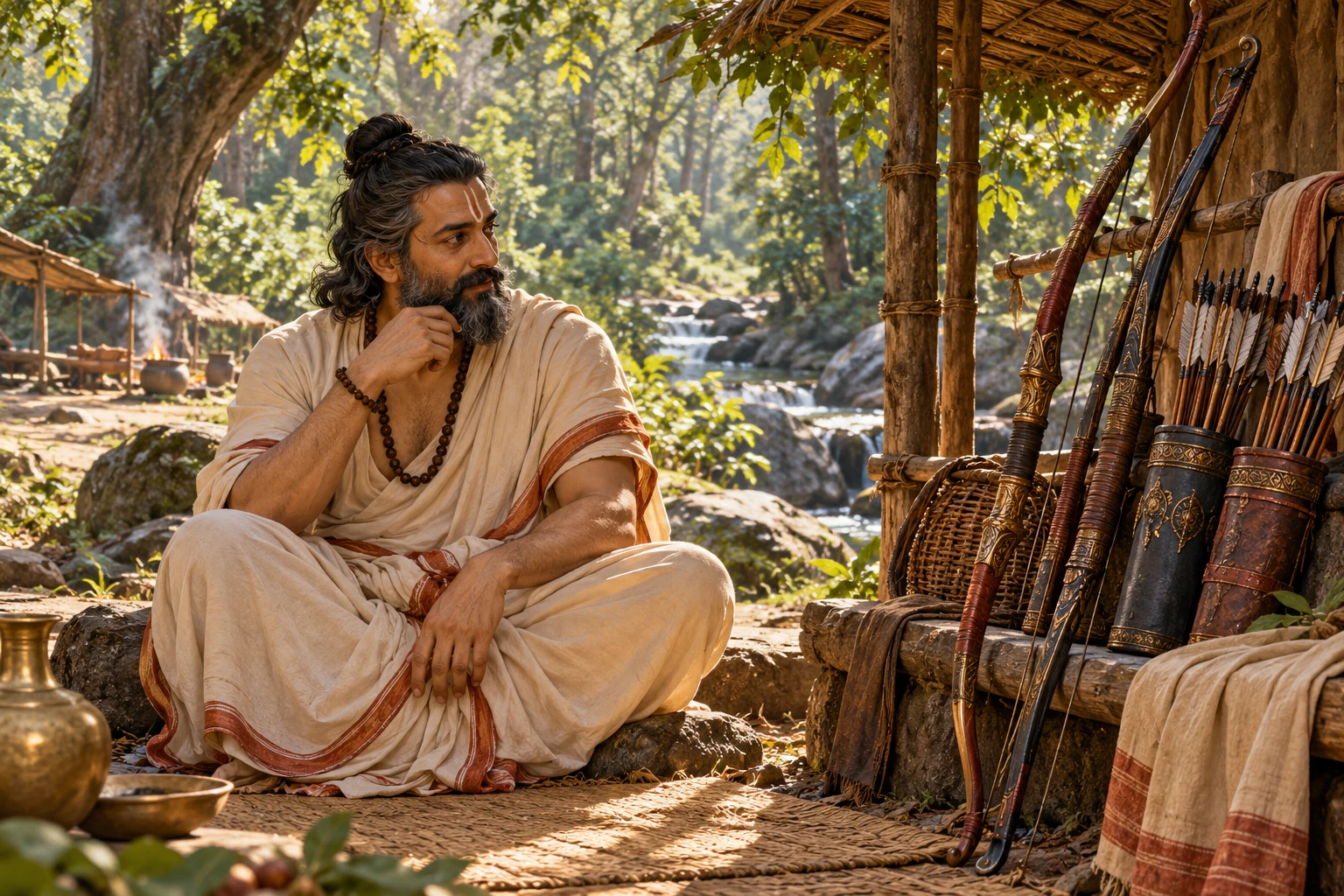
AI-generated interpretation of Jatasura in his narrated human disguise near the Pandavas’ weapons. Face, clothing, religious marks, weapon ornamentation and camp details are artistic choices; this is not historical or ethnographic evidence.
Full delivered frame inspected: adult human disguise seated beside weapons and quivers, complete seated pose. Face, dress, marks and camp are interpreted, not ethnographic evidence or canonical monster anatomy.
Overview
Jatasura enters the Pandavas’ company in the guise of a learned Brahmana in Ganguli’s Vana Parva translation. He claims skill in counsel and knowledge of the scriptures, and Yudhishthira supports him as a guest. His concealed aims are to seize their weapons and carry off Draupadi. He waits until Bhima is hunting, Ghatotkacha and his followers have departed, and the sages are away. Then he takes a gigantic, terrifying form, gathers the weapons and abducts Yudhishthira, Nakula, Sahadeva and Draupadi.
The captives participate in their rescue. Sahadeva frees himself, recovers the sword Kausika and calls for Bhima. Yudhishthira reproaches the abductor for injuring those who have fed and sheltered him, then makes himself heavy enough to slow the escape. His speech presents Rakshasas as capable of recognising moral obligations, rather than treating their category as an excuse for every action. Those arguments belong to this translated episode, not a universal description of religious belief.
Bhima arrives carrying a mace and confronts Jatasura. He says that the stranger’s interest in their weapons had already aroused suspicion, but that he had not killed a guest who had not yet committed an offence. Jatasura puts down the remaining captives and answers with a threat to avenge Rakshasas Bhima has killed. When the twins move to help, Bhima asks them to watch. The opponents uproot trees, exchange rocks and wrestle. Bhima finally incapacitates the abductor, kills him and returns to Yudhishthira, receiving praise from the Brahmanas.
This complete account makes disguise, misplaced trust, resistance and rescue central to the named being’s role. Its text gives a gigantic revealed form but no fixed skin colour, number of horns or tiger face. The threat to Draupadi is part of the attempted abduction; the narrative does not say that sexual violence was completed. The selected historical English witness is Ganguli’s translation, with its own spellings and moral speeches. The Sanskrit original and other recensions have not been collated here, and no modern game’s use of this particular story is established.
Origins & earliest records
Mahabharata, Book 3, Vana Parva, section CLVI in Kisari Mohan Ganguli’s historical English translation. Hosted body includes printed markers 316–318; its opening precedes marker 316. The translation’s overall publication period is 1883–1896; the exact print exemplar used by the host is unverified.
Records & interpretation
Complete section CLVI read through Jatasura’s death and Bhima’s return/praise; subsequent CLVII–CLVIII read as context. Complete translator’s preface and title evidence reused from the immediately preceding independently read Ganguli packet. No attached original footnote appears in the selected returned section; a modern word-link was removed in the clean reading copy, with raw evidence preserved.
Selected bibliography
Documented works and useful reading. This is not a list of every appearance.
- 01
The Mahabharata, Book 3: Vana Parva, section CLVI
Complete named account; markers 316–318 in hosted text. Exact physical print edition and Sanskrit recension unverified.
Family, evolution & connections
Rakshasa (Dungeons & Dragons)
Ganguli’s complete Vana Parva CLVI describes Jatasura entering a household in a learned human disguise, then stealing weapons and abducting its members. This supplies a particular traditional disguise narrative beside the game’s shape-changing Rakshasa. The comparison does not establish designer consultation of this episode, tiger anatomy, reversed hands or shared game mechanics.
References
Sources supporting this profile. Linked pages have their own scope and editorial standards.
- Historical English epic translationGanguli, complete Vana Parva CLVIResearch access: 2026-10-26
Image credits
Modern interpretation of a historical literary accountAI-generated interpretation of Jatasura in his narrated human disguise near the Pandavas’ weapons. Face, clothing, religious marks, weapon ornamentation and camp details are artistic choices; this is not historical or ethnographic evidence.
Full delivered frame inspected: adult human disguise seated beside weapons and quivers, complete seated pose. Face, dress, marks and camp are interpreted, not ethnographic evidence or canonical monster anatomy.