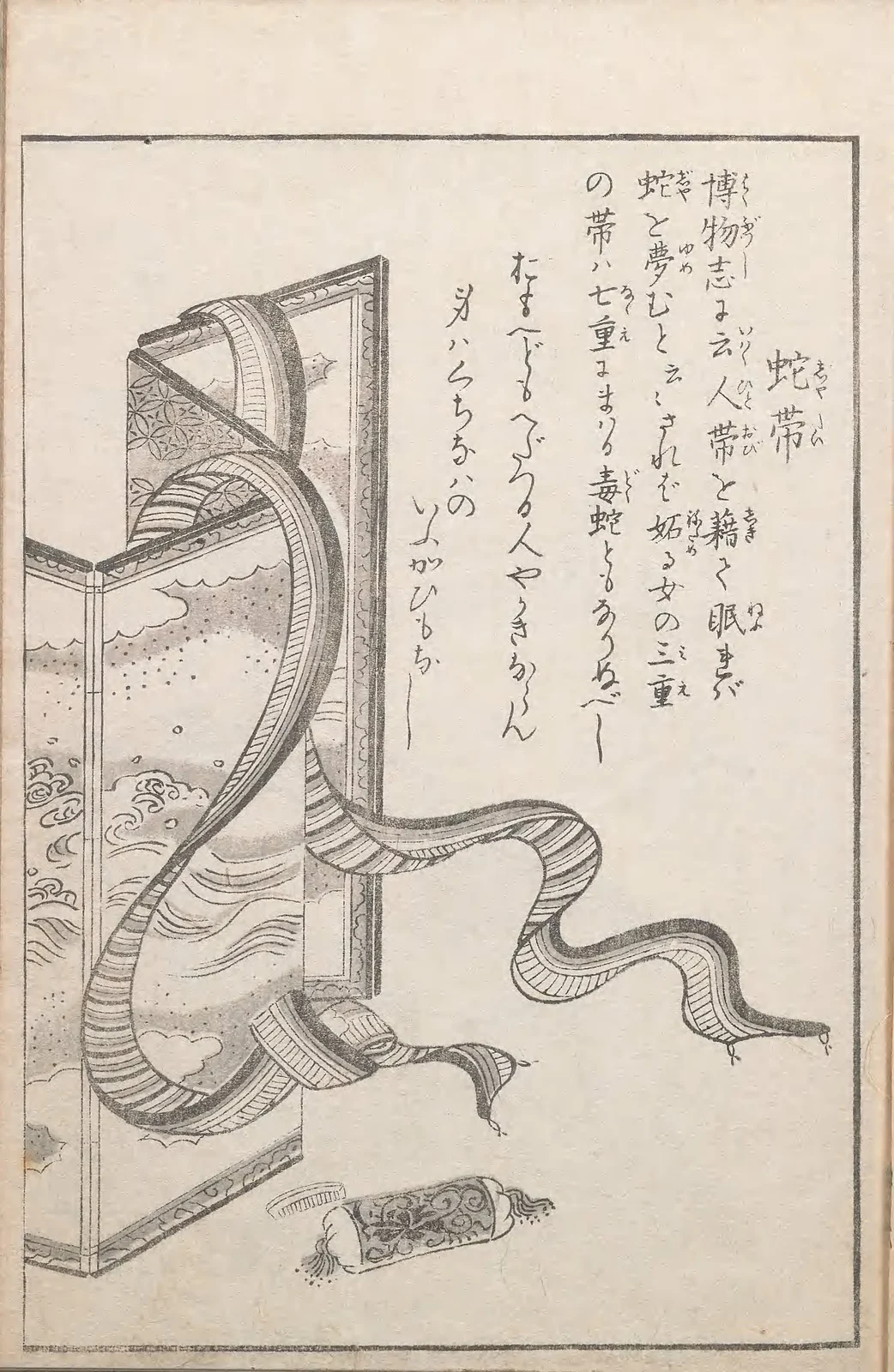
Jatai, named plate by Toriyama Sekien
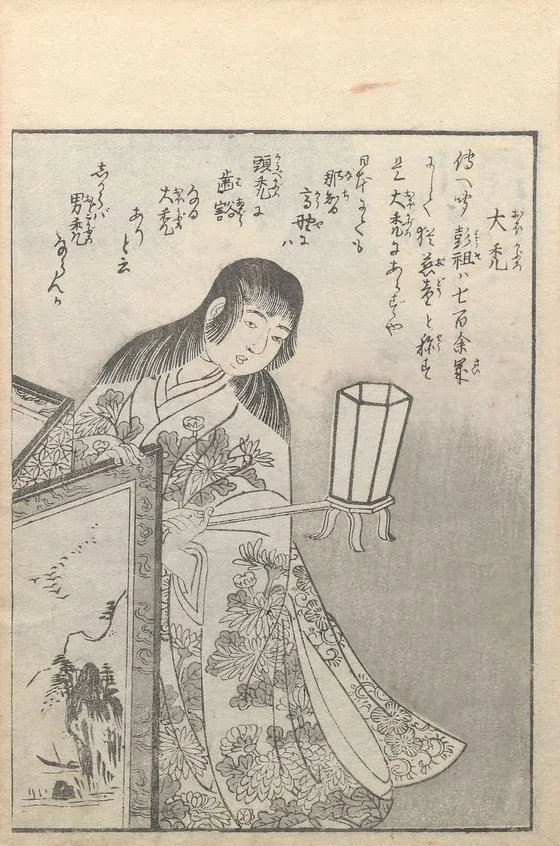
Jatai is labelled 蛇帯 in Sekien’s Konjaku Hyakki Shūi. The drawing transforms a sash or belt into a serpentlike object: a long striped band bends upward around a decorated folding screen and ends in a small snake’s head. A second snake-headed strip lies lower in the composition. Ordinary fabric patterning remains visible, allowing the viewer to recognize both the garment and its animated reptilian form. Caption label checked at enlarged resolution.
Overview
Jatai is labelled 蛇帯 in Sekien’s Konjaku Hyakki Shūi. The drawing transforms a sash or belt into a serpentlike object: a long striped band bends upward around a decorated folding screen and ends in a small snake’s head. A second snake-headed strip lies lower in the composition. Ordinary fabric patterning remains visible, allowing the viewer to recognize both the garment and its animated reptilian form.
The inscription explicitly introduces a dream of a snake and a sash through a reference to the Bowuzhi. That literary connection is part of Sekien’s caption and should not be mistaken for a verified independent translation of the older Chinese passage. The plate’s evidence concerns cloth assuming a serpentine appearance. It does not show a venomous bite or a garment strangling its wearer. Such actions would require another narrative source rather than extrapolation from the winding shapes.
Origins & earliest records
Japan; Toriyama Sekien’s illustrated collection; Chinese literary reference in caption
Records & interpretation
Directly inspected labelled primary woodblock plate; descriptive claims limited to this witness.
Selected bibliography
Documented works and useful reading. This is not a list of every appearance.
- 01
Konjaku Hyakki Shūi
Inspected Smithsonian digitization; image canvas index 14 (zero-based, not printed page number).
Family & connections
A source-supported family tree or inspiration record has not yet been compiled for this profile. Related reading below indicates a connection in subject matter, not a proven lineage or creative influence.
Primary records and illustrations
Konjaku Hyakki Shūi
HyakkishuYiV2Tori. Label 蛇帯; IIIF canvas index 14; zero-based scan locator, not printed pagination
Jatai is labelled 蛇帯 in Sekien’s Konjaku Hyakki Shūi. The drawing transforms a sash or belt into a serpentlike object: a long striped band bends upward around a decorated folding screen and ends in a small snake’s head. A second snake-headed strip lies lower in the composition. Ordinary fabric patterning remains visible, allowing the viewer to recognize both the garment and its animated reptilian form. Caption label checked at enlarged resolution.
References
Sources supporting this profile. Linked pages have their own scope and editorial standards.
- Primary illustrated sourceKonjaku Hyakki Shūi digitized primary plate 蛇帯Research access: 2026-10-05
- Institutional catalogSmithsonian Libraries digitized volumeResearch access: 2026-10-05
Image credits
Historical illustrationJatai, named plate by Toriyama Sekien
Jatai is labelled 蛇帯 in Sekien’s Konjaku Hyakki Shūi. The drawing transforms a sash or belt into a serpentlike object: a long striped band bends upward around a decorated folding screen and ends in a small snake’s head. A second snake-headed strip lies lower in the composition. Ordinary fabric patterning remains visible, allowing the viewer to recognize both the garment and its animated reptilian form. Caption label checked at enlarged resolution.