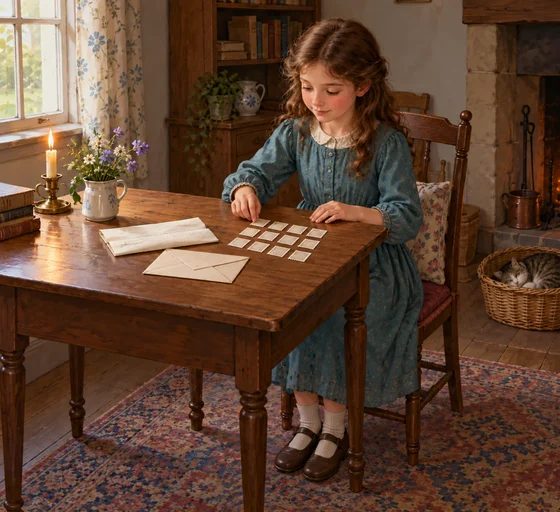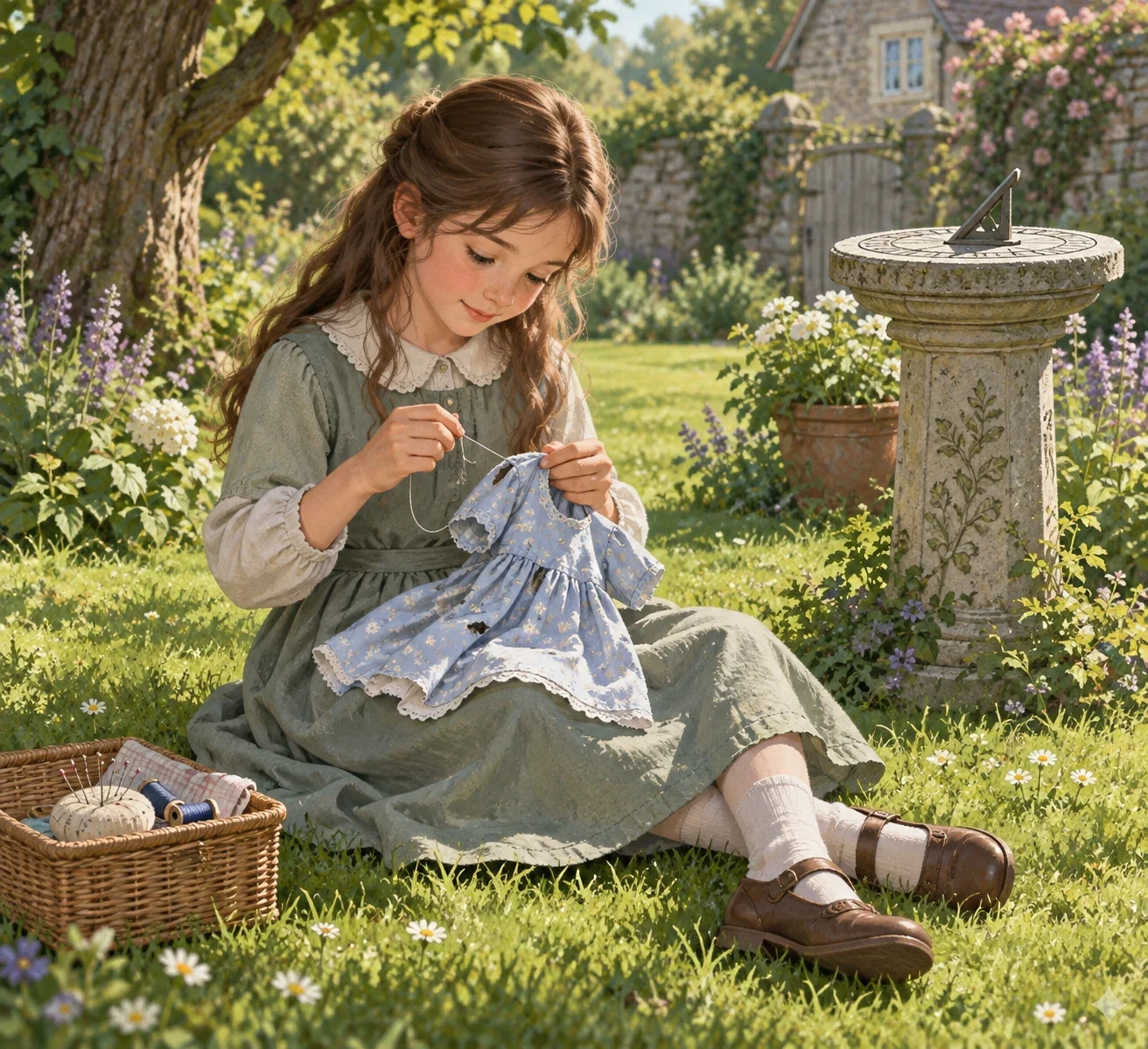
Imagined Jane mends her frock beside the sundial.
Unofficial AI interpretation. Jane mends her frock beside the sundial. Action and selected objects follow the original narrative; portrait, precise age, clothes beyond named details, setting and light are imagined, without an adaptation likeness claim. Full-frame display derivative; no upscaling.
Overview
Jane is the child nicknamed Pussy in Five Children and It, one of the four older siblings who share the Psammead adventures. Her name and nickname identify a human character rather than a cat or an animal spirit. At the gravel-pit she worries that digging through to Australia might drop sand into other people’s eyes, an imaginative fear that Cyril and Anthea know does not reflect the real distance. She then wonders whether the hidden creature is a snake. The scene distinguishes the children’s speculation from what they uncover; Jane’s worry is part of her voice, not a geographical or zoological claim.
Jane participates in the children’s hope that better wishes can still be found. After the goldfish bowl is upset, she must mend the frock torn during the Rochester outing instead of wearing her best clothes. She works on the grass near the sundial while the others stay with her and discuss their disappointments. The narrator says that she and Cyril are the more hopeful pair at this point. She insists that having an unusual opportunity is a reason to think harder rather than abandon it. This practical domestic episode gives her a distinct activity outside the magical spectacle, while its presence does not imply that sewing defines all her interests.
Her suggestions can be ingenious and dangerous at the same time. With rainbow wings she argues that birds are not treated like ordinary human wrongdoers when they take fruit; the remark belongs to her argument, not a moral permission established by the narrator. Cyril later makes her lookout for the larder expedition because she has sharp eyes and can whistle. After Robert’s enlargement, Jane proposes earning money by exhibiting him at the fair. The proposal promises a useful result from a wish, but the tiring show, the exhibitors’ assumptions and the difficulty of escaping at sunset reveal costs that she did not foresee.
The last jewellery trouble is set in motion by Jane’s casual wish that their mother could find the admired jewels in her own room. Her siblings recognise immediately that she has used the day’s opportunity, although the consequences are not visible at first. When the jewels appear, Jane and Anthea search for the Psammead and negotiate a repair. Jane specifically asks that mother forget the diamonds; the final requests also remove related memories and protect the creature’s secret. She asks afterwards whether they have done right, and tells Robert the outcome when they return. This original-novel scope allows mistakes, initiative and cooperation to remain together. It supplies neither a permanent magical talent, an exact age or adult career, nor a fixed later adaptation likeness.
First appearances & development
E. Nesbit’s original Five Children and It. This profile follows the retained original narrative rather than the later sequence or adaptations; no undocumented personal model or influence is asserted.
Canon & continuity
Original narrative.
Selected bibliography
Documented works and useful reading. This is not a list of every appearance.
- 01
Five Children and It
Selected original chapters.
Family & connections
A source-supported family tree or inspiration record has not yet been compiled for this profile. Related reading below indicates a connection in subject matter, not a proven lineage or creative influence.
References
Sources supporting this profile. Linked pages have their own scope and editorial standards.
- PrimaryFive Children and ItResearch access: 2026-10-11
- CatalogueGutenberg: Five Children and ItResearch access: 2026-10-11
Image credits
Unofficial modern AI interpretationImagined Jane mends her frock beside the sundial.
Unofficial AI interpretation. Jane mends her frock beside the sundial. Action and selected objects follow the original narrative; portrait, precise age, clothes beyond named details, setting and light are imagined, without an adaptation likeness claim. Full-frame display derivative; no upscaling.