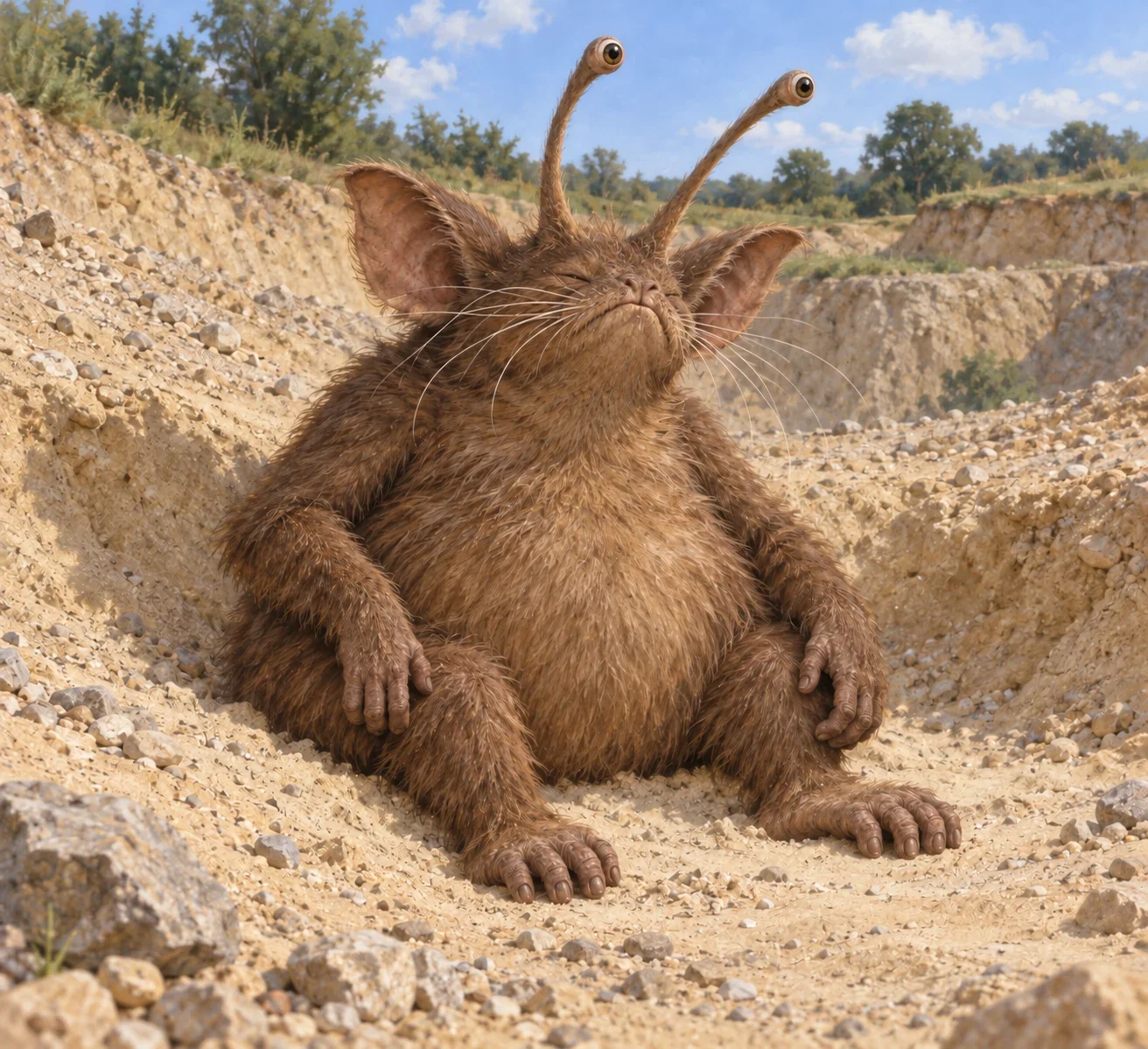
Unofficial AI interpretation of the Psammead in its sandy hollow. Stalk-tip eyes, bat-like ears, tubby brown fur, whiskers and monkey-like hands and feet follow the text. Fine proportions, limb arrangement, face and setting are imagined; no literal spider limb-count claim is made.
Unofficial AI interpretation of the Psammead in its sandy hollow. Stalk-tip eyes, bat-like ears, tubby brown fur, whiskers and monkey-like hands and feet follow the text. Fine proportions, limb arrangement, face and setting are imagined; no literal spider limb-count claim is made. Full-frame display derivative; no upscaling.
Overview
Anthea discovers the creature while the children dig in the gravel-pit. Brown, furry and fat, it emerges from the sand and rubs the ends of its eyes. Those eyes sit on long horns like a snail’s and retract and extend like telescopes. Bat-like ears, a tubby spider-shaped body, furry arms and legs, monkey-like hands and feet, and long rat-like whiskers give the sand-fairy a particular composite appearance. These comparisons do not make it a literal spider or monkey, and the passage does not establish a numbered arthropod limb plan.
The Psammead identifies itself as a sand-fairy and claims to have lived for several thousand years. Its accounts of ancient breakfasts and other sand-fairies are dialogue within the fantasy, not palaeontological evidence. The children learn that requesting a gift involves more than choosing an attractive result. Their wish for beauty leaves them unrecognisable at home; golden guineas prove inconvenient to carry and spend; wings provide freedom while creating a problem when the day’s enchantment ends. Consequences come from the collision between literal magic and practical needs, rather than a consistent intention to punish every petitioner.
Wish-making is visibly physical. The creature pushes out its eyes, holds its breath, swells greatly and releases a sigh before announcing completion. The children often expect transformations to end at sunset, but the closing episode also contains corrective and memory-changing wishes. A blanket assertion that every consequence vanishes without exception would therefore flatten the story’s treatment. The Psammead’s complaint that repeated swelling may strain it supplies a personal limit and fear, not a medical explanation of supernatural physiology.
When jewels create a serious crisis, Anthea offers an agreement: after the necessary corrective wishes, the children will never ask it for another. The relieved creature performs the sequence and requests secrecy, fearing what grown-ups would demand if they discovered it. It cannot simply wish for itself and asks the children to frame the protective wish. This negotiation gives it interests beyond serving as a machine for the children’s desires. The profile follows the gravel-pit individual in this novel rather than importing later adventures as extra anatomical evidence.
First appearances & development
Nesbit’s original novel places an ancient-seeming sand-fairy in a familiar country setting beside the children’s home. Its invented comparative anatomy and first-person memories belong to that literary encounter. This account does not turn the creature into a traditional Greek fairy species merely because its name is explained as Greek in the dialogue.
Canon & continuity
Complete primary text supports the selected appearance and episodes. Character statements and narrator explanations are distinguished. Catalogue rights metadata is retained without using its automated plot summary.
Selected bibliography
Documented works and useful reading. This is not a list of every appearance.
- 01
Five Children and It
Original narrative in the retained English edition. Catalogue rights and electronic provenance are separate from story claims; source illustrations were not used.
Family & connections
A source-supported family tree or inspiration record has not yet been compiled for this profile. Related reading below indicates a connection in subject matter, not a proven lineage or creative influence.
References
Sources supporting this profile. Linked pages have their own scope and editorial standards.
- Primary fictionFive Children and It — original primary textResearch access: 2026-10-11
- Bibliographic and rights recordProject Gutenberg catalogue: Five Children and ItResearch access: 2026-10-11
Image credits
Unofficial modern AI interpretationUnofficial AI interpretation of the Psammead in its sandy hollow. Stalk-tip eyes, bat-like ears, tubby brown fur, whiskers and monkey-like hands and feet follow the text. Fine proportions, limb arrangement, face and setting are imagined; no literal spider limb-count claim is made.
Unofficial AI interpretation of the Psammead in its sandy hollow. Stalk-tip eyes, bat-like ears, tubby brown fur, whiskers and monkey-like hands and feet follow the text. Fine proportions, limb arrangement, face and setting are imagined; no literal spider limb-count claim is made. Full-frame display derivative; no upscaling.