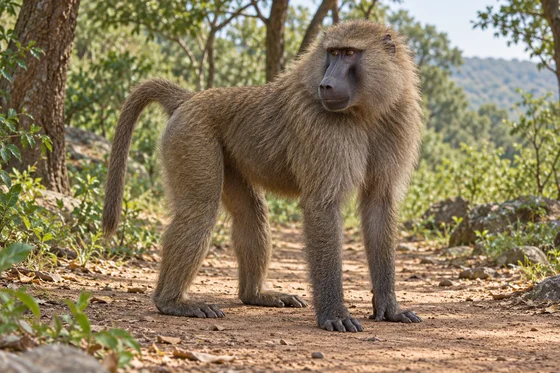
AI-generated interpretation of Isuro in the selected English retelling.
Original AI interpretation of the big white rabbit with pink eyes specified in this edited English witness. Exact natural species, anatomy, pose, scale, vegetation, river arrangement and light are imagined. The image is not an indigenous-language or ethnographic record.
Overview
Isuro and Gudu begin the selected tale as close friends: a big white rabbit and a tall baboon seldom seen apart. Isuro accompanies Gudu on a courting journey, carrying green food in a bag. At a river crossing, the baboon pretends to discard his provisions by throwing in a stone; Isuro actually throws his own food away. Gudu then eats from a concealed bag and withholds his fruit. The friendship’s language gives way to a practical inequality in which one companion controls both information and access to food.
Repeated deception changes Isuro’s behaviour. After being directed toward hard green oranges while Gudu keeps the ripe yellow ones, he resolves to do the opposite of what the baboon recommends. He also gathers healing leaves in advance, anticipating an errand Gudu has demanded. That precaution does not immediately save his supper: the baboon invents a village rule requiring Isuro to wait, then fakes a burnt mouth and eats both portions while the rabbit briefly goes away. The narrator identifies the claimed rule as a lie. It is a character’s device, not evidence of a community’s eating customs.
Isuro gains room to act when others are watching. He takes edible nuts instead of the empty shells Gudu points out, knowing the baboon cannot easily seize them in public. Later he keeps the meat he prefers and hides it when Gudu extinguishes a fire to steal it in darkness. His remark that the baboon has taught him cleverness states the reversal openly. But he is not simply an innocent observer of Gudu’s later offence: he helps prepare a stolen goat, then eats its meat while Gudu sleeps and fastens the bones into the baboon’s fur.
The ending turns concealed evidence into a lethal advantage. Isuro clears himself by tumbling and shaking before the villagers, whereas the bones rattle when Gudu jumps. When both are threatened with death, the rabbit proposes burning them inside a wood-pile, claiming the one who burns will be revealed as the killer. He already knows a hole beneath the wood and escapes into it; Gudu dies. Isuro emerges from the ashes and presents survival as proof. The reader knows the hiding place, so the result is successful manipulation of an ordeal rather than independent supernatural confirmation of his innocence.
Origins & earliest records
The selected witness is How Isuro the Rabbit Tricked Gudu in The Orange Fairy Book, edited by Andrew Lang. Its footer labels it a Mashona Story. The printed edition history gives first publication in 1906 and includes a 1937 reprint. Lang’s preface openly describes edited, nonliteral adaptations for children; it mentions Fairbridge’s Rhodesian collecting but provides no individual teller, Shona-language text or precise locality for this tale.
Records & interpretation
Complete tale read from opening friendship through the final claim after the fire. Opening expressly specifies a big white rabbit, and the night-watch scene specifies pink eyes. The narrator exposes Gudu’s lies and the hidden hole, allowing the reader to distinguish successful trickery from the villagers’ mistaken evidential conclusions. Appearance is limited to this English adaptation.
Selected bibliography
Documented works and useful reading. This is not a list of every appearance.
- 01
The Orange Fairy Book — How Isuro the Rabbit Tricked Gudu
Complete tale, printed pp.29–36, and complete preface pp.v–viii, in a later Crown Edition witness listing reprints through 1937. Historical Mashona attribution retained without a claim of literal oral transcription.
Family & connections
A source-supported family tree or inspiration record has not yet been compiled for this profile. Related reading below indicates a connection in subject matter, not a proven lineage or creative influence.
References
Sources supporting this profile. Linked pages have their own scope and editorial standards.
- Historical edited narrative witnessThe Orange Fairy Book — complete selected English retelling, preface and edition matterResearch access: 2026-10-21
Image credits
AI-generatedAI-generated interpretation of Isuro in the selected English retelling.
Original AI interpretation of the big white rabbit with pink eyes specified in this edited English witness. Exact natural species, anatomy, pose, scale, vegetation, river arrangement and light are imagined. The image is not an indigenous-language or ethnographic record.