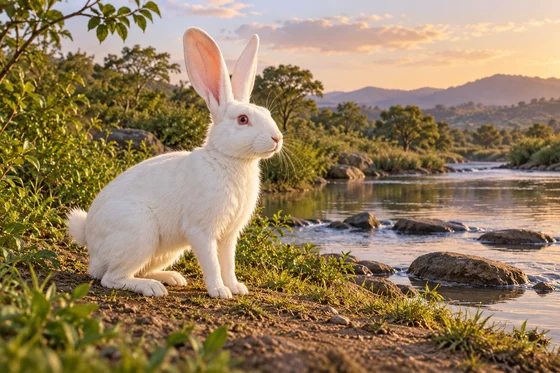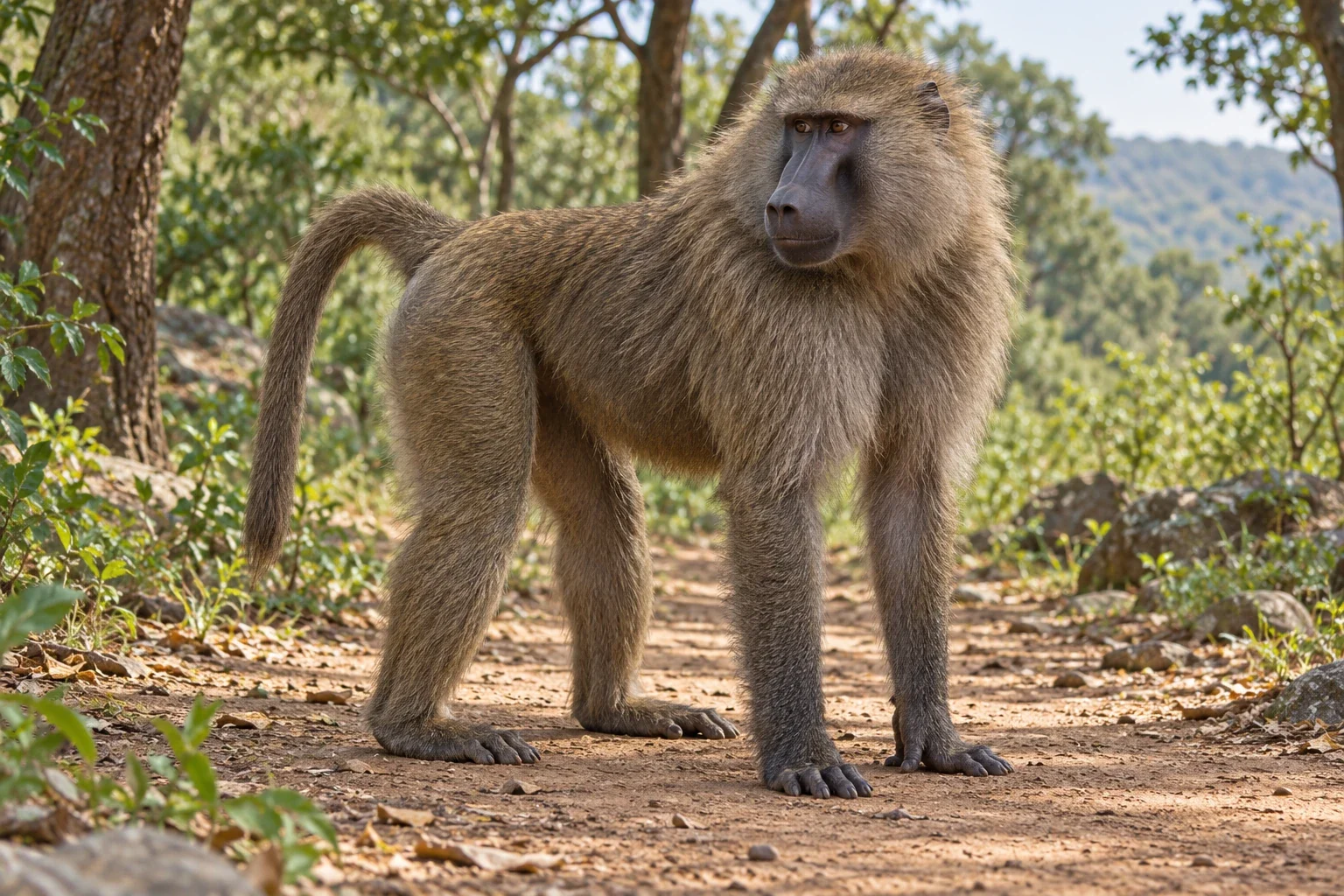
AI-generated interpretation of Gudu in the selected English retelling.
Original AI interpretation of the tall baboon and thick neck hair specified by this edited English witness. Natural species, coat colour, exact anatomy, pose, woodland plants and light are imagined. No community costume or ritual imagery is inferred.
Overview
Gudu is introduced as a tall baboon and Isuro’s close companion. He takes the rabbit along while visiting his intended wife and her family, but their shared journey repeatedly serves his appetite. He makes a stone’s splash stand in for a discarded food bag, while keeping his real provisions hidden in the thick hair around his neck. His deception depends on what Isuro can hear and see, and on the rabbit accepting instructions from a seemingly trusted friend.
He continues the pattern by steering Isuro toward unripe oranges, refusing ripe fruit under the pretence of protecting him, and inventing a rule that the rabbit must wait until he has eaten. Gudu then feigns a burnt mouth so that Isuro will leave to collect leaves. During the absence he eats the rabbit’s portion and blames other visitors. These incidents are narrated as calculated lies. The village and the prospective in-laws provide the setting, but their presence does not make his claims an accurate account of marriage hospitality or local custom.
Gudu’s control weakens as Isuro recognizes the pattern. The rabbit chooses kernels instead of the shells offered to him, and witnesses prevent Gudu from taking them away. A later attempt to steal the rabbit’s meat by extinguishing the fire also fails. Gudu then steals a goat and recruits Isuro to cook it. Together they skin the animal, stuff the hide with dry leaves and stand it among bushes to delay discovery. While waiting for the cooking, Gudu hopes to eat the meat alone, but believes Isuro is awake because the sleeping rabbit’s pink eyes remain open. Exhaustion finally makes the baboon sleep.
He wakes with the goat’s bones attached to his fur, placed there after Isuro has eaten. When the missing animal is discovered, the bones become apparent proof against him. Gudu correctly accuses Isuro of eating the meat and hanging the bones, but also falsely denies having killed the goat. The villagers cannot resolve the competing stories and threaten both animals. Gudu then dies in the fire ordeal proposed by Isuro, who has reserved an escape hole for himself. The conclusion preserves both companions’ participation in deception; the baboon’s death does not make every part of the rabbit’s final explanation true.
Origins & earliest records
The selected witness is How Isuro the Rabbit Tricked Gudu in The Orange Fairy Book, edited by Andrew Lang. Its footer labels it a Mashona Story. The printed edition history gives first publication in 1906 and includes a 1937 reprint. Lang’s preface openly describes edited, nonliteral adaptations for children; it mentions Fairbridge’s Rhodesian collecting but provides no individual teller, Shona-language text or precise locality for this tale.
Records & interpretation
Complete tale read, including the opening identity, concealed bag in thick neck hair, food tricks, stolen goat and final accusation. It specifies a tall baboon but not a natural species or exact coat colour. The final account is tested against earlier narrated action rather than treated as a reliable confession or supernatural judgement.
Selected bibliography
Documented works and useful reading. This is not a list of every appearance.
- 01
The Orange Fairy Book — How Isuro the Rabbit Tricked Gudu
Complete tale, printed pp.29–36, and complete preface pp.v–viii, in a later Crown Edition witness listing reprints through 1937. Historical Mashona attribution retained without a claim of literal oral transcription.
Family & connections
A source-supported family tree or inspiration record has not yet been compiled for this profile. Related reading below indicates a connection in subject matter, not a proven lineage or creative influence.
References
Sources supporting this profile. Linked pages have their own scope and editorial standards.
- Historical edited narrative witnessThe Orange Fairy Book — complete selected English retelling, preface and edition matterResearch access: 2026-10-21
Image credits
AI-generatedAI-generated interpretation of Gudu in the selected English retelling.
Original AI interpretation of the tall baboon and thick neck hair specified by this edited English witness. Natural species, coat colour, exact anatomy, pose, woodland plants and light are imagined. No community costume or ritual imagery is inferred.