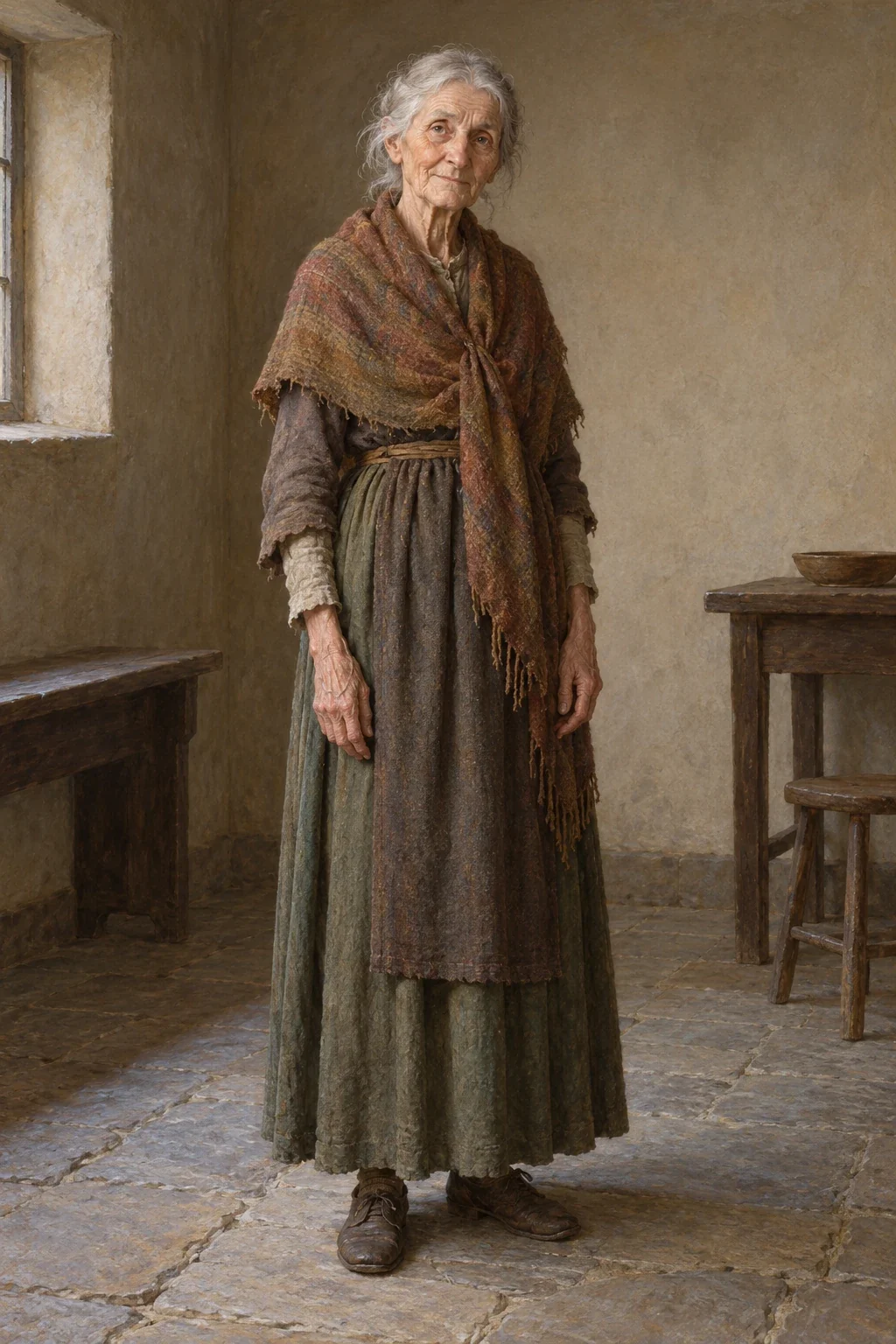
Portrayal of The Innkeeper’s Protective Mother (Gaster’s Version).
Portrayal selects the mother in her deliberately assumed very old, thin human form, alone inside the plain chamber before the rescue. Exact face, hair, clothing and room furnishings are imagined; no pointed hat, occult symbol, ointment application, dog, victim, duck, corpse, fire or collapsing building.
Overview
The protective mother enters Gaster’s tale LXXXV after a young woman has been abducted by robbers and sold to a murderous innkeeper. The innkeeper kills travellers and serves their flesh to later guests, forcing the captive to prepare the food. One day he brings in another captive, an extremely old, thin and wizened woman whom he has bought. The young woman is initially frightened by her appearance. The newcomer speaks kindly and identifies herself as a powerful witch who can change things. She says the innkeeper is her own son, whom she cursed for cruelty while he was still a boy.
Her appearance is deliberate concealment. She explains that she has assumed this ugly old form because her son would otherwise recognise and kill her. The account does not describe her underlying appearance, ordinary age, name or earlier life, beyond the reported relationship and earlier curse. Nor does it explain the specific circumstances of that curse. She has come to punish him, but first listens to the young woman’s account and promises that the locked room will not prevent escape. This is a particular mother’s intervention in the tale, not a claim that all old women, mothers or practitioners have these powers.
The rescue has a troubling cost: she tells the captive to kill the small dog inherited from her parents and swallow a piece of its heart. While the girl does so, the mother takes ointment from her own bosom and rubs it over the girl, who becomes a duck. The duck waits quietly in a corner and flies out when the innkeeper opens the door. The dog’s death and the transformation belong to the historical narrative; they supply no advice for treating animals or performing a real-world rite.
After the son searches for his missing captive, the mother follows him out and pronounces a curse. The entire house falls upon him and kills him. The duck turns back and sees the ruins, as the mother had foretold. Because the mother has not explained how to reverse the transformation, the young woman remains a duck. The account gives no subsequent fate for the mother and no restoration of the dog. Gaster compares the murderous inn to Bluebeard, Polyphemus and Sindbad, but these are comparative comments rather than identities assigned to the son or additional exploits of his mother. Her protective action is therefore preserved alongside the cost and limits of her rescue.
Origins & earliest records
Gaster, Rumanian Bird and Beast Stories (1915), LXXXV, Why Does the Duck Feed on Refuse? / The Story of the Cannibal Innkeeper, printed pp. 259-262. Individual teller, exact source edition and field locality are not assigned here.
Records & interpretation
Complete selected English narrative and attached commentary read. Complete preface and introduction paragraphs 0-11 and 119-132 already read for the same unchanged edition; full introduction retained without a whole-introduction reading claim. Original 1915 titlepage image previously viewed; no independent Romanian-language translation.
Selected bibliography
Documented works and useful reading. This is not a list of every appearance.
- 01
Rumanian Bird and Beast Stories Rendered into English
LXXXV, Why Does the Duck Feed on Refuse? / The Story of the Cannibal Innkeeper, pp. 259-262, complete selected account and notes. Retained original titlepage gives London, Folk-Lore Society, Sidgwick & Jackson.
Family & connections
A source-supported family tree or inspiration record has not yet been compiled for this profile. Related reading below indicates a connection in subject matter, not a proven lineage or creative influence.
References
Sources supporting this profile. Linked pages have their own scope and editorial standards.
- Primary historical folklore translation and compilationGaster 1915 historical English compilation, complete retained PG transcriptionResearch access: 2026-10-21
Image credits
AI-generatedPortrayal of The Innkeeper’s Protective Mother (Gaster’s Version).
Portrayal selects the mother in her deliberately assumed very old, thin human form, alone inside the plain chamber before the rescue. Exact face, hair, clothing and room furnishings are imagined; no pointed hat, occult symbol, ointment application, dog, victim, duck, corpse, fire or collapsing building.