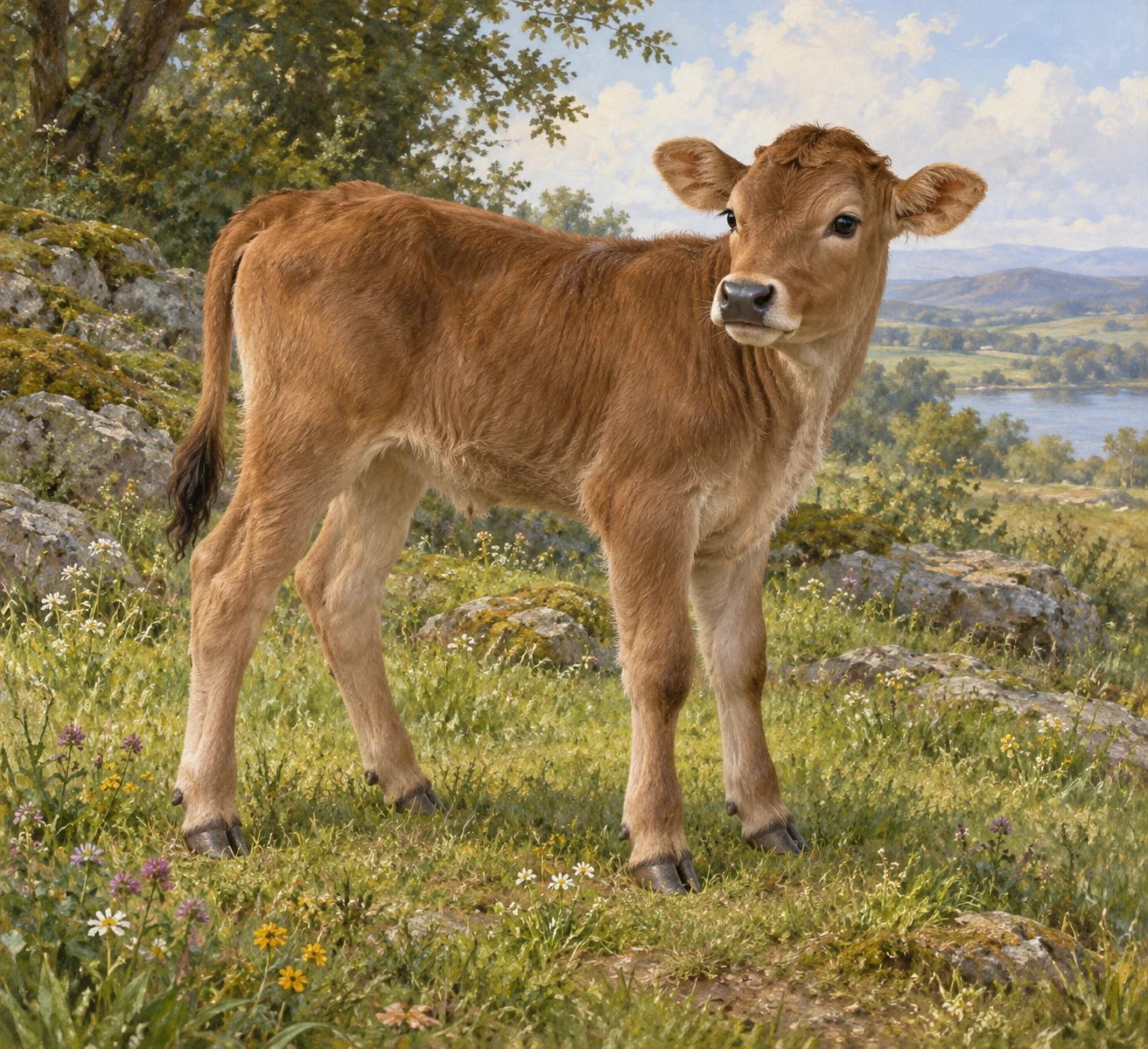
Portrayal of The Calf Whose Bones Become Doves (Gaster’s Version).
Portrayal selects the one living calf before its killing, alone at a quiet meadow edge. Ordinary young bovine anatomy and a muted brown coat are imagined; no species or breed identification beyond calf, adult horns, textile apparatus, human hands, doves, bones, wounds or slaughter scene.
Overview
The helpful calf appears in Gaster’s tale LXXXIX, which he introduces as a brief variant of the Cinderella cycle. A father gives the animal to his daughter, whose stepmother keeps her dirty, sends her to tend cattle and imposes impossible textile work. The account calls the calf wise and gives it speech, but does not identify it as the girl’s dead mother, a transformed fairy or a particular breed. Its sex, coat colour and exact age beyond being a little calf are unspecified. The descriptive name here distinguishes this narrative helper from other cattle in related tales.
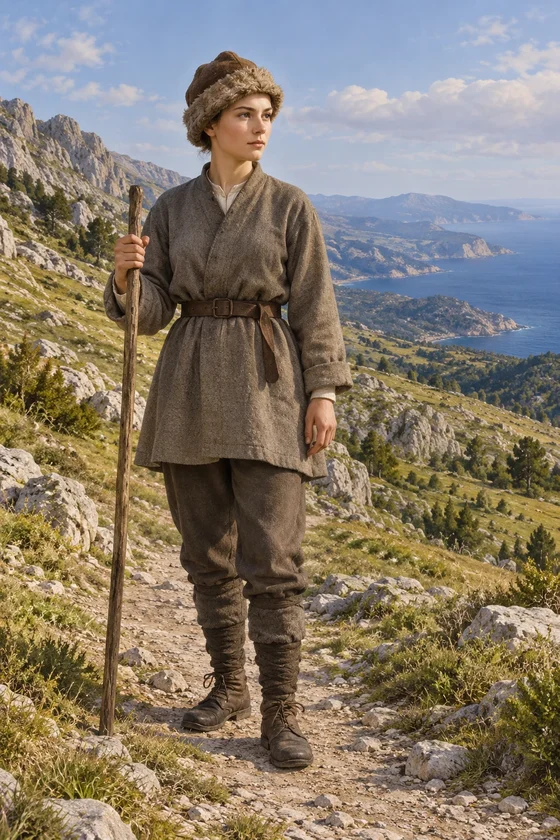
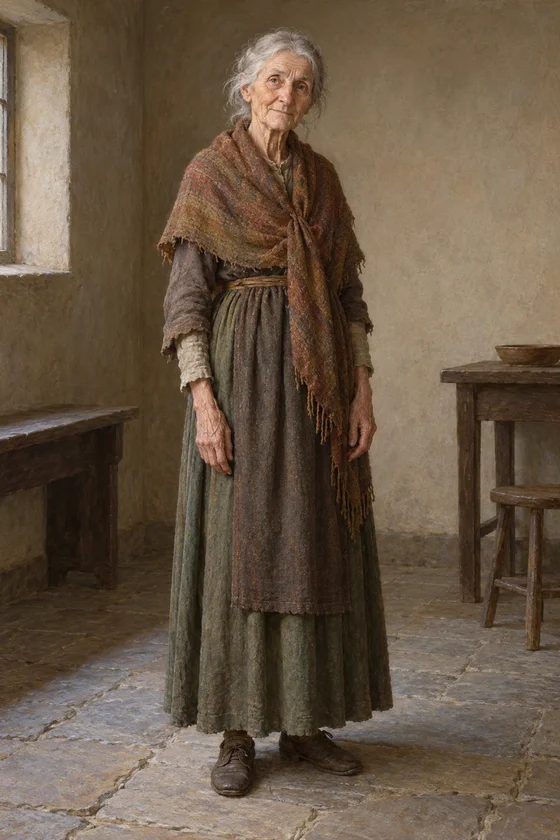
The stepmother first demands that a bag of hemp be carded, spun, woven and bleached before evening. The calf reassures the girl and completes the work while she looks after the other cattle. The task increases to two bags and then three. Suspecting help, the stepmother follows the girl and overhears the conversation. She pretends to be gravely ill and tells her husband that only roasted meat from this particular calf can save her. He protests that it is all his daughter possesses, but ultimately complies. Both adults eat; the girl refuses.
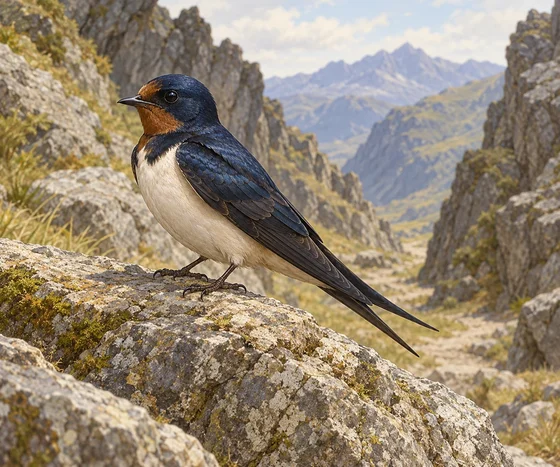
Before its death the calf foresees what will happen and tells the girl to collect its bones and hide them in a hollow tree near the field. She obeys. The bones turn into three white doves, which take over its helping role. When the family leaves for church and the stepmother orders housework and the sorting of mixed linseed and poppy seed, the birds perform the tasks. They also direct the girl to the tree, where fine clothes and a carriage with a pair of horses await her. The text thus makes the three birds a later collective state of the calf’s bones; they are not three additional calves or a separate set of helpers arriving without that connection.
On the third Sunday the squire’s son dislodges her slipper while trying to stop her departure. Searching for its owner, he reaches the household, where the stepmother hides the girl beneath a trough. A cock exposes the deception in speech, the slipper fits, and the young man marries her. He is a squire’s son, not explicitly a prince. The account ends by calling this the origin of the dove, but does not independently explain a measurable homing ability or give a subsequent fate for the three birds. Its title and closing explanation remain features of the historical tale, rather than evidence for animal behaviour or a universal account of Romanian belief.
Origins & earliest records
Gaster, Rumanian Bird and Beast Stories (1915), LXXXIX, Why Is the Dove a Homing Bird?, printed pp. 275-277. The introduction describes material from Romanian-speaking communities across several regions but supplies no individual teller or specific locality for this selected account.
Records & interpretation
Complete selected English narrative and attached commentary read, with complete preface and selected complete introduction paragraphs 0-11 and 119-132. Full introduction retained but not claimed wholly read. Original titlepage image viewed; no original Romanian text independently translated.
Selected bibliography
Documented works and useful reading. This is not a list of every appearance.
- 01
Rumanian Bird and Beast Stories Rendered into English
LXXXIX, Why Is the Dove a Homing Bird?, pp. 275-277; complete account and attached commentary. Titlepage gives London, published for the Folk-Lore Society by Sidgwick & Jackson.
Family & connections
A source-supported family tree or inspiration record has not yet been compiled for this profile. Related reading below indicates a connection in subject matter, not a proven lineage or creative influence.
References
Sources supporting this profile. Linked pages have their own scope and editorial standards.
- Primary historical folklore translation and compilationGaster 1915 original historical English compilation, complete PG transcriptionResearch access: 2026-10-21
Image credits
AI-generatedPortrayal of The Calf Whose Bones Become Doves (Gaster’s Version).
Portrayal selects the one living calf before its killing, alone at a quiet meadow edge. Ordinary young bovine anatomy and a muted brown coat are imagined; no species or breed identification beyond calf, adult horns, textile apparatus, human hands, doves, bones, wounds or slaughter scene.