Original AI literary interpretation; unspecified likeness and clothing details are artistic choices.
Overview
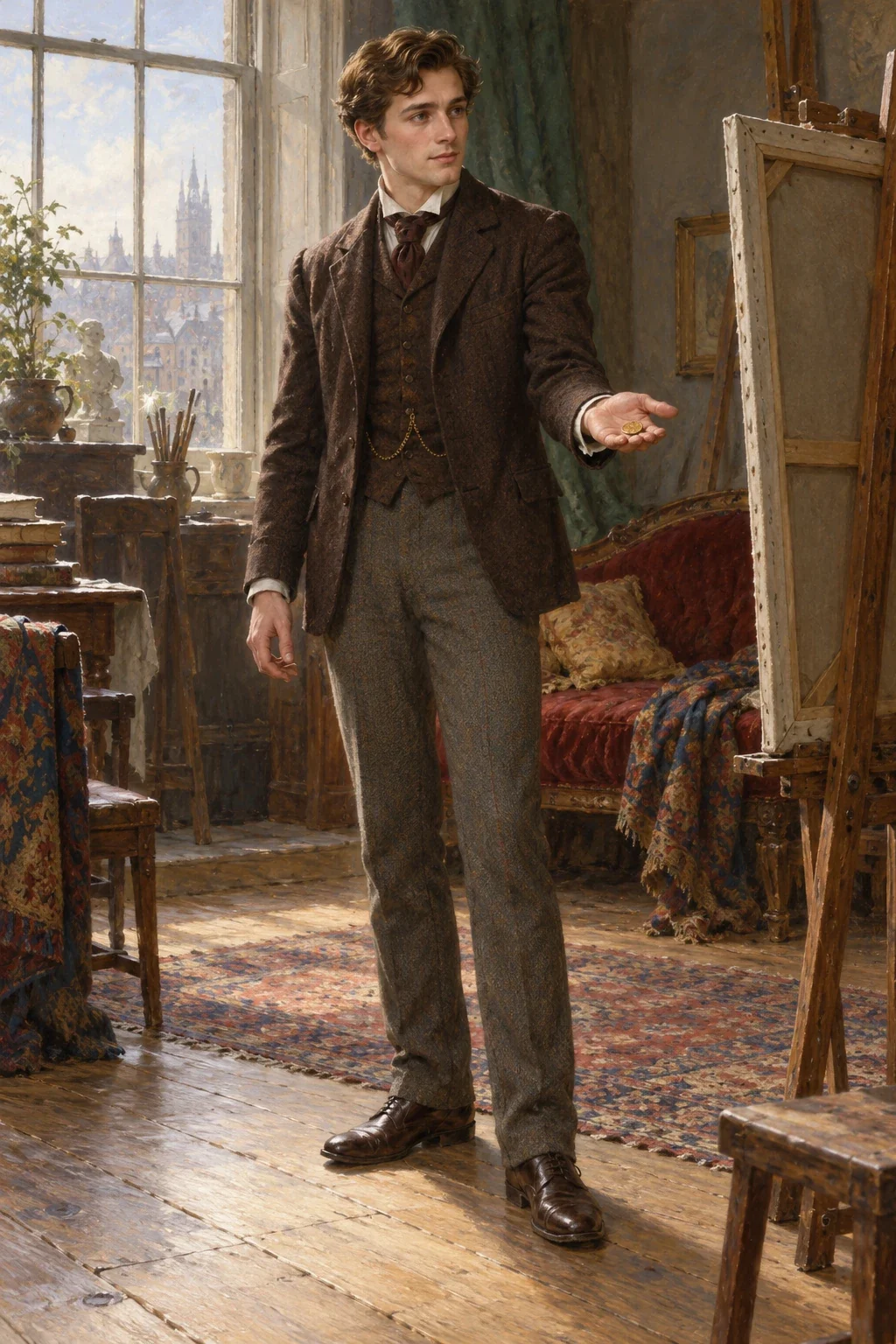
Hughie Erskine is a charming young Londoner with crisp brown hair, grey eyes and a clear-cut profile, but no profitable profession. His attempts at the Stock Exchange, tea dealing and selling dry sherry have failed. He lives on an aunt’s allowance of two hundred pounds a year; his father’s legacy consists of a cavalry sword and a multivolume military history. He and Laura Merton love one another, but her father, a retired Colonel, will not consider an engagement until Hughie has ten thousand pounds of his own. Wilde’s opening judgments about wealth, charm and intellectual importance are part of the tale’s ironic social voice.
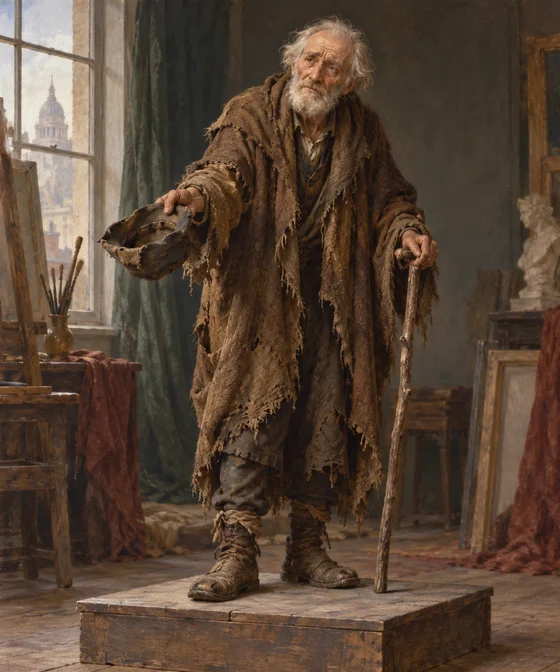
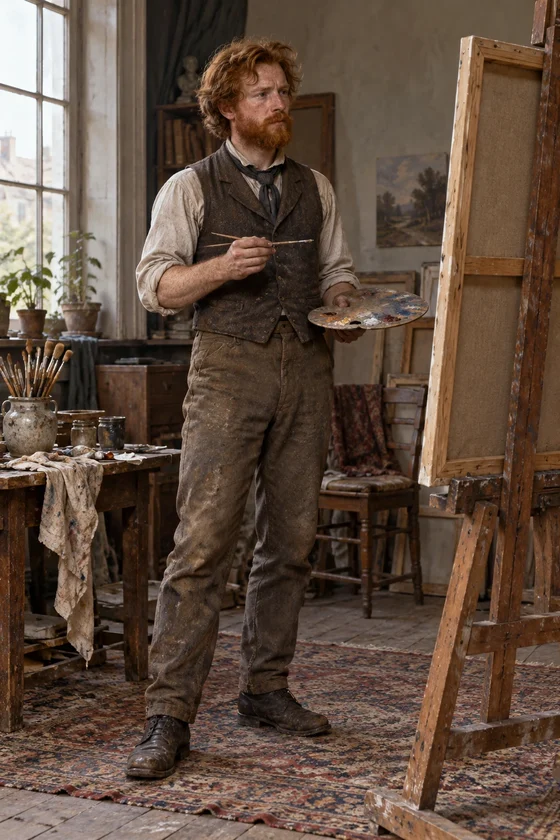
While visiting his friend Alan Trevor’s studio, Hughie admires an elderly model dressed as a beggar. Trevor values the model’s appearance for a painting, whereas Hughie responds to what he takes to be suffering. After hearing the contrast between the model’s shilling an hour and the painter’s two-thousand-guinea picture, he argues that the model deserves a percentage. Left briefly alone, he finds a sovereign and some coppers in his pockets and slips the gold coin into the old man’s hand, knowing it will mean walking instead of taking hansoms for a fortnight. He later offers old clothes as further help.
At the Palette Club that evening, Hughie is upset to learn that Trevor has told the model about Laura, his income and the Colonel’s condition. Trevor then reveals that the supposed beggar is Baron Hausberg, a rich friend who commissioned the portrait in borrowed rags. Hughie is mortified and fears being thought foolish. The next morning the Baron’s messenger, Gustave Naudin, brings a letter enclosing a ten-thousand-pound cheque as a wedding gift to Hugh and Laura. They marry, Trevor serves as best man and Hausberg speaks at the wedding breakfast. The conclusion rewards Hughie’s generosity; it supplies no account of a subsequent professional success.
First appearances & development
Individual in Oscar Wilde’s authored English tale The Model Millionaire, a satirical account of money, appearances and generosity.
Canon & continuity
Complete selected tale and retained original title, author, publisher, publication table and contents read. Tale subtitle A Note of Admiration. Book-text character identity only; no adaptation likeness.
Selected bibliography
Documented works and useful reading. This is not a list of every appearance.
- 01
Lord Arthur Savile’s Crime, The Portrait of Mr W. H. and Other Stories - The Model Millionaire
Year denotes retained original tenth-edition publication table. No independently verified physical-copy or first-appearance claim.
Family & connections
A source-supported family tree or inspiration record has not yet been compiled for this profile. Related reading below indicates a connection in subject matter, not a proven lineage or creative influence.
References
Sources supporting this profile. Linked pages have their own scope and editorial standards.
- Primary authored literary narrativeOscar Wilde - The Model Millionaire, complete original English taleResearch access: 2026-10-23
Image credits
AI-generated literary illustrationOriginal AI literary interpretation; unspecified likeness and clothing details are artistic choices.