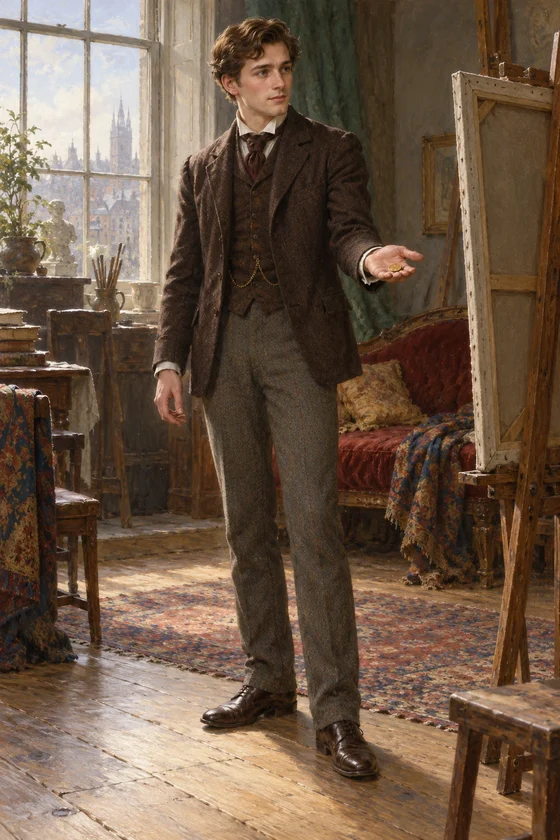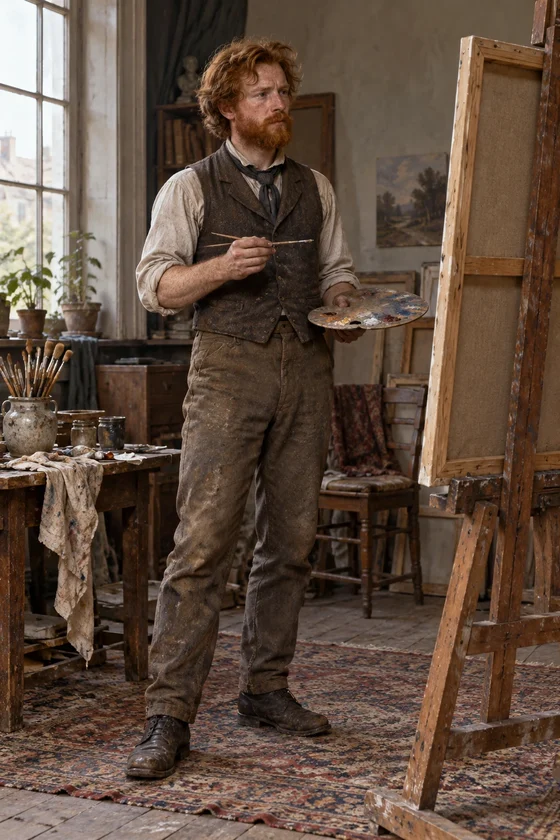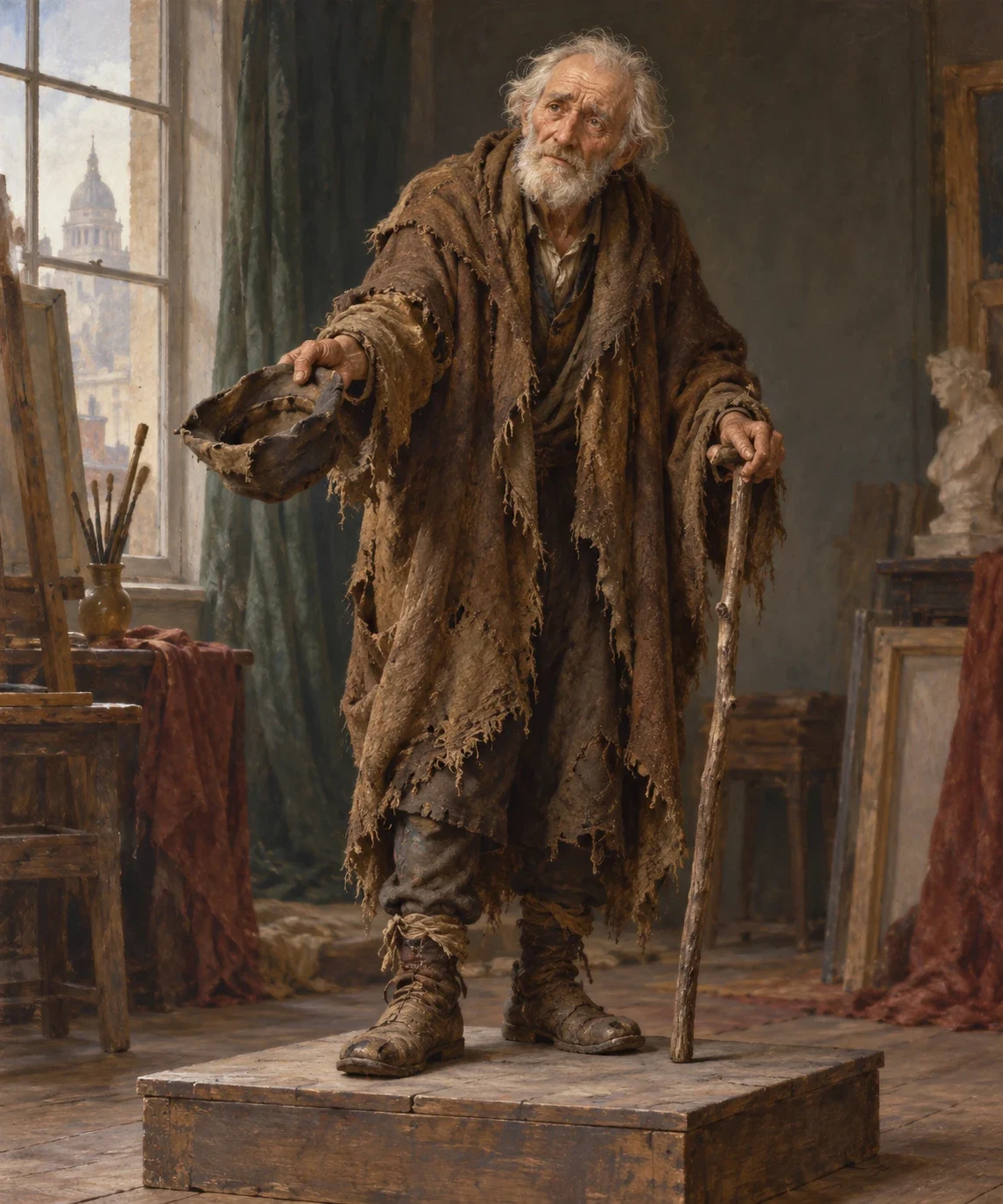
Original AI literary interpretation; unspecified likeness and clothing details are artistic choices.
Overview
Baron Hausberg first appears without his name as the elderly sitter in Alan Trevor’s studio. He stands on a raised platform, supporting himself with a rough stick and extending a battered hat. His face is wizened and deeply wrinkled, his expression pitiful; a torn coarse brown cloak and heavily patched boots complete the apparent poverty. The later revelation changes the meaning of this scene: Hausberg is Trevor’s rich friend and patron, who commissioned the beggar portrait a month earlier. The rags are Trevor’s old Spanish suit. They are an artistic disguise, not proof that the Baron has fallen into hardship.
When Trevor leaves to speak with the framemaker, Hausberg rests on a wooden bench. Hughie, who does not know his identity, gives him a sovereign. The old man starts, smiles faintly and thanks him. Trevor later says that the sitter became delighted and inquisitive about Hughie’s circumstances, rubbing his wrinkled hands and chuckling. The painter describes him as one of Europe’s richest men and makes extravagant claims about his houses, gold plate and political influence. Those particulars remain Trevor’s speech; the tale establishes the Baron’s wealth through the revealed commission and the subsequent cheque without requiring each flourish to be literal.
Hausberg does not personally deliver his response. He sends Gustave Naudin, an older gentleman with gold spectacles and grey hair, to Hughie’s breakfast room with a sealed envelope. It contains a ten-thousand-pound cheque and an inscription presenting it as an old beggar’s wedding gift to Hugh and Laura. The sum matches the condition imposed by Laura’s father. At the resulting wedding Hausberg makes a speech while Trevor is best man. Trevor’s concluding play on a millionaire who models and an exemplary millionaire frames the Baron’s gesture as generosity; the story does not describe his business practices or establish a wider philanthropic career.
First appearances & development
Individual in Oscar Wilde’s authored English tale The Model Millionaire, a satirical account of money, appearances and generosity.
Canon & continuity
Complete selected tale and retained original title, author, publisher, publication table and contents read. Tale subtitle A Note of Admiration. Book-text character identity only; no adaptation likeness.
Selected bibliography
Documented works and useful reading. This is not a list of every appearance.
- 01
Lord Arthur Savile’s Crime, The Portrait of Mr W. H. and Other Stories - The Model Millionaire
Year denotes retained original tenth-edition publication table. No independently verified physical-copy or first-appearance claim.
Family & connections
A source-supported family tree or inspiration record has not yet been compiled for this profile. Related reading below indicates a connection in subject matter, not a proven lineage or creative influence.
References
Sources supporting this profile. Linked pages have their own scope and editorial standards.
- Primary authored literary narrativeOscar Wilde - The Model Millionaire, complete original English taleResearch access: 2026-10-23
Image credits
AI-generated literary illustrationOriginal AI literary interpretation; unspecified likeness and clothing details are artistic choices.