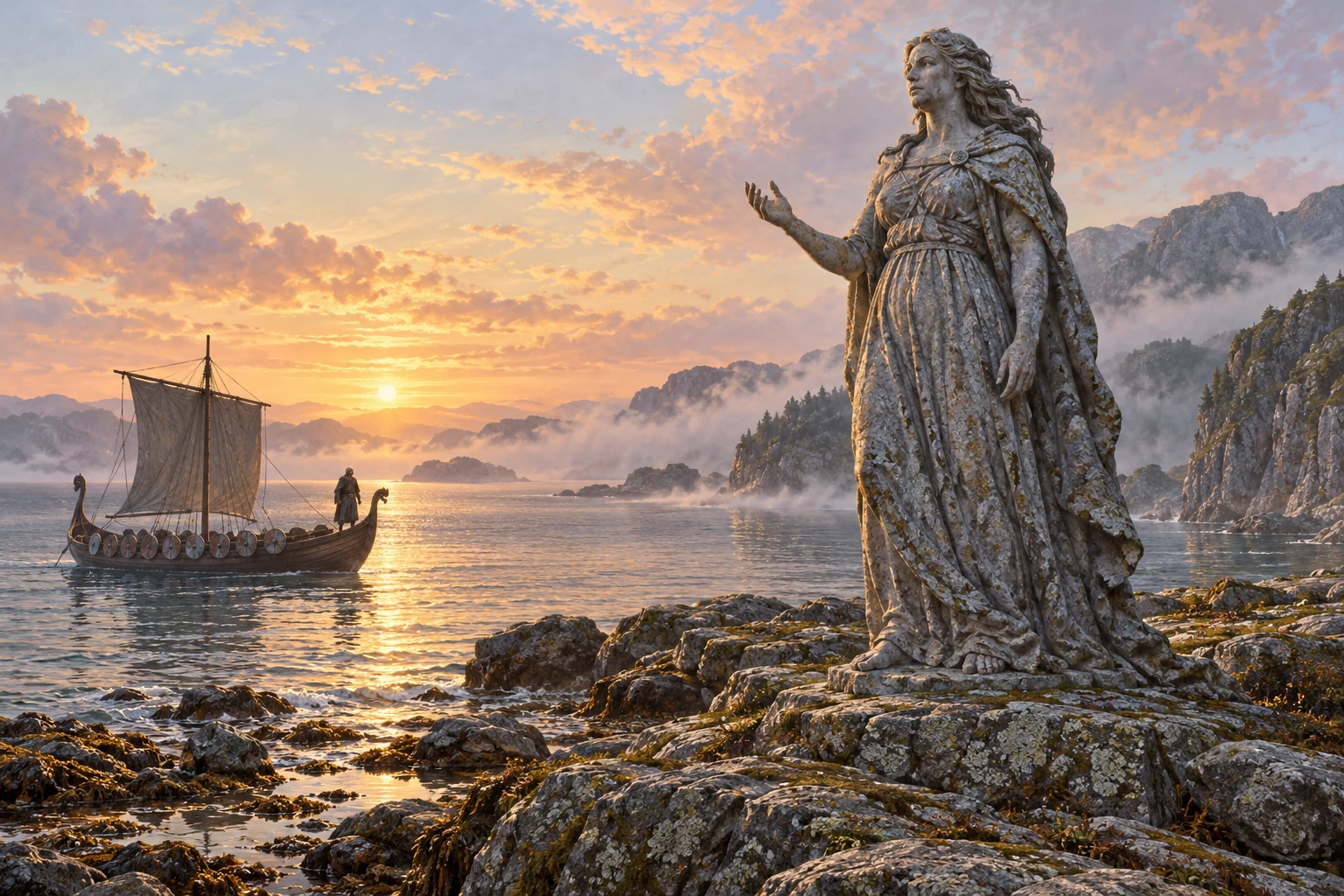
AI-generated interpretation of Hrimgerd’s stone-image ending in Thorpe’s Helgi lay. The daylight, haven and guarded fleet follow the narrative; her face, garment, scale, ship and landscape are artistic choices. This is not an ancient sculpture or a depiction of Tolkien’s trolls.
The image interprets the end of the nightwatch exchange, keeping the later Helgi and Svava narrative separate.
Overview
The lay places Hrimgerd’s encounter after Helgi and Atli have killed Hrodmar and performed other deeds. Its prose says Helgi kills the Jotun Hati on a crag, then anchors with Atli in Hatafiord. While Atli keeps the first nightwatch, Hati’s daughter Hrimgerd asks who commands the shielded ships. Atli names Helgi and asserts that the fleet is protected against giantesses. Their ensuing dialogue combines threats, insults and disputed accounts; the speakers’ hostile descriptions should not become a neutral catalogue of her body.
Hrimgerd names Hati as her father and calls him a mighty Jotun who carried women from their homes before Helgi slew him. Atli accuses her of lying across the fiord’s entrance to destroy the ships. She corrects him: her mother occupied that position, while she herself drowned Hlodvard’s sons. Those are distinct claims about mother and daughter. They do not make Hrimgerd the mother, name either woman as a sea-goddess, or establish that she personally caused every danger encountered by Helgi’s company.
She challenges Atli to meet her ashore and later demands one night with Helgi as compensation for Hati’s death. Helgi answers by proposing another Jotun as a suitable partner instead. The exchange then turns to the shining female defenders who secured the fleet. Hrimgerd describes three troops of mounted maidens with a foremost helmeted rider; she says their protection prevented her from killing the men. The broader lay has already identified Svava as a Valkyria and Helgi’s protector, but this speech does not itself give the leading rider a name. Their defence is not a transformation of Hrimgerd into a helpful figure.
Atli finally tells Hrimgerd to look east. He announces that day has come and that he has detained her to the loss of her life, describing the stone image she will stand as beside the haven. The dawn conclusion ends this encounter through delayed hostile speech rather than a narrated fight or successful agreement over the blood-fine. Thorpe’s English wording supplies a particular giantess’s stone outcome. It does not establish that every Eddic giant, Norwegian troll or later fictional troll must be destroyed by sunlight.
The complete lay continues after Hrimgerd’s episode. Helgi and Svava marry; Hedin’s meeting with a wolf-riding woman and his rash vow at the Bragi-cup create a separate crisis. Helgi understands the woman as an attendant spirit connected with his approaching death, and he later receives a fatal wound fighting Alf. Svava comes to him, Hedin promises vengeance, and the final prose says that Helgi and Svava were born again. This broader ending neither revives Hrimgerd nor identifies her with the wolf-rider. The rebirth statement belongs to Helgi and Svava, and no identity with Sigrun from another lay is inferred here.
Origins & earliest records
The Lay of Helgi Hiorvard’s Son in Benjamin Thorpe’s historical English Elder Edda, retained in the Norroena Society 1906 volume. No earliest oral origin or uniform Norse belief is established by this witness.
Records & interpretation
Entire lay read from its first Hiorvard prose paragraph through all 43 stanzas, all intervening prose, the Helgi/Svava rebirth sentence and footnote 48. Hrimgerd’s exchange is in verses 12–30 with the preceding Hati frame; the following First Helgi Hundingcide poem is outside this selection.
Selected bibliography
Documented works and useful reading. This is not a list of every appearance.
- 01
The Elder Eddas: The Lay of Helgi Hiorvard’s Son
Complete introductory, intervening and closing prose, all 43 stanzas and footnote 48; Hrimgerd’s nightwatch exchange is in verses 12–30.
Family, evolution & connections
Troll (Middle-earth)
Thorpe’s Hrimgerd exchange ends with Atli announcing daylight and her stone-image fate after keeping her talking. Tolkien’s separately documented Hobbit trolls likewise encounter a delay through speech before dawn petrification. This is a limited narrative-motif comparison: Hrimgerd is a named Eddic giantess, not a Middle-earth species member, and the similarity does not establish Tolkien’s consultation of Thorpe.
References
Sources supporting this profile. Linked pages have their own scope and editorial standards.
- Eddic literary witness in historical English translationThorpe, complete Lay of Helgi Hiorvard’s SonResearch access: 2026-10-26
Image credits
Modern interpretation of a historical literary accountAI-generated interpretation of Hrimgerd’s stone-image ending in Thorpe’s Helgi lay. The daylight, haven and guarded fleet follow the narrative; her face, garment, scale, ship and landscape are artistic choices. This is not an ancient sculpture or a depiction of Tolkien’s trolls.
The image interprets the end of the nightwatch exchange, keeping the later Helgi and Svava narrative separate.